Book summary
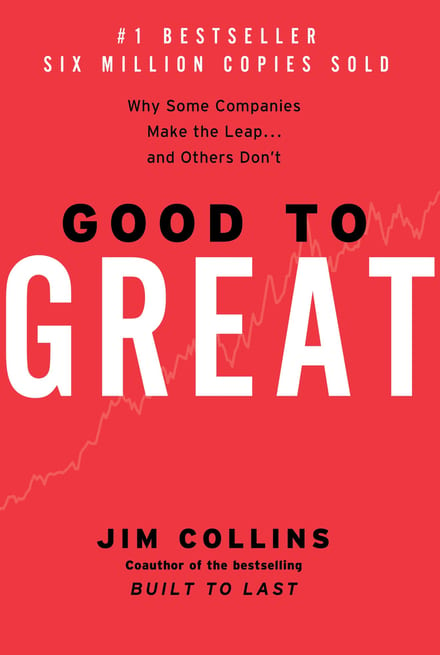
Good to Great: Why Some Companies Make the Leap and Others Don't
The full book runs ~300 pages — roughly 6 hours of reading. You get the key ideas here in 3 minutes.
The key ideas
- Hire the right people before deciding where to go
- Confront brutal facts while keeping unwavering faith you'll prevail
- Focus on your Hedgehog Concept where passion, excellence, and economics meet
- Treat technology as an accelerator, never a savior
- Push the flywheel patiently until momentum compounds into breakthrough
- Reject flashy leaders and quick-fix programs
The summary
Good is the enemy of great. Collins opens with that line and means it as a diagnosis: we have so few great schools, great governments, and great lives precisely because good ones are comfortable enough to settle for. The same trap catches companies. To find out how a few of them escaped it, Collins and his team spent five years studying firms that made a durable leap, ones whose stock returns averaged 6.9 times the market over fifteen years, and matched each against a direct competitor with similar resources that stayed merely good. What separated them wasn’t brilliant strategy or a visionary at the helm. It was a specific, mostly unglamorous sequence of choices.
Great leaders, and the right people before the plan
At every one of these transitions sat what Collins calls a Level 5 leader, the top rung of executive capability. These people fused deep personal humility with fierce professional will. They channeled their ambition into the company rather than themselves, credited luck and their colleagues for success while taking the blame for failure, and deliberately set their successors up to win. They were usually promoted from within; the flashy celebrity outsiders tended to fail.
Their first move was not to pick a direction but to pick people. “First who, then what.” Get the right people on board, and the question of where to go becomes easier to answer. If there’s real doubt about a hire, don’t make it, because letting the wrong people linger is unfair to the right ones, who end up compensating for them and eventually leave. Great companies leaned far less on layoffs and restructuring than their rivals, and they put their strongest people on their biggest opportunities rather than their biggest problems. Pay wasn’t the lever, and skills mattered less than character, since the right people are driven by the work itself.
Confront the brutal facts, and keep the faith
Great companies meet the same harsh realities as everyone else. The difference is that they look straight at the ugliest facts instead of spinning or denying them. That takes a particular culture: leaders who lead with questions rather than answers, blame-free autopsies when things go wrong, and warning systems that surface bad news early. The moment a leader lets himself become the primary reality people worry about, rather than reality itself, you have a recipe for mediocrity, which is one reason less charismatic leaders often outperform their dazzling peers over time.
Collins pairs this with the Stockdale Paradox: hold absolute faith that you will prevail in the end, and at the same time confront the most brutal facts of your current situation. The blind optimists who ignored hard truths didn’t make it. Neither did those who lost faith. You need both at once.
Find your Hedgehog Concept
The fox knows many things, but the hedgehog knows one big thing, and great companies are hedgehogs. Their one big thing lives at the intersection of three circles: what they are deeply passionate about, what they can be the best in the world at, and what drives their economic engine. That overlap, not any single circle, is the Hedgehog Concept, and it is an understanding rather than a strategy or a goal. It doesn’t arrive quickly. On average these companies took about four years of iteration to reach it.
Once they had it, they became ruthlessly disciplined. They turned down opportunities outside the three circles no matter how tempting, and, counterintuitively, that discipline surfaced more real growth, not less. “Stop doing” lists mattered more than to-do lists. This is also why the great companies needed so little bureaucracy: the purpose of bureaucracy is to compensate for incompetence and lack of discipline, and when the right people are pointed at the right thing, you don’t need layers of process to keep them in line.
Technology accelerates; the flywheel does the work
Technology gets less credit than you’d expect. Eighty percent of the executives Collins interviewed didn’t rank it among their top five factors for success, and the evidence shows outdated technology is never the primary cause of decline. Mediocrity comes first from management failure, not technological failure. Great companies adopt technology thoughtfully, pioneering the few applications that accelerate their Hedgehog Concept and ignoring the rest, because technology amplifies momentum, it doesn’t create it.
The momentum itself builds like a flywheel. You push a giant, heavy wheel, and at first nothing seems to move. You keep pushing, one consistent turn after another, until the wheel’s own weight starts to carry it and the breakthrough comes. From outside it looks sudden, an overnight turnaround, but inside it was years of aligned, incremental effort. Lesser companies try to skip the buildup and jump straight to breakthrough, then lurch from program to program when it doesn’t take, spiraling into a doom loop. Crawl, walk, run. Results and momentum produce motivation, not the other way around.
The bottom line
Greatness isn’t dramatic. It’s getting the right people, facing hard truths without losing faith, narrowing to the one thing you can be best at, and pushing in that single direction with discipline until the flywheel takes over. Read this if you lead anything, a company, a team, or a department, and want a research-backed alternative to the usual management hype.
Fact check
Popular books repeat findings that later research has complicated. Where Good to Great makes a testable claim, here's what the evidence actually shows.
The eleven companies studied made a durable leap to greatness, averaging 6.9 times the market's stock returns over fifteen years.
The 6.9x figure describes a window that closed before the book appeared, and several of the eleven fared badly afterward. Fannie Mae was placed into federal conservatorship on September 6, 2008, after deterioration in the housing market left it unable to meet its mission without government intervention. Wells Fargo, praised for its disciplined culture, was fined $100 million by the Consumer Financial Protection Bureau in September 2016 after employees opened roughly two million deposit and credit-card accounts customers had not authorized, in order to hit sales targets. The historical return number is accurate; treating it as proof of enduring greatness is not.
- Federal Housing Finance Agency. Conservatorship of Fannie Mae and Freddie Mac. Accessed July 30, 2026. Source
- Consumer Financial Protection Bureau. Consumer Financial Protection Bureau fines Wells Fargo $100 million for widespread illegal practice of secretly opening unauthorized accounts. September 8, 2016. Source
The habits these eleven companies shared are what made them great, so other companies can copy them.
Choosing winners first and then cataloguing what they share cannot separate causes from coincidences, because every firm that used the same practices and failed was excluded from the sample before the analysis began. Denrell's formal treatment of this bias shows that risky practices unrelated to performance across the full population of organizations still appear positively related to performance among survivors, so studying existing organizations produces compelling but potentially misleading evidence for common managerial practices. What the book documents is what eleven survivors had in common, which is a weaker statement than what makes a company great.
- Denrell J. Vicarious learning, undersampling of failure, and the myths of management. Organ Sci. 2003;14(3):227-243. Source
Humble leaders promoted from within beat charismatic celebrity outsiders.
The skepticism about star CEOs survives outside Collins' sample. Malmendier and Tate used prestigious business awards to mark the moment a chief executive became a celebrity and found that winners subsequently underperformed both their own prior records and comparable non-winning peers, while extracting higher pay, spending more time on outside boards and book-writing, and presiding over more earnings management — with the damage concentrated at firms with weak governance. The positive half of the claim is the unproven one: Level 5 humility was identified by looking backwards at companies already known to have succeeded, so it has not been shown to predict which firms will make the leap.
- Malmendier U, Tate G. Superstar CEOs. Cambridge, MA: National Bureau of Economic Research; 2008. NBER Working Paper 14140. Source
Frequently asked questions
What is Good to Great about?
Good to Great asks why a handful of companies made a durable leap, averaging 6.9 times the market over fifteen years, while direct competitors with similar resources stayed merely good. After a five-year study, Jim Collins found the answer wasn't brilliant strategy or a visionary CEO but a specific, unglamorous sequence of choices about people, discipline, and focus.
What are the key takeaways from Good to Great?
The book names a clear progression: Level 5 leaders who blend deep humility with fierce will; "first who, then what," getting the right people on board before deciding direction; confronting the brutal facts while holding the Stockdale Paradox of unshakable faith paired with honest realism; and the Hedgehog Concept, the one thing you're passionate about, can be best in the world at, and that drives your economics. Momentum then builds like a flywheel, years of aligned pushing that looks sudden from outside, while lesser firms lurch from program to program in a doom loop.
Who should read Good to Great?
Read it if you lead anything, a company, a team, or a department, and want a research-backed alternative to the usual management hype. It's built for people responsible for taking something good and making it genuinely great.
Is Good to Great worth reading?
Its strength is that the conclusions come from five years of matched-pair research rather than opinion, and the frameworks, the Hedgehog Concept, the flywheel, Level 5 leadership, have become durable management vocabulary for good reason. The lessons are deliberately undramatic, so anyone hunting for a quick strategic silver bullet will be disappointed, but that plainness is the point.