Book summary
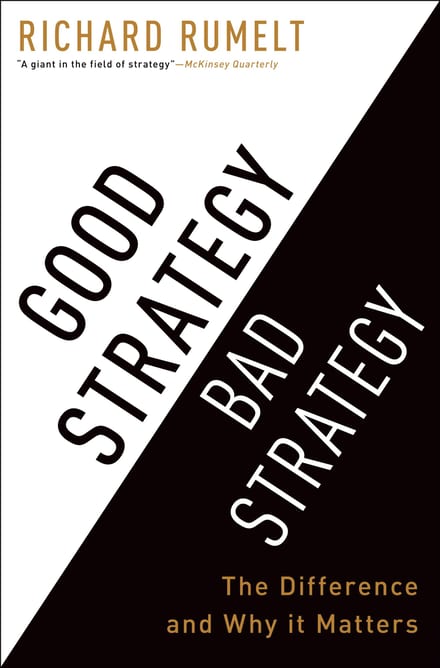
Good Strategy Bad Strategy: The Difference and Why It Matters
The Difference and Why It Matters
The full book runs ~329 pages — roughly 6 hours of reading. You get the key ideas here in 5 minutes.
The key ideas
- The kernel: a diagnosis, a guiding policy, and coordinated action.
- Bad strategy's four tells: fluff, dodged challenges, goals-as-strategy, unreachable objectives.
- International Harvester's 1979 plan never mentioned its ruinous work rules.
- Jobs cut fifteen desktop models to one; focus, not vision, saved Apple.
- Wal-Mart's insight: the network of 150 stores, not the store, was the unit.
- Universal buy-in usually signals that no real choice was made.
The summary
In 1805, off the southwest coast of Spain, thirty-three French and Spanish ships met twenty-seven British ones. Doctrine said both lines should stay parallel and trade broadsides. Nelson drove two columns perpendicularly into the enemy line instead, betting that in the heavy swell the less-trained Franco-Spanish gunners couldn’t compensate. The enemy lost twenty-two ships; Britain lost none. That is Richard Rumelt’s strategy in one picture — a judgment about which one or two things in a situation actually matter, then action concentrated there. It doesn’t take a thick deck of slides.
Bad strategy has a shape you can learn to see
Bad strategy is not the absence of strategy. It has a logic of its own, and four tells.
Fluff is gibberish dressed as insight. A retail bank’s internal memo announced that “our fundamental strategy is one of customer-centric intermediation.” Peel off the covering and it says: our bank’s strategy is being a bank.
Failure to face the challenge. In 1979, International Harvester — the fourth-largest corporation in the United States — produced a thick Corporate Strategic Plan with a hockey-stick profit forecast and an intent to gain share in all five divisions. It never named the elephant in the elevator: work rules that let senior employees transfer jobs at will, each transfer triggering a cascade of others, which had held margins at half its rivals’ for years. By 1985 Harvester had lost more than $3 billion and closed thirty-five of forty-two plants.
Mistaking goals for strategy. Chad Logan, CEO of a graphics arts firm, had a “20/20 plan”: 20 percent revenue growth and 20 percent margins, at a company whose after-tax margin had been about 12 percent. Asked what would have to happen, he produced a highlighted Jack Welch quote about reaching for the impossible.
Bad strategic objectives come as a dog’s dinner or as blue sky. One small city’s plan held 47 “strategies” and 178 action items; item 122 was “create a strategic plan.” Los Angeles asked its 34 worst schools for “transformational leadership” inside a bureaucracy where a principal can’t change the color of the paper without permission.
The kernel is three parts, and all three are required
A diagnosis says what is going on — which facts are the critical ones. A guiding policy says how you’ll deal with it. Coherent actions carry the policy out, coordinated so they reinforce rather than cancel each other.
When Lou Gerstner took over IBM in 1993, the consensus diagnosis was that IBM was too integrated for a fragmenting industry; stock offerings for the separated pieces were already being prepared. Gerstner changed the diagnosis: IBM was the one company with expertise in every area, and its real problem was failing to use it. The guiding policy followed — sell customers tailored solutions, outside hardware included — and so did the actions.
A guiding policy is not a vision; it rules actions out. Rumelt’s friend Stephanie, who runs a corner grocery, had a hundred small questions (organic produce, longer hours, paint the ceiling green or white) and collapsed them into one: students or busy professionals? Once she chose “the busy professional who has little time to cook,” the answers arrived on their own. A second checkout stand for the five o’clock rush. Prepared food where the student snacks had been. No late hours. Compare Ford, which bought Volvo and Jaguar because brand drives profit in cars, then put them on a shared platform to reach a million units. Volvo buyers do not want a safe Jaguar.
Why capable people keep producing the bad kind
Because choosing hurts. In 1992, executives at Digital Equipment argued for Boxes, Chips, and Solutions — three incompatible futures. Told to reach consensus, they produced: “DEC is committed to providing high-quality products and services and being a leader in data processing.” No ego was bruised and the company was crippled. Universal buy-in, Rumelt notes, usually signals the absence of choice.
The second escape route is the template — vision, mission, values, strategies — which spares everyone the work of analysis and hurts no feelings. The third is treating motivation as a substitute for thinking. Rumelt hears Ross Perot on never quitting and thinks of Passchendaele, where “one last push” ran three months and cost more than 70,000 Allied dead to gain five miles of mud.
Power usually hides in a shift of viewpoint
Every class studying the Wal-Mart case recites the same facts: big stores in small towns, everyday low prices, computerized logistics. The conventional wisdom held that a full-line discount store needed a population base of 100,000. Walton didn’t break that logic; he broke the definition of a store. The unit was a regional network of 150 stores around a distribution hub — which is why copying one piece of it, as Kmart tried, bought nothing.
Focus is the other half. Jobs returned to an Apple two months from bankruptcy and cut fifteen desktop models to one, killed the printers, dropped five of six national retailers, and took inventory down more than 80 percent. Asked what came next, he said he’d wait for the next big thing. Schwarzkopf’s 1991 “left hook” was called brilliant and secret; envelopment sat on page 101 of the Army’s own field manual, yours for twenty-five dollars from the Government Printing Office. The surprise was never the maneuver. It was that a big organization concentrated instead of paying off every internal claimant. Good objectives also sit close enough to hit: Kennedy picked the moon because von Braun had shown the required tenfold jump in rocket power favored America.
The bottom line
Strategy is a cohesive response to a specific challenge, and its hardest part is saying no — to interests, to hopes, to everything not on the short list. A plan that never names the obstacle is a budget or a wish with better formatting. Read it if you write, approve, or live inside strategic plans; it will leave you permanently intolerant of the fluffy kind.
Frequently asked questions
What is Good Strategy Bad Strategy about?
It draws a hard line between real strategy and the goal-setting that usually passes for it. A strategy is a cohesive response to a specific challenge: you diagnose what is actually going on, choose an approach to it, and take coordinated action. Ambition, vision statements and stretch targets are none of those things.
What are the key takeaways from Good Strategy Bad Strategy?
Three ideas carry the book. The kernel: every good strategy has a diagnosis, a guiding policy, and a coherent set of actions, and if one is missing you don't have a strategy. The four tells of bad strategy: fluff, failing to name the challenge, mistaking goals for strategy, and objectives that are either a scrambled dog's dinner or pure blue sky. And power usually comes from a shift in viewpoint — Sam Walton didn't beat the 100,000-population rule for discount stores, he replaced the store with a network of 150 stores around a distribution hub.
Who should read Good Strategy Bad Strategy?
Anyone who writes, approves, or has to live inside a strategic plan — executives, founders, board members, and people running schools, agencies or nonprofits. It is equally useful if you keep suspecting your organization's plan is hollow but can't articulate why.
Is Good Strategy Bad Strategy worth reading?
Yes, largely because of the failures. The dissections of International Harvester's 1979 plan, Digital Equipment's consensus statement, and the 20/20 growth goal are more instructive than most success stories, and the kernel gives you a test you can apply in an afternoon. What it won't give you is a procedure — Rumelt insists good strategy is designed for one specific situation, so readers who want a template to fill in will leave frustrated.