Book summary
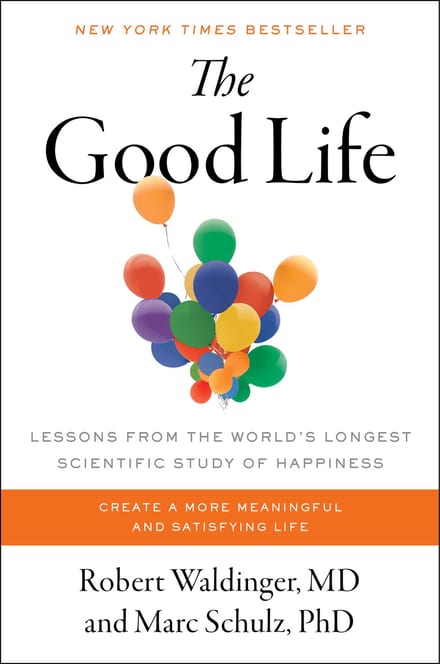
The Good Life: Lessons from the World's Longest Scientific Study of Happiness
The full book runs ~354 pages — roughly 6 hours of reading. You get the key ideas here in 2 minutes.
The key ideas
- Prioritize relationship depth over a wide, shallow social network
- Loneliness ranks among the deadliest risks to health
- Toxic marriages harm well-being more than divorce does
- Relationships predict future happiness better than wealth or status
- Build bonds deliberately—show up, stay curious, invest time
- Pair deep connection with purpose and personal growth
The summary
Ask people what will make their later years good and most will point to money, career, or health habits. More than eight decades of data say they’re aiming at the wrong target. The single best predictor of how well you age — how long you live, how sharp you stay, how content you feel — is the warmth of your close relationships. That’s the headline finding of the Harvard Study of Adult Development, and after tracking the same lives for generations, its directors state it plainly: good relationships keep us healthier and happier. Period. It’s an unglamorous conclusion, and a costly one to earn — you can’t run this experiment in a lab or over a weekend, and it took decades of patient, every-two-years tracking before the pattern stood out from the noise.
What eight decades of data actually found
The study began in 1938 and has followed two very different groups of men — Harvard sophomores and disadvantaged boys from inner-city Boston — with medical exams, blood samples, and searching interviews every two years, later pulling in their wives, and it’s still running. Across all that evidence, one factor tied itself to physical health, mental health, and longevity more consistently than anything else. Not career success, not exercise, not diet — those matter, but relationships matter more. People with strong social connections lived longer and suffered less mental decline. Loneliness, by contrast, turned out to be a serious risk factor for both failing health and depression. The effect even showed up in the body: people in good relationships didn’t let physical pain drag down their mood, while those in bad ones had their physical pain compounded by emotional pain.
Quality beats quantity
A big social circle isn’t the point, and it isn’t the protection. What counts is depth. A few reliable, warm bonds do more for your health than a wide, shallow network of acquaintances. The corollary is uncomfortable: bad relationships actively harm you. A toxic marriage proved worse for well-being than divorce. Tending the connections you have — and being honest about the ones that hurt — matters more than adding names to the list. The finding also held up across two groups the study followed who could hardly have been more different, privileged Harvard undergraduates on one side and boys from Boston’s poorest neighborhoods on the other, which is part of why the researchers trust it.
Chasing prestige is the wrong bet
Most young people, surveys find, want to be rich and famous. The study followed people who got exactly that, and the ones who chased prestige tended to be less satisfied in later life. The best indicator of future well-being wasn’t social class, IQ, or biomarkers like cholesterol — it was the quality of relationships, full stop. That makes the book quietly radical: it asks you to reevaluate your priorities and shift attention from external scoreboards to the people around you, which can be genuinely transformative.
Relationships are built, not found
Good relationships don’t simply happen to lucky people; they’re built, and they take time. The happiest people in retirement were the ones who had actively worked to make new connections rather than coasting on old ones. That means showing up, staying curious about the people in your life, and swapping cynicism for empathy. Purpose helps too — participants who found meaning in work, community, family, or helping others were happier — as does steady personal growth, whether through hobbies, new skills, or practices like gratitude and mindfulness. These aren’t separate from relationships so much as reasons and occasions to have them. The findings held across race, gender, and background, though the researchers note that wider, more diverse studies are still needed.
The bottom line
After more than eighty years of watching hundreds of lives unfold, the clearest lesson is that the warmth of your close relationships predicts how well you’ll age better than wealth, intelligence, or any lab result. Invest in people, cut the connections that poison you, and treat relationships as something you build on purpose. Read this if you’ve been chasing the usual markers of success while quietly neglecting the people who actually keep you well.
Fact check
Popular books repeat findings that later research has complicated. Where The Good Life makes a testable claim, here's what the evidence actually shows.
The warmth of your close relationships predicts how well you age better than wealth, IQ, social class or cholesterol.
Social connection genuinely predicts survival: a meta-analysis of 148 studies covering 308,849 people found a 50% higher likelihood of survival for those with stronger social relationships (OR 1.50, 95% CI 1.42-1.59). The ranking above money is much harder to defend. In the United States the life-expectancy gap between the richest and poorest 1% is 14.6 years for men and 10.1 years for women, a spread larger than anything social ties have been shown to move. Both bodies of evidence are observational, so neither establishes what would change if you altered one factor and held the rest fixed.
Loneliness ranks among the deadliest risks to health, on a par with smoking.
The pooled effects are real but moderate: odds ratios of 1.26 for loneliness, 1.29 for social isolation and 1.32 for living alone, meaning roughly a quarter to a third higher mortality odds. That places them alongside other established risk factors, which is where the smoking comparison began. In 2023 Holt-Lunstad, whose meta-analyses produced those numbers, co-wrote that benchmarking loneliness against smoking oversimplifies the evidence and pushes attention toward treating individuals rather than the conditions that make close relationships possible.
- Holt-Lunstad J, Smith TB, Baker M, Harris T, Stephenson D. Loneliness and social isolation as risk factors for mortality: a meta-analytic review. Perspect Psychol Sci. 2015;10(2):227-237. PubMed
- Smith RW, Holt-Lunstad J, Kawachi I. Benchmarking social isolation, loneliness, and smoking: challenges and opportunities for public health. Am J Epidemiol. 2023;192(8):1238-1242. PubMed
A toxic marriage does more damage to well-being than divorce does.
Marital quality and health are linked, but the association is modest. A meta-analysis of 126 studies covering more than 72,000 people found correlations ranging from r = .07 to .21, with r = .11 for mortality risk. Divorce carries its own durable cost: an 18-year study of more than 30,000 German adults found life satisfaction falls as divorce approaches and then only partly rebounds, never returning to the earlier level. The same study found people who eventually divorced were already less satisfied before they married, so part of the difference precedes the marriage rather than being produced by it.
The Harvard Study's findings hold across race, gender and background.
For most of its length the study followed men only: 268 Harvard sophomores recruited in 1938, when the College was still all-male, plus 456 boys from inner-city Boston added later, also all male. Wives were brought in roughly a decade before 2017, and the second-generation cohort of about 1,300 offspring is still comparatively young. The central finding does hold in mixed samples — the 148-study meta-analysis pooling 308,849 men and women found the same survival advantage for strong social ties. The finer rankings the book draws, such as relationships beating cholesterol or social class, rest on the two male cohorts.
Frequently asked questions
What is The Good Life about?
The Good Life reports what the Harvard Study of Adult Development learned after tracking the same lives for more than eighty years: the single best predictor of how well you age, how long you live, and how content you feel is the warmth of your close relationships. Not money, career, diet, or IQ, but the quality of the bonds you keep.
What are the key takeaways from The Good Life?
Quality beats quantity, a few warm, reliable bonds protect your health more than a wide, shallow network. Bad relationships actively harm you: a toxic marriage proved worse for well-being than divorce, and loneliness is a serious risk for both failing health and depression. Chasing prestige is the wrong bet, as the people who pursued wealth and fame tended to be less satisfied later. And good relationships are built on purpose through showing up, staying curious, and swapping cynicism for empathy, not stumbled into by the lucky.
Who should read The Good Life?
Read it if you've been chasing the usual markers of success, money, status, health metrics, while quietly neglecting the people who actually keep you well. It's for anyone ready to reevaluate their priorities and shift attention from external scoreboards to the relationships around them.
Is The Good Life worth reading?
Its central finding is unglamorous, invest in people, cut the connections that poison you, but it's backed by decades of patient, every-two-years data that held across two very different groups, so it carries weight most self-help claims don't. If you already prioritize your close relationships you may find the conclusion familiar, but as a research-grounded nudge to stop measuring your life by wealth and prestige, it lands.