Book summary
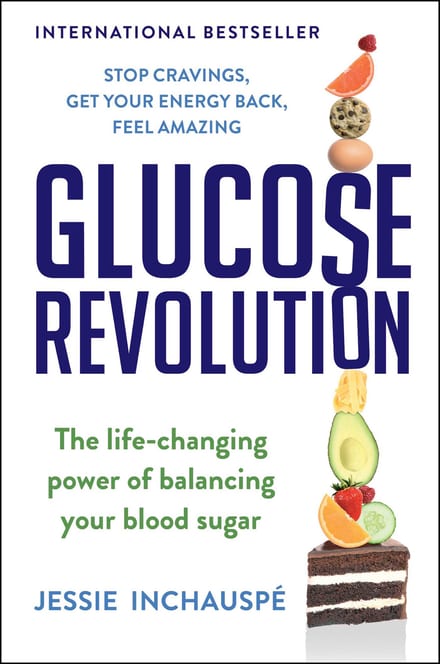
Glucose Revolution
The Life-Changing Power of Balancing Your Blood Sugar
The full book runs ~288 pages — roughly 5 hours of reading. You get the key ideas here in 5 minutes.
The key ideas
- Spikes, not sugar itself, drive crashes, cravings, and disease
- Eat fiber first, starches and sugars last
- Start meals with a green vegetable starter
- Make breakfast savory to avoid the morning spike
- Drink vinegar water before carb-heavy meals
- Walk after eating to burn glucose without insulin
The summary
You don’t have to give up bread, fruit, or dessert to feel better. That’s the surprise at the center of Jessie Inchauspé’s argument. The problem isn’t that you eat sugar and starch. The problem is the shape of what happens next: a steep spike in your blood glucose followed by a crash. Plot your glucose minute by minute and you get a curve with peaks and valleys. Flatten those peaks and you get steadier energy, fewer cravings, a calmer mood, and lower long-term risk. That’s the whole game. Not less food on the plate. A gentler curve.
Inchauspé is not a doctor peddling a diet. She studied mathematics in college and biochemistry in grad school, then spent months wearing a continuous glucose monitor, watching her own levels rise and fall in real time. What she found is that most of us are riding what she calls the glucose roller coaster without knowing it. One study she cites puts it starkly: only 12 percent of Americans are metabolically healthy. If you get sleepy in the afternoon, need caffeine to keep going, feel hangry when a meal is late, or crave something sweet an hour after eating, you’re likely on that ride.
Flatten the curve, don’t quit sugar
The old advice was to cut sugar and count calories. Inchauspé’s point is that two meals with identical calories and nutrients can hit your body completely differently depending on how you eat them. So the lever isn’t restriction. It’s the curve.
When your glucose spikes, insulin surges to clear it, because too much glucose loose in the bloodstream causes damage. That works, but it comes at a cost, and chronically high insulin is one of the main drivers of insulin resistance and type 2 diabetes. A big spike also drops you into a crash soon after, which is exactly what makes you tired and hungry again. Flatten the spike and you flatten the crash with it. You also, almost for free, flatten your fructose curve, because fructose rides alongside glucose in sweet foods. That matters, because your body can’t store fructose as fuel the way it stores glucose. Excess fructose gets turned into fat, and too much of it pushes up the risk of obesity, heart disease, and fatty liver.
What a spike does behind the scenes
Inchauspé walks you through three things a spike sets off. First, free radicals: excess glucose floods your cells and releases these unstable molecules, which damage whatever they touch and pile up into oxidative stress. Second, glycation, the slow “toasting” of your body’s own structures. The more glucose you deliver, the more often it happens. It’s so tied to glucose that the standard long-term blood test, HbA1c, actually measures glycation. Together these feed chronic inflammation.
Third, and most surprising, is fat. Inchauspé compares your body to a game of Tetris. When glucose pours in, insulin rushes to stash it away before it can do harm. It fills the liver first, then your muscles. But those storage units are small and fill fast. Everything beyond that gets turned into fat. So the spike you didn’t feel this morning is quietly writing itself onto your waistline. None of this asks you to fear food. It asks you to smooth the delivery.
The hacks: same food, gentler curve
Here’s where the book earns its keep. The hacks don’t remove anything from your plate. Often they add to it. A few, drawn straight from her science:
- Eat your food in the right order. Fiber first, protein and fat second, starches and sugars last. In a Cornell study she cites, this single reordering cut the glucose spike by 73 percent and the insulin spike by 48 percent, for the exact same meal. Fiber forms a viscous mesh in your gut that slows how fast the rest is absorbed.
- Add a green starter. A plate of vegetables before the main event lays down that fiber mesh in advance, so whatever carbs follow land more softly.
- Make breakfast savory. First thing in the morning your empty stomach is at its most sensitive, so a sugary-starchy breakfast is the biggest spike of the day and sets up the roller coaster for lunch and dinner too. Build it on protein, fat, and fiber instead. Save the sweet thing for after a meal.
- Reach for vinegar before you eat. A tablespoon in a tall glass of water a few minutes before a carb-heavy meal blunted the resulting spike by 8 to 30 percent in the research she cites, and it does this without raising insulin. The acetic acid slows the enzymes that break starch into glucose.
- Move after you eat. A ten- to twenty-minute walk, or a few squats, within about seventy minutes of finishing. Contracting muscles pull glucose out of the blood without needing insulin at all. A review of 135 people with type 2 diabetes found walking after meals cut the spike by up to 27 percent.
- Put some clothes on your carbs. Never eat a starch or sugar naked. Add fat, fiber, or protein, and your body receives the glucose at a slower, more manageable speed. This is also why lentils beat white rice, since they already carry their own fiber and protein.
The bottom line
Steady beats spiky, and you get there by reshaping how you eat, not by starving or swearing off the foods you love. Pick one hack, the easiest one, and let the steadier energy convince you to add another. Read it if you’re tired of crashes, cravings, and afternoon slumps and you want changes that fit around real meals rather than replacing them.
Fact check
Popular books repeat findings that later research has complicated. Where Glucose Revolution makes a testable claim, here's what the evidence actually shows.
Eating fibre and protein before starch cut the glucose spike by 73 percent and the insulin spike by 48 percent for the identical meal, in a Cornell study.
Both numbers are quoted accurately from the source: glucose incremental area under the curve over two hours was 73.5 percent lower and insulin 48.5 percent lower when vegetables and protein came before the carbohydrate. But that was an 11-person pilot in overweight adults with metformin-treated type 2 diabetes, and the figures describe area under the curve rather than the peak — the actual peak glucose fell 28.6 to 37 percent. A follow-up in 15 people with prediabetes reproduced the direction at smaller magnitude: peaks attenuated by more than 40 percent and glucose iAUC 38.8 percent lower. Neither study tested metabolically healthy people.
- Shukla AP, Iliescu RG, Thomas CE, Aronne LJ. Food order has a significant impact on postprandial glucose and insulin levels. Diabetes Care. 2015;38(7):e98-9. PubMed
- Shukla AP, Dickison M, Coughlin N, et al. The impact of food order on postprandial glycaemic excursions in prediabetes. Diabetes Obes Metab. 2019;21(2):377-381. PubMed
Only 12 percent of Americans are metabolically healthy.
Analysing 8,721 adults in NHANES 2009-2016, researchers found 12.2 percent (95% CI 10.9-13.6) met optimal levels on all five markers — waist circumference, glucose and HbA1c, blood pressure, triglycerides and HDL — while taking no related medication. The figure moves with the definition: 19.9 percent qualified under the older ATP III cut points, and 17.6 percent if waist circumference is dropped. Even among normal-weight adults fewer than a third were metabolically healthy, falling to 8.0 percent in overweight and 0.5 percent in obese participants.
- Araújo J, Cai J, Stevens J. Prevalence of optimal metabolic health in American adults: National Health and Nutrition Examination Survey 2009-2016. Metab Syndr Relat Disord. 2019;17(1):46-52. PubMed
A tablespoon of vinegar in water before a carb-heavy meal blunts the resulting glucose spike by 8 to 30 percent.
Pooling clinical trials, vinegar did lower postprandial glucose area under the curve (standardised mean difference -0.60, 95% CI -1.08 to -0.11) and lowered insulin as well (-1.30, 95% CI -1.98 to -0.62), so the direction holds and the book is right that it does not come at the cost of an insulin surge. The glucose confidence interval nearly touches zero, though, and the underlying trials are small acute crossovers with conflicting results — which is where a spread as wide as 8 to 30 percent comes from. Treat it as a modest, variable nudge rather than a reliable third off your spike.
- Shishehbor F, Mansoori A, Shirani F. Vinegar consumption can attenuate postprandial glucose and insulin responses; a systematic review and meta-analysis of clinical trials. Diabetes Res Clin Pract. 2017;127:1-9. PubMed
The shape of your glucose curve, rather than how much sugar or how many calories you eat, is what drives cravings, fat storage and chronic disease.
The cravings half has direct support, with a twist. Across 1,070 people wearing continuous glucose monitors through 8,624 standardised and 71,715 free-choice meals, it was the glucose dip 2-3 hours after eating — not the peak, and not the area under the curve at 0-2 hours — that best predicted hunger (r = 0.16), a shorter gap before the next meal (r = -0.14) and more energy eaten over the following 24 hours (r = 0.27). So the crash matters, and arguably more than the spike the book puts at the centre. The further step, that curve shape outweighs total intake for fat gain and chronic disease in people who are metabolically healthy, rests on mechanism rather than on trials measuring those outcomes.
- Wyatt P, Berry SE, Finlayson G, et al. Postprandial glycaemic dips predict appetite and energy intake in healthy individuals. Nat Metab. 2021;3(4):523-529. PubMed
Frequently asked questions
What is Glucose Revolution about?
You don't have to give up bread, fruit, or dessert to feel better. Jessie Inchauspé's argument is that the problem isn't sugar and starch but the shape of what follows, a steep glucose spike and crash, and that flattening those peaks gives you steadier energy, fewer cravings, a calmer mood, and lower long-term risk, without eating less.
What are the key takeaways from Glucose Revolution?
Two meals with identical calories can hit your body completely differently, so the lever is the curve, not restriction. A spike sets off free radicals, glycation, inflammation, and stored fat behind the scenes. The hacks keep your food but gentle the curve: eat in order (fiber first, protein and fat second, starches and sugars last, which cut one study's spike by 73%), start with a green or vegetables, make breakfast savory, take a tablespoon of vinegar in water before carbs, move for ten to twenty minutes after eating, and never eat a starch or sugar "naked."
Who should read Glucose Revolution?
Read it if you're tired of crashes, cravings, and afternoon slumps and you want changes that fit around real meals rather than replacing them.
Is Glucose Revolution worth reading?
It's approachable and the hacks are easy to try, each tied to a cited study, so you can pick the simplest one and build from there. The science is simplified and some claims lean on single studies, so a rigorous reader may want more caveats, but as practical, low-effort habit changes the advice is easy to act on.