Book summary
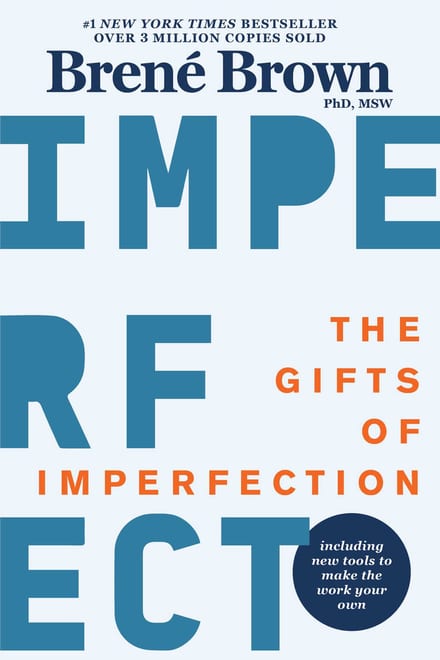
The Gifts of Imperfection
Let Go of Who You Think You're Supposed to Be and Embrace Who You Are
The full book runs ~202 pages — roughly 4 hours of reading. You get the key ideas here in 4 minutes.
The key ideas
- Believe in your worthiness first, before love and belonging follow
- Speak shame aloud to trusted people; silence only strengthens it
- Reject perfectionism's fear of judgment for self-focused healthy striving
- Learn hope as thinking, not feeling; hard doesn't mean impossible
- Numbing pain also numbs joy, gratitude, and connection
- Protect creativity, play, and rest against the productivity cult
The summary
You can’t achieve your way into feeling worthy. That single idea sits under everything Brené Brown learned from years of research into shame and belonging. Most of us assume it works the other way: if we look good enough, accomplish enough, please enough people, we’ll finally earn a place at the table. Brown found the reverse. The people who feel genuinely loved and connected aren’t the most impressive ones; they’re simply the ones who already believe they’re worthy of love and belonging—no prerequisites, no résumé, no waiting for the weight to come off. Worthiness comes first, and everything good grows from there.
Brown calls the life built on that belief “wholehearted living.” It means waking up thinking I am enough no matter how much got left undone, and going to bed still believing it after a day of being imperfect, vulnerable, and afraid. You cultivate it through three daily practices: courage, which is telling the truth about who you are; compassion, which is accepting yourself and others as you actually are; and connection, the energy that flows when you feel seen, heard, and valued. And you can only offer others as much love as you’ve managed to give yourself.
Shame can’t survive being spoken
Shame is the universal fear that we’re unworthy of love and belonging, and it runs on silence. The less you say about it, the more it controls you. Brown’s finding is almost mechanical: shame hates being wrapped in words and told to someone who’s earned the right to hear it. Spoken aloud, it withers. Buried, it spreads. “The most dangerous thing to do after a shaming experience is hide or bury our story,” she writes; do that and the shame metastasizes.
Building shame resilience means learning your triggers, then reaching out and telling the story instead of hiding it. This is also why authenticity is less a trait than a daily choice—the practice of letting your real self be seen even when that invites criticism. Shrinking yourself to keep others comfortable can feel safer, but every time you do it, your sense of worth quietly erodes.
Perfectionism is about them, not you
Perfectionism disguises itself as high standards, but it’s really a shield against shame—the hope that if you can just be flawless, no one can judge or blame you. Brown draws the line cleanly: “Healthy striving is self-focused—How can I improve? Perfectionism is other-focused—What will they think?” One asks how to get better; the other asks how to avoid getting caught being human. It’s addictive and self-defeating, and the way out is the unglamorous work of admitting your vulnerabilities, building shame resilience, and treating yourself with the kindness you’d extend to a friend.
That resilience has recognizable parts. Resilient people are resourceful, ask for help, believe they can cope, and lean on social support, and many draw strength from a sense of connection to something larger than themselves. Hope belongs here too, and Brown’s research reframes it: hope isn’t a warm feeling, it’s a way of thinking you can learn. The cultural fantasy that everything should be fast and easy primes us for despair, so the moment something turns hard we decide it’s not worth it or that we’re just bad at it. Hopeful self-talk sounds plainer than that: This is tough, but I can do it.
You can’t numb selectively
When painful feelings show up, the reflex is to dull them—with overwork, food, a drink, an hour of scrolling. The trap is that numbing isn’t selective. Deaden the pain and you deaden joy, gratitude, and connection right along with it. Joy and gratitude, Brown found, are bound together: the practice of gratitude is what actually produces joy, not the other way around. What blocks it is fear and a scarcity mindset that whispers there’s never enough. The antidote isn’t chasing extraordinary highs but noticing ordinary good moments and choosing a sense of sufficiency. It helps to stay clear-eyed about the machinery working against you—advertising sells not just products but ideas of who you should be, and the images on your feed were never reality.
Rest and play aren’t indulgences
Everyone is creative, and Brown insists the only truly original contribution you can make is born of that creativity. Her own vivid memories of painting and cooking with her mother went quiet around age eight or nine, when a family move made fitting in matter more than making things. Reclaiming it is simple in form: cook, write, doodle, knit, dance, rebuild an engine—so long as you’re creating, you’re making meaning. Play and rest do the same quiet work, feeding creativity, empathy, and joy, and they collide head-on with a culture that treats exhaustion as a status symbol and productivity as proof of worth. Living wholeheartedly means getting deliberate about sleep and play — real self-care, not indulgence — and letting that story go. Brown’s own research drove her into therapy for anxiety severe enough to cause dizzy spells, where she learned to cultivate calm—perspective over reactivity—and stillness, the clutter-free space to feel and think and dream. Anxiety is contagious, she notes. So is calm.
The bottom line
Worthiness isn’t a prize for becoming impressive enough; it’s something you claim right now, flaws and all, and shame loosens its grip the moment you say it out loud to someone you trust. Read this if you’re worn down by perfectionism, numbing, or the endless work of fitting in when what you actually want is to belong.
Fact check
Popular books repeat findings that later research has complicated. Where The Gifts of Imperfection makes a testable claim, here's what the evidence actually shows.
You cannot numb selectively — dulling painful feelings dulls joy, gratitude, and connection along with them.
The spillover is real but modest. Pooling 41 samples and 11,010 people, habitually suppressing emotional expression was associated with lower positive affect at r = -0.16 — a small correlation, not the near-total flattening the book describes. It also did not hold everywhere: the association was absent in people with anxiety disorders and in East Asian samples (r = 0.003 versus r = -0.16 in Western ones), and the data are correlational, so lower positive feeling could just as easily drive the suppressing.
- Fernandes MA, Tone EB. A systematic review and meta-analysis of the association between expressive suppression and positive affect. Clin Psychol Rev. 2021;88:102068. PubMed
Practising gratitude is what produces joy, rather than joy producing gratitude.
Gratitude exercises do improve wellbeing, but modestly, and they are not special. Against measurement-only controls the effect on wellbeing was d = .31; against an alternative activity, gratitude practice beat it on feelings of gratitude (d = .46) but only d = .17 on psychological wellbeing and not at all on anxiety (d = .11). A later review of 64 randomized trials likewise found better mood and fewer depression and anxiety symptoms. So gratitude works — at roughly the level of any other engaging psychological activity, not as the engine that generates joy.
- Davis DE, Choe E, Meyers J, et al. Thankful for the little things: a meta-analysis of gratitude interventions. J Couns Psychol. 2016;63(1):20-31. PubMed
- Diniz G, Korkes L, Tristão LS, Pelegrini R, Bellodi PL, Bernardo WM. The effects of gratitude interventions: a systematic review and meta-analysis. Einstein (Sao Paulo). 2023;21:eRW0371. PubMed
Shame withers when it is spoken aloud to someone who has earned the right to hear it, and spreads when it is buried.
Brown is on firm ground that shame is the corrosive emotion: pooling 108 studies and 22,411 participants, shame correlated with depressive symptoms at r = .43 versus r = .28 for guilt, and external shame — what you believe others see — was strongest at r = .56. Disclosure helps too, but the trials test something more structured than simply saying it out loud: a three-session program coaching adolescents on whether and how to disclose a mental illness cut stigma stress against treatment as usual (d = .92, n = 98), with knock-on gains in self-stigma and quality of life. The shame-depression link is correlational, and the disclosure evidence is for deliberate, supported telling — not for disclosure in general.
- Kim S, Thibodeau R, Jorgensen RS. Shame, guilt, and depressive symptoms: a meta-analytic review. Psychol Bull. 2011;137(1):68-96. PubMed
- Mulfinger N, Müller S, Böge I, et al. Honest, Open, Proud for adolescents with mental illness: pilot randomized controlled trial. J Child Psychol Psychiatry. 2018;59(6):684-691. PubMed
Frequently asked questions
What is The Gifts of Imperfection about?
You can't achieve your way into feeling worthy. Brené Brown's research found that people who feel genuinely loved and connected are simply the ones who already believe they're worthy of it, with no prerequisites, and that everything good grows from there in a life she calls "wholehearted living."
What are the key takeaways from The Gifts of Imperfection?
Worthiness comes first and is cultivated through courage, compassion, and connection. Shame can't survive being spoken aloud to someone who's earned the right to hear it. Perfectionism is other-focused ("What will they think?") while healthy striving is self-focused ("How can I improve?"). You can't numb selectively, since deadening pain also deadens joy, and gratitude is what actually produces joy. Rest, play, and creativity aren't indulgences but real self-care.
Who should read The Gifts of Imperfection?
Read it if you're worn down by perfectionism, numbing, or the endless work of fitting in when what you actually want is to belong.
Is The Gifts of Imperfection worth reading?
It's warm, quotable, and grounded in real research on shame and belonging, with reframes on worthiness and perfectionism that stick. The tone is more inspirational than instructional, so readers wanting a concrete method may want more, but the ideas are memorable and they land.