Book summary
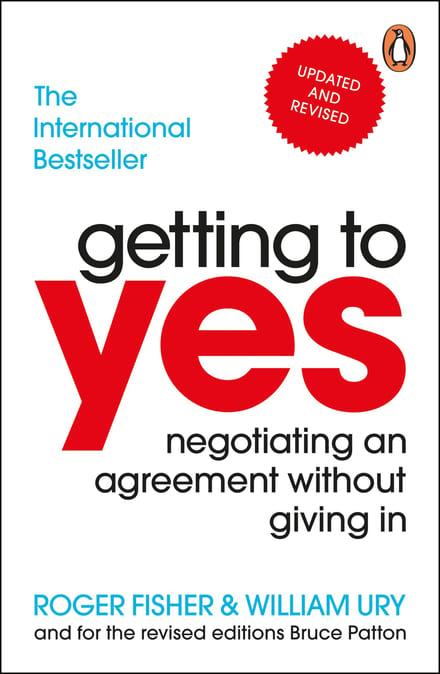
Getting to Yes: Negotiating Agreement Without Giving In
Negotiating Agreement Without Giving In
The full book runs ~200 pages — roughly 4 hours of reading. You get the key ideas here in 5 minutes.
The key ideas
- Separate the people from the problem: soft on the person, hard on the merits.
- Dig for interests, not positions — ask why they want what they want.
- Invent options before judging them; early criticism kills the trade you needed.
- Settle disputes on objective standards, so neither side's will has to lose.
- Improve your BATNA — your power is what you'll do without a deal.
- Ask questions instead of statements, then stay quiet and let them answer.
The summary
Most negotiation runs on positions: one side names a number, the other names a worse one, and they grind toward a middle nobody chose. Fisher, Ury and Patton judge any method on three counts — a wise agreement, reached efficiently, relationship intact — and positional bargaining fails all three. Kennedy’s 1961 nuclear test ban talks broke down over on-site inspections, the Soviets offering three and the Americans insisting on ten, though nobody had settled whether an inspection meant one person for a day or a hundred for a month. Being nice is no fix: a soft bargainer trades substance for goodwill and rewards stubbornness. The Harvard Negotiation Project’s alternative is to change the game, and it rests on four points.
Separate the people from the problem
Every negotiator has two sets of interests, the substance and the relationship, and positional bargaining pits them against each other: you concede the point to keep the peace, or hold the relationship hostage to win it. Handle the people problem in its own currency: perception, emotion, communication.
Their thinking is the problem: put yourself in their shoes and feel the force of their view without agreeing with it. Don’t deduce their intentions from your fears. Involve them early; participation decides acceptance. Let them vent without answering the substance — a labor-management committee in the 1950s steel industry ran on a rule that only one person could get angry at a time. Give their case back at its strongest, and speak about yourself rather than about them: “I feel let down” lands where “you broke your word” starts a fight.
Interests, not positions
Two men quarrel in a library over a window: open a crack, halfway, three-quarters, nothing satisfies both. The librarian asks why: one wants fresh air, the other no draft. She opens a window in the next room. A position is what you decided; your interests are what made you decide it.
Camp David, 1978. Israel had occupied the Sinai since 1967 and insisted on keeping part of it; Egypt insisted on every inch, and every map splitting the peninsula failed. Underneath sat Israel’s interest in security and Egypt’s in sovereignty, regained only lately after centuries of foreign rule. Sadat and Begin agreed to full Egyptian sovereignty with large areas demilitarized — the Egyptian flag everywhere, Egyptian tanks nowhere near Israel. Ask why they hold a position, then ask why not — what blocks the decision you want.
Invent options for mutual gain
Two children quarrel over an orange and cut it in half. One eats the fruit and throws away the peel; the other throws away the fruit and bakes with the peel. Half an orange each, when one could have had the whole fruit and the other the whole peel.
Four habits keep the options thin: judging ideas the moment they appear, hunting for the single right answer, assuming a fixed pie, and deciding that solving their problem is their problem. Invent first, decide later — brainstorm with your own side, criticism outlawed, wild ideas welcome. Then dovetail the differences: gaps in interest, belief, timing and appetite for risk are what make a trade possible in the first place.
Insist on objective criteria
Some interests really are opposed, and no invention dissolves them. Then it comes down to whose will prevails — unless you take will out of it. Your contractor wants two-foot foundations, you want five, and he offers to trade because he gave way on the roof girders. Don’t horse-trade: ask what the standard specifications are for these soil conditions.
At the Law of the Sea talks, India proposed a $60 million initial fee per deep-seabed mining site; the United States proposed none. Both dug in, until someone produced an MIT model of seabed mining economics that both sides accepted as objective. It showed India that a fee that size, payable five years before a mine earned anything, would make mining impossible, and showed the Americans that some fee was feasible. Both moved, neither looked weak. Fair procedures work the same way: one cuts, the other chooses.
Three rules govern the discussion. Frame each issue as a joint search for standards. Stay open to reason about which standard fits. Never yield to pressure, only to principle.
Your power is your alternative
A bottom line protects you badly: rigid by design, it shuts your ears to whatever you learn at the table and smothers imaginative packages. Use your BATNA instead — your Best Alternative To a Negotiated Agreement, what you’ll actually do if you walk. Judge every offer against it and work to improve it: the better it is, the harder you can press.
A small town once negotiated factory taxes with one of the world’s largest corporations. The town knew exactly what it would do without a deal: extend the town limits to take in the factory and tax it at the full residential rate, some $2,500,000 a year. The corporation had committed to keeping the factory and developed no alternative. The small town had more power.
If they still won’t negotiate on the merits, try negotiation jujitsu: don’t push back against an attack, sidestep it and deflect it against the problem. Ask questions instead of statements — statements generate resistance, questions generate answers — then be quiet; some of the most effective negotiating happens while you aren’t talking.
The bottom line
Stop trying to win a contest of wills and start working a shared problem: soft on the people, hard on the merits, settled by standards neither side invented. Your strength comes from knowing exactly what you’ll do if you walk away, not from refusing to move. Read it if you bargain over anything — a salary, a lease, a treaty, a bedtime — and want a method instead of a bag of tricks.
Fact check
Popular books repeat findings that later research has complicated. Where Getting to Yes makes a testable claim, here's what the evidence actually shows.
Working the problem together — soft on the people, hard on the merits — produces better joint outcomes than positional haggling.
A meta-analysis of 28 negotiation studies found that negotiators with a prosocial motive were less contentious, did more problem solving, and reached higher joint outcomes than egoistic ones. The catch is the second half of the book's formula: the benefit appeared only when resistance to yielding was high. Cooperative intent paired with a willingness to concede produced no integrative gain, which is the same warning the book gives about soft bargaining.
- De Dreu CK, Weingart LR, Kwon S. Influence of social motives on integrative negotiation: a meta-analytic review and test of two theories. J Pers Soc Psychol. 2000;78(5):889-905. PubMed
Your power in a negotiation comes from your BATNA, so the better your alternative, the harder you can press.
Alternatives do confer power, but not evenly. Kim and Fragale found that an advantage in BATNA moved resource allocations more than an advantage in contribution when the bargaining zone was small, while contribution mattered more when the zone was large. The relationship also breaks at the bottom: negotiators handed weak alternatives made lower first offers and secured worse outcomes than negotiators with no alternative at all, because the weak alternative worked as a low anchor. A poor BATNA can cost you more than having none.
- Kim PH, Fragale AR. Choosing the path to bargaining power: an empirical comparison of BATNAs and contributions in negotiation. J Appl Psychol. 2005;90(2):373-81. PubMed
- Schaerer M, Swaab RI, Galinsky AD. Anchors weigh more than power: why absolute powerlessness liberates negotiators to achieve better outcomes. Psychol Sci. 2015;26(2):170-81. PubMed
Settling on objective standards rather than trading positions keeps the opening number from deciding the outcome.
Opening numbers move deals more than the book's framing suggests. Across three experiments, whichever side made the first offer — buyer or seller — ended up better off, and first offers strongly predicted final settlement prices. But the first-mover advantage vanished when the responding negotiator focused on the other side's alternatives, their reservation price, or their own target, and it held in email as well as face to face. That escape route is close to the book's own advice: argue from a standard and your walk-away, rather than reacting to their number.
- Galinsky AD, Mussweiler T. First offers as anchors: the role of perspective-taking and negotiator focus. J Pers Soc Psychol. 2001;81(4):657-69. PubMed
Frequently asked questions
What is Getting to Yes about?
It lays out the Harvard Negotiation Project's method for reaching agreements without the usual grind of positional bargaining, where each side names a number and inches toward a middle nobody chose. Fisher, Ury and Patton judge any negotiation on three counts: whether the agreement is wise, whether it was reached efficiently, and whether the relationship survived. Their alternative is to negotiate on the merits of the problem rather than on whose will is stronger.
What are the key takeaways from Getting to Yes?
Four points carry the method. Separate the people from the problem, handling perception, emotion and communication in their own currency rather than trading substance for goodwill. Focus on interests, not positions — the two men quarrelling over a library window wanted fresh air and no draft, so the librarian opened a window next door. Invent options for mutual gain before judging any of them, and insist on objective criteria so a standard settles the issue instead of pressure. Behind all four sits your BATNA, the Best Alternative To a Negotiated Agreement — the thing you'll actually do if you walk.
Who should read Getting to Yes?
Anyone who bargains over anything — a salary, a lease, a treaty, a bedtime — and wants a method instead of a bag of tricks. It's especially useful if you tend to go soft to keep the peace, or hard and find yourself in a contest of wills.
Is Getting to Yes worth reading?
Yes, if you want the underlying logic rather than tactics. The examples earn their place — Camp David, the Law of the Sea talks, a small town facing down a huge corporation — and the BATNA idea alone changes how you weigh an offer. Readers who want scripts for hardball opponents will find less here, though the chapter on negotiation jujitsu covers the case where the other side refuses to negotiate on the merits.