Book summary
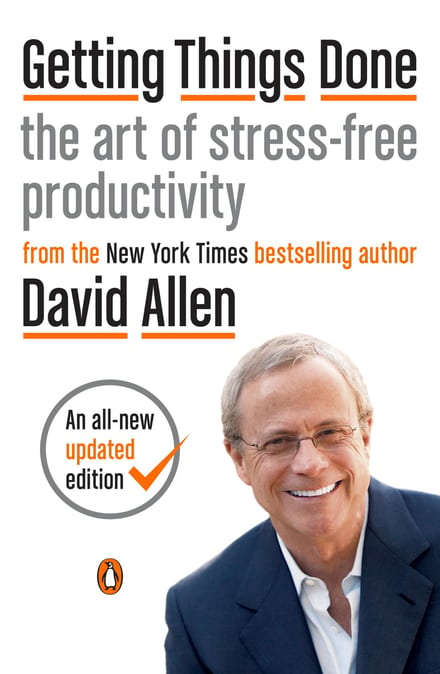
Getting Things Done: The Art of Stress-Free Productivity
The full book runs ~279 pages — roughly 5 hours of reading. You get the key ideas here in 4 minutes.
The key ideas
- Capture every task and thought outside your head
- Define the concrete next physical action for everything
- Apply the two-minute rule: do it now if quick
- Organize actions by context, not urgency
- Review weekly to keep the system current and trusted
- Resolve mental noise: complete, renegotiate, or drop commitments
The summary
Your mind is for having ideas, not holding them. David Allen’s whole method starts from the observation that the brain is a lousy storage device but a relentless reminder service — it will interrupt you at 2 a.m. about an email you can’t send until Monday. Trying to keep everything up there wrecks your concentration and your calm. The fix isn’t a better memory or more willpower; it’s getting every commitment out of your head and into a system you trust so completely that your mind finally lets go. Getting Things Done is that system, built on a five-step workflow:
- Capture — write down every task, idea, and reminder.
- Clarify — decide what each item is and whether it’s actionable.
- Organize — put it where it belongs, in lists and on your calendar.
- Reflect — review the whole system regularly.
- Engage — pick something and do it.
Capture everything, then ask what’s the next action
Capture happens in collection tools — a notebook, a list app, whatever is always within reach. Keep the number of them small, since a reminder you scatter across six places is a reminder you lose. To start, sweep every existing to-do, half-formed idea, and loose scrap of material into these tools so nothing is still living in your head.
Clarifying is where most of the work is. Take each captured item and ask first whether it’s actionable. If it isn’t, it goes to one of three places: the trash, a reference file, or a Someday/Maybe list for things like learning French or repainting a room. If it is actionable, name the outcome you want, and if getting there takes more than one step, it’s a project. Then ask the single most important question in the whole method: what’s the next physical, visible action? Not “deal with the party” but “buy posterboard”; not “sort out the account” but “email John.” One rule keeps this from bogging down — if an action takes less than two minutes, do it right now. Anything longer, delegate it if you can, or defer it to a list.
Organize by context, not urgency
Your calendar is reserved for time-specific commitments only — appointments, that dentist visit — and nothing else. Everything else lives on Next Action lists, and the trick is to sort those lists by context rather than importance: calls to make, computer tasks, errands to run. Then the list matches the moment. Standing in the store, you pull up the errands; sitting with your laptop, you work the computer list.
A few dedicated lists carry the load. A Projects list holds anything with multiple steps, from planning a party to buying a car, and you review it to confirm each one has a concrete next action attached. A Waiting For list tracks what you’ve handed to other people, with deadlines, so that the moment someone misses theirs, chasing them becomes your next action. For genuinely complex projects, Allen offers the natural planning method: define the purpose and the principles that bound it (“don’t spend over $10,000”), picture the outcome (“increase customer count by 20%”), brainstorm freely without judging, organize those ideas, and only then pin down next actions.
Reflect weekly, then choose what to do
The system earns your trust only by staying current, which is why review matters as much as capture. Each morning, check your calendar to see the day’s shape, then scan your Next Action lists for what fits the context you’re in. The backbone, though, is the weekly review: tie up loose ends, mark off what’s done, look over the calendar, run through the Waiting For and Projects lists, and reconsider Someday/Maybe to see if anything is ready to move up.
When it’s finally time to engage, you can trust your intuition or weigh four things: the task’s priority, the context you’re in, the time you have, and your energy level. Drained and stuck in a waiting room is the moment for quick calls, not deep thinking. To keep the bigger picture in view, Allen stacks your commitments into horizons — from the ground of current actions up through projects, areas of responsibility, one-to-two-year goals, longer visions, and finally life purpose. Most days you live at ground level, but the review is when you lift your eyes.
Why undone tasks nag at you
The low-grade guilt around unfinished items isn’t really about the items. Each one is a broken agreement you made with yourself, and that’s what your mind keeps flagging. You have exactly three honest ways out: don’t make the agreement in the first place and only take on what you truly need or want, complete it, or renegotiate it — because changing the terms is not the same as breaking your word. The stress comes from limbo, not from the work itself. Keep the friction low elsewhere too: a consistent workspace and a filing system quick enough to use in under a minute, purged once a year so it doesn’t rot.
The bottom line
Calm comes from a complete system, not a disciplined mind — when every commitment is captured, clarified into a next action, and reviewed weekly, your head is free to actually think. GTD isn’t about doing more; it’s about trusting that nothing is slipping through the cracks. Read this if you feel chronically overwhelmed or your brain won’t stop reminding you of things you already know.
Fact check
Popular books repeat findings that later research has complicated. Where Getting Things Done makes a testable claim, here's what the evidence actually shows.
Unfinished commitments keep intruding on your attention until you get them out of your head, and writing down a concrete plan is enough to quiet the nagging even before the task is done.
Across six experiments, unfulfilled goals produced intrusive thoughts, made goal-related words more mentally accessible, and degraded performance on unrelated tasks — the Zeigarnik pattern Allen describes. Having participants write a specific plan removed all of those effects without the goal being completed, and the size of the release tracked how earnestly the plan was made. Two caveats: the active ingredient is the plan, not the act of writing as such, and the finding rests largely on this one research group's work.
- Masicampo EJ, Baumeister RF. Consider it done! Plan making can eliminate the cognitive effects of unfulfilled goals. J Pers Soc Psychol. 2011;101(4):667-83. PubMed
Naming the concrete next physical action for a commitment is what turns intention into follow-through.
This is the best-evidenced part of GTD. Specifying in advance exactly what you will do and when — if-then or implementation-intention planning — had a large effect on goal attainment in a meta-analysis of 29 experiments with clinical and analogue samples (d+ = 0.99, k = 28, N = 1,636), and it worked across different diagnoses and different kinds of goal. Allen's demand for a physical, visible action ('email John', not 'sort out the account') is essentially that specification prompt in plain language.
- Toli A, Webb TL, Hardy GE. Does forming implementation intentions help people with mental health problems to achieve goals? A meta-analysis of experimental studies with clinical and analogue samples. Br J Clin Psychol. 2016;55(1):69-90. PubMed
- Gollwitzer PM, Sheeran P. Implementation intentions and goal achievement: a meta-analysis of effects and processes. Adv Exp Soc Psychol. 2006;38:69-119. Source
Offloading commitments into an external system frees up mental capacity for the work in front of you.
Offloading does buy real capacity, and Allen's insistence that the system be trusted is the part the evidence is sharpest on: saving one file before studying a second measurably improved memory for the second file, but only when the saving mechanism was reliable — make it unreliable and the benefit vanished. The cost side is less flattering. Across three experiments people set external reminders more often than was optimal even when paid to choose well, a bias driven by underestimating their own memory, so a capture habit can drift into offloading things you would have remembered anyway.
- Storm BC, Stone SM. Saving-enhanced memory: the benefits of saving on the learning and remembering of new information. Psychol Sci. 2015;26(2):182-8. PubMed
- Gilbert SJ, Bird A, Carpenter JM, Fleming SM, Sachdeva C, Tsai PC. Optimal use of reminders: metacognition, effort, and cognitive offloading. J Exp Psychol Gen. 2020;149(3):501-517. PubMed
Frequently asked questions
What is Getting Things Done about?
Your mind is for having ideas, not holding them. David Allen's method is to get every commitment out of your head and into a system you trust so completely that your brain finally stops nagging and can actually think, built on a five-step workflow: capture, clarify, organize, reflect, and engage.
What are the key takeaways from Getting Things Done?
Capture everything into a few collection tools. Clarify by asking whether each item is actionable and naming the single next physical action ("email John," not "sort out the account"), and if it takes under two minutes, do it now. Organize by context (calls, computer, errands) rather than urgency, and reserve the calendar for time-specific commitments only. Reflect with a weekly review, then engage using priority, context, time, and energy. Undone tasks nag because each one is a broken agreement with yourself.
Who should read Getting Things Done?
Read it if you feel chronically overwhelmed or your brain won't stop reminding you of things you already know.
Is Getting Things Done worth reading?
The core insight and the next-action habit are genuinely useful and have stayed influential for a reason. The full system is involved and some of the tool advice feels dated, so you may adopt the principles more than the entire apparatus, but even that pays off.