Book summary
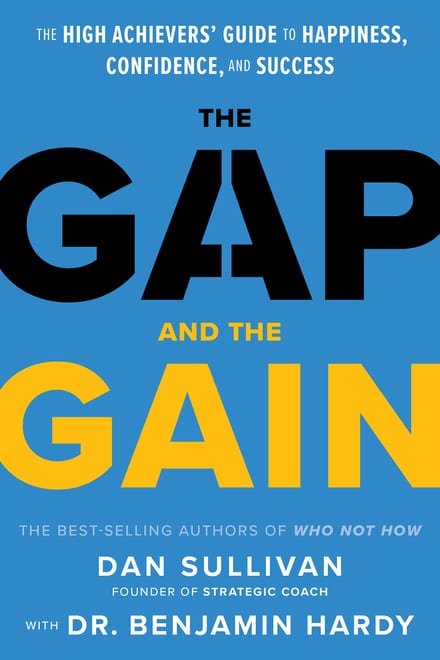
The Gap and the Gain: The High Achievers' Guide to Happiness, Confidence, and Success
The High Achievers' Guide to Happiness, Confidence, and Success
The full book runs ~264 pages — roughly 5 hours of reading. You get the key ideas here in 5 minutes.
The key ideas
- Separate the ideal from the goal — only one of them can be reached.
- Standing in the Gap means judging every result by what it isn't.
- Expect high achievers to suffer most; they raise the bar reflexively.
- Record wins daily, because memory argues with you and a written record doesn't.
- Run setbacks through three questions: what worked, what didn't, what you'd change.
- Beware making the Gain itself an ideal — that is the Gap again.
The summary
Two entrepreneurs have identical numbers — same revenue, same reputation, same admiring peers. One is satisfied with their life. The other feels like they’re falling behind and quietly suspects they’re a fraud. Dan Sullivan spent years watching that split inside his coaching program before he worked out what caused it, and the answer had nothing to do with the size or quality of anyone’s success. It came down to where they were pointing the ruler.
The ideal was never meant to be a ruler
Sullivan separates two things most people run together: an ideal and a goal. An ideal is the picture of a bigger, better future, and its only job is to excite you and show you which way to walk. A goal is different — it has measurable attributes, which means you can actually arrive at it.
Treat the ideal as a measuring stick and you end up permanently standing in what Sullivan calls the Gap: the space between where you are and where you imagine you should be. That space never closes, because the ideal isn’t a destination. It moves as you move, and for ambitious people it tends to grow as they get better, so every result gets judged by what it isn’t rather than what it is. Turn around and measure from your starting point to where you now stand and you’re in the Gain. As Sullivan puts it, “the way to measure your progress is backward against where you started, not against your ideal.” The Gain has one advantage the ideal can never have: it already happened, and no one can revise it.
The most driven people get hit hardest
Benjamin Hardy, the organizational psychologist who wrote the book with Sullivan, points to hedonic adaptation. An achievement becomes the new baseline almost immediately, so within days the only thing left to feel is the distance still to cover. High performers do this faster than anyone, because raising the bar the moment they clear it is exactly the reflex that made them high performers.
Hardy tells it through his teenage son’s tennis matches, where the parents on the sideline reliably make a noise at the errors and none at the good shots — a whole crowd measuring children against an ideal. When he switched to naming what his son was doing better than the previous week, the boy’s progress took off.
It’s worth being clear about what kind of claim this is. The evidence is Sullivan’s observation across a long coaching career — Strategic Coach ran its first workshop in Toronto in 1989 with six clients and now puts the total at more than 25,000 entrepreneurs — plus Hardy’s reading of positive psychology. Hardy reaches for Barbara Fredrickson’s broaden-and-build theory, which holds that positive emotions widen the range of thought and action available to you and build durable personal resources over time. That research is real; it was never a test of Gap-versus-Gain measurement. What you’re getting is a sharply observed frame, not a proven mechanism, and the book is more confident about that distinction than it should be.
Measuring backward has to be a habit, not a mood
Sullivan admits he slides into the Gap several times a day, usually when he’s building something new and doesn’t yet know how it will land. He isn’t claiming to have escaped it. The skill is noticing where you are and turning around fast.
The practices are unglamorous by design. Strategic Coach teaches a tool called the Positive Focus: daily or weekly, name specific wins — a system you fixed, a decision that finally got clear, a conversation that went well. Hardy writes down three wins at the end of each day, a habit he says takes under five minutes, and every quarter he reviews the previous 90 days in a journal: trips taken, books finished, things that shifted. Keeping a running record of your own progress matters more than it sounds, because when you’re discouraged, the record argues with you and memory doesn’t.
The best line in the book is a warning about its own advice. Decide you must be in the Gain at all times, and you’ve just built a new ideal — and measuring yourself against it puts you right back in the Gap.
A failure is only a loss if you don’t convert it
The strongest part of the argument is what it does with bad outcomes. Sullivan’s Experience Transformer runs any event, good or bad, through three questions:
- What worked?
- What didn’t work?
- If I could do this over, how would I do it better?
He’s explicit that this is not an inquest. Blame and excuses are beside the point; you’re mining the thing for what’s now usable. That’s the Gain applied to a setback, and it’s the part that saves the framework from being simple positive thinking. The claim isn’t that painful things are secretly good. It’s that experience is the one asset a failure reliably produces, it belongs to you, and most people throw it away by reliving the event instead of interrogating it. Hardy pushes the responsibility further — you happen to your experiences rather than letting them happen to you — and borrows from the post-traumatic growth literature, though again as an analogy rather than as proof.
The bottom line
Your dissatisfaction may have nothing to do with your results and everything to do with the reference point you’re holding them against, which means the fix is a measurement habit rather than another achievement. It’s one idea, and the book stretches it further than it needs; the research backing is thin, and the strongest evidence on offer is Sullivan’s coaching room. Read it if you keep hitting your targets and feeling nothing — and if you liked Who Not How, this is the middle book of the same trilogy.
Fact check
Popular books repeat findings that later research has complicated. Where The Gap and the Gain makes a testable claim, here's what the evidence actually shows.
Because of hedonic adaptation, an achievement becomes the new baseline almost immediately, so the satisfaction from reaching a goal evaporates within days.
Adaptation is real, but the fast, complete return to baseline the book describes is the version researchers have already walked back. Diener, Lucas and Scollon revised the treadmill model on five points: set points are not hedonically neutral, they differ between people, different components of well-being move in different directions, and set points can change permanently. In a 15-year panel of more than 24,000 people, average life satisfaction drifted back toward baseline after marital transitions, but people who reacted strongly were still far from baseline years later and many moved in the opposite direction to what adaptation predicts. For a windfall specifically, Swedish lottery winners surveyed 5 to 22 years after their prize showed sustained gains in life satisfaction with no evidence of dissipating over time.
- Diener E, Lucas RE, Scollon CN. Beyond the hedonic treadmill: revising the adaptation theory of well-being. Am Psychol. 2006;61(4):305-14. PubMed
- Lucas RE, Clark AE, Georgellis Y, Diener E. Reexamining adaptation and the set point model of happiness: reactions to changes in marital status. J Pers Soc Psychol. 2003;84(3):527-39. PubMed
- Lindqvist E, Ostling R, Cesarini D. Long-run Effects of Lottery Wealth on Psychological Well-being. NBER Working Paper No. 24667. National Bureau of Economic Research; 2018. Source
Writing down your wins each day is a reliable way to raise happiness and confidence.
The practice does beat doing nothing, but not by much, and not because of the counting. Seligman and colleagues tested six exercises in a randomised, placebo-controlled trial and found three of them — including writing down three good things that went well each day — lastingly raised happiness and lowered depressive symptoms. A later meta-analysis of gratitude interventions found the effect on psychological well-being was d = 0.31 against a measurement-only control (k = 5) and d = 0.17 against an alternative-activity condition (k = 20), but d = -0.03 against a psychologically active comparison (k = 9). In other words, a wins journal works about as well as any other structured reflective exercise, not better.
- Seligman ME, Steen TA, Park N, Peterson C. Positive psychology progress: empirical validation of interventions. Am Psychol. 2005;60(5):410-21. PubMed
- Davis DE, Choe E, Meyers J, Wade N, Varjas K, Gifford A, Quinn A, Hook JN, Van Tongeren DR, Griffin BJ, Worthington EL. Thankful for the little things: A meta-analysis of gratitude interventions. J Couns Psychol. 2016;63(1):20-31. PubMed
A painful experience reliably yields growth if you extract the lesson from it — the post-traumatic growth the book invokes to argue that any setback can be converted into a gain.
People do report growing after adversity, but self-reported growth is a poor proxy for measured change. Frazier and colleagues tracked 122 undergraduates who experienced a traumatic event between two assessments and found Posttraumatic Growth Inventory scores were generally unrelated to actual change on the same domains; perceived growth went with rising distress while actual growth went with falling distress, suggesting the two reflect different processes. A meta-analysis of 122 longitudinal studies (364 effect sizes, N = 98,436) found genuine positive trends only for self-esteem, positive relationships and mastery, none for meaning or spirituality, and in most studies with control groups the event group did not differ from controls. It also found no evidence that negative events produce more growth than positive ones, which undercuts the idea that hardship is the special ingredient.
- Frazier P, Tennen H, Gavian M, Park C, Tomich P, Tashiro T. Does self-reported posttraumatic growth reflect genuine positive change? Psychol Sci. 2009;20(7):912-9. PubMed
- Mangelsdorf J, Eid M, Luhmann M. Does growth require suffering? A systematic review and meta-analysis on genuine posttraumatic and postecstatic growth. Psychol Bull. 2019;145(3):302-338. PubMed
Frequently asked questions
What is The Gap and the Gain about?
Two people with identical results can feel completely differently about their lives, and Dan Sullivan's explanation is where they're pointing the ruler. Measure yourself against your ideal — a picture of a bigger future that moves as you move — and you stand permanently in the Gap, judging every result by what it isn't. Turn around and measure from your starting point to where you now stand and you're in the Gain, which has one advantage the ideal never will: it already happened, and no one can revise it.
What are the key takeaways from The Gap and the Gain?
An ideal and a goal aren't the same thing — an ideal exists to excite you and point a direction, while a goal has measurable attributes you can actually arrive at, so only one of them works as a ruler. Hedonic adaptation hits high performers hardest, because raising the bar the moment they clear it is the reflex that made them high performers. The fix is a habit, not a mood: Strategic Coach's Positive Focus, Benjamin Hardy's three written wins at the end of each day, a quarterly review of the last 90 days, because when you're discouraged the record argues with you and memory doesn't. And Sullivan's Experience Transformer runs any event through three questions — what worked, what didn't, and how would I do it better — to mine a setback for the one asset it reliably produces.
Who should read The Gap and the Gain?
Read it if you keep hitting your targets and feeling nothing. If you liked Who Not How, this is the middle book of the same trilogy.
Is The Gap and the Gain worth reading?
The strongest part is what it does with bad outcomes: not that painful things are secretly good, but that experience is what a failure reliably produces, it belongs to you, and most people throw it away by reliving the event instead of interrogating it. The book is also self-aware enough to warn that insisting you must be in the Gain at all times just builds a new ideal to fall short of. The caution is the evidence — it's one idea stretched further than it needs, resting on Sullivan's coaching room and a reading of positive psychology like Fredrickson's broaden-and-build work, which was never a test of Gap-versus-Gain measurement.