Book summary
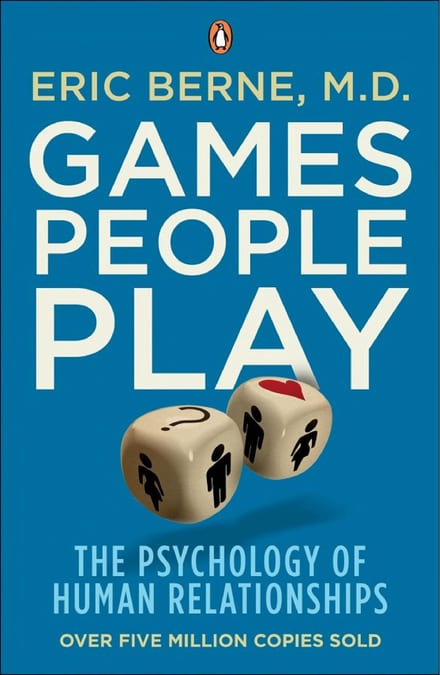
Games People Play: The Psychology of Human Relationships
The Psychology of Human Relationships
The full book runs ~192 pages — roughly 4 hours of reading. You get the key ideas here in 5 minutes.
The key ideas
- Notice which of the three is talking: Parent, Adult or Child.
- Watch for the crossed transaction — that's where communication breaks off.
- Look past the moves; the payoff lands where nobody is watching.
- Spot "Why Don't You – Yes But": the point is rejecting every suggestion.
- Withhold the payoff and the game collapses — expect despair, then laughter.
- Trade games for autonomy: awareness, spontaneity, intimacy.
The summary
Watch people talk long enough and the conversation is rarely about what it seems. Someone lays out a problem at a party, turns down every suggestion, and looks quietly pleased when the room runs out of ideas. Eric Berne, a psychiatrist writing in the early 1960s, called these sequences games: an ongoing series of ulterior transactions running to a well-defined, predictable payoff. Superficially plausible, dishonest underneath, and — his real claim — most of serious social life.
Everyone carries three people around inside
Berne’s unit is the ego state: a system of feelings with a matching set of behaviours. People shift between them mid-conversation, changing posture, voice and vocabulary. He sorts them into three. The Parent reproduces the ego states of your parents as you perceived them. The Adult does objective appraisal and probability estimates. The Child is the still-active relic of early childhood.
These aren’t roles you put on, and none of them is the flaw. Berne refuses the word “childish”: the Child holds intuition, creativity and spontaneous enjoyment, and is often the most valuable part of a personality.
Communication breaks where the vectors cross
A transaction is a stimulus from one ego state answered by a response from another. The surgeon holds out his hand and the scalpel arrives: Adult to Adult, complementary, and such exchanges can run indefinitely. Communication breaks off when a transaction crosses. “Do you know where my cuff links are?” is Adult to Adult; “You always blame me for everything” answers it Child to Parent. Berne thinks this one pattern causes most of the social difficulty in the world, in marriage and at work.
Ulterior transactions run two levels at once, and these are what games are built from. The salesman says, “This one is better, but you can’t afford it” — Adult facts on the surface, aimed at the customer’s Child. “That’s the one I’ll take.”
The payoff is the point
Every game culminates in something the earlier moves exist to set up, usually the part nobody is watching. The guest playing “Schlemiel” spills the highball and burns the tablecloth, apologizing each time; the mess is a bonus, the forgiveness is the payoff.
“Why Don’t You – Yes But” started the theory and is still the game most played at parties. A woman describes a husband who insists on doing his own repairs badly. Why doesn’t he take a carpentry course? Yes, but he hasn’t the time. Why not buy him good tools? Yes, but he can’t use them. She had already bought the tools and he had already taken the course. The purpose is never to collect suggestions; it’s to reject them, until everyone runs dry and the crestfallen silence confirms that they are the inadequate ones.
“Now I’ve Got You, You Son of a Bitch” turns the structure to rage: a man disputes four extra dollars on a four-hundred-dollar plumbing job and writes a long letter about the plumber’s integrity, a trivial grievance licensing years of stored fury.
“Alcoholic” is a five-handed game, with roles for the Persecutor, the Rescuer, the Patsy who supplies money, and the Connexion who sells the drink. The drinking is a move, not the point; the payoff is the morning after, the Child arranging to be scolded by every parental figure willing to oblige. Berne’s proof is “Dry Alcoholic”: same moves, same cast, same ending, no bottles.
Why anyone would play
Berne builds from Spitz’s finding that infants deprived of handling decline and can die of it. Grown-ups compromise: a nod of recognition stands in for touch, a stroke is the unit of social action, an exchange of strokes a transaction. After stimulus-hunger comes structure-hunger — the problem of what to do with your waking hours, answered by rituals, pastimes, games, intimacy and activity.
Games sit in the gap. Pastimes go stale with repetition; intimacy is candid, and the Child fears the unmasking it involves, so most people settle for games.
Mrs White complained that her domineering husband stopped her doing everything. When treatment loosened his grip and she enrolled in dance classes, she found she had a morbid fear of dance floors. His prohibitions had been shielding her from a terror she never had to face and confirming the position she had held all along — that all men are tyrants. Positions like that get fixed between roughly the first and seventh year of life, and games are how they are defended afterwards.
Refusing to play
The test of whether something is a game is the antithesis: refuse to play, or undercut the payoff. The player tries harder, then drops into what Berne calls despair — sharper than depression — which at best turns into laughter and “There I go again.” Anti-Schlemiel is withholding absolution: wreck the rug if you like, but please don’t say you’re sorry. Anti-“Yes But” is declining the adviser’s chair — “That is a difficult problem. What are you going to do about it?” Berne counsels prudence: for some people a game holds a precarious equilibrium together.
What replaces games is autonomy: awareness, spontaneity, intimacy. Awareness is hearing the birds in your own way rather than the way you were taught — the moment the good father says “that’s a jay and this is a sparrow,” the boy can no longer hear them sing.
Read the 1964 framing with your eyes open: Berne describes games “from the male point of view” by default, and much of the casework rests on mid-century assumptions about wives, husbands and sexuality that belong to the period, not the theory.
The bottom line
The arguments that keep recurring in your life are not accidents: they run to a payoff someone is collecting, and the move that looks like the point is usually just the setup. Name the payoff and you can decline to supply it — uncomfortable for everyone, and the only way out. Read it if the same fight, at home or at work, keeps arriving in different words.
Fact check
Popular books repeat findings that later research has complicated. Where Games People Play makes a testable claim, here's what the evidence actually shows.
Infants deprived of physical handling and individual attention decline physically, and the deprivation can kill them — which is why adults keep hunting for substitutes.
The developmental half has since been tested about as rigorously as this question allows. The Bucharest Early Intervention Project randomly assigned 136 institutionalised Romanian children, aged 6 to 31 months at baseline, to foster care or continued institutional care and followed them to ages 16-18 across 7,088 observations; those placed with families had higher IQ, better physical growth and less severe psychopathology, and the gap held roughly constant over nearly 20 years. Reviews of institutional rearing document deficits in physical growth, cognitive function, neurodevelopment and mental health, with the worst effects where children had least access to individual caregiving. Mortality is the part that has not carried forward — what the modern evidence establishes is severe, lasting developmental damage rather than death from lack of handling as such.
- King LS, Guyon-Harris KL, Valadez EA, Radulescu A, Fox NA, Nelson CA, Zeanah CH, Humphreys KL. A Comprehensive Multilevel Analysis of the Bucharest Early Intervention Project: Causal Effects on Recovery From Early Severe Deprivation. Am J Psychiatry. 2023;180(8):573-583. PubMed
- Berens AE, Nelson CA. The science of early adversity: is there a role for large institutions in the care of vulnerable children? Lancet. 2015;386(9991):388-98. PubMed
The basic position a person takes toward themselves and other people is fixed between roughly the first and seventh year of life, and the games they play afterwards exist to defend it.
Personality is far less settled by seven than that. A meta-analysis pooling 3,217 test-retest correlations from 152 longitudinal studies found trait consistency of only .31 in childhood, rising to .54 in the college years and .64 at age 30, and plateauing near .74 only between 50 and 70. A companion meta-analysis of 92 samples found conscientiousness, emotional stability and social dominance still climbing between ages 20 and 40, with four of six trait categories changing significantly in middle and old age. The continuity Berne noticed is real and early experience clearly leaves a mark — the childhood lock-in is what the data don't show.
- Roberts BW, DelVecchio WF. The rank-order consistency of personality traits from childhood to old age: a quantitative review of longitudinal studies. Psychol Bull. 2000;126(1):3-25. PubMed
- Roberts BW, Walton KE, Viechtbauer W. Patterns of mean-level change in personality traits across the life course: a meta-analysis of longitudinal studies. Psychol Bull. 2006;132(1):1-25. PubMed
Frequently asked questions
What is Games People Play about?
Eric Berne, a psychiatrist writing in the early 1960s, argues that much of social life runs on games: ongoing series of ulterior transactions moving toward a well-defined, predictable payoff. They look plausible on the surface and are dishonest underneath. The book gives you the machinery to read them — three ego states, the transactions between them, and the hidden reward that explains why the same conversation keeps happening.
What are the key takeaways from Games People Play?
Everyone carries three ego states: the Parent (reproducing your parents as you perceived them), the Adult (objective appraisal), and the Child (the still-active relic of early childhood, and often the most valuable part of a personality). Conversation runs smoothly while transactions are complementary and breaks off when they cross — "Do you know where my cuff links are?" answered by "You always blame me for everything." Games are built from ulterior transactions, and the payoff, not the visible move, is the point: in "Why Don't You – Yes But," the woman collecting suggestions had already bought the tools and sent her husband to the course, because the aim was rejecting advice until everyone ran dry. People play because strokes are the currency of social contact and intimacy feels too exposing. The way out is the antithesis: refuse to play or withhold the payoff, then aim for awareness, spontaneity and intimacy.
Who should read Games People Play?
Read it if the same fight, at home or at work, keeps arriving in different words. It's also useful for anyone who wants a vocabulary for what's happening under a conversation rather than in it.
Is Games People Play worth reading?
The core insight holds up — naming the payoff is genuinely the move that lets you stop supplying it — and Berne's case studies are sharp and specific. Read the 1964 framing with your eyes open: he describes games "from the male point of view" by default, and much of the casework rests on mid-century assumptions about wives, husbands and sexuality that belong to the period rather than the theory. Berne also counsels prudence, since for some people a game holds a precarious equilibrium together.