Book summary
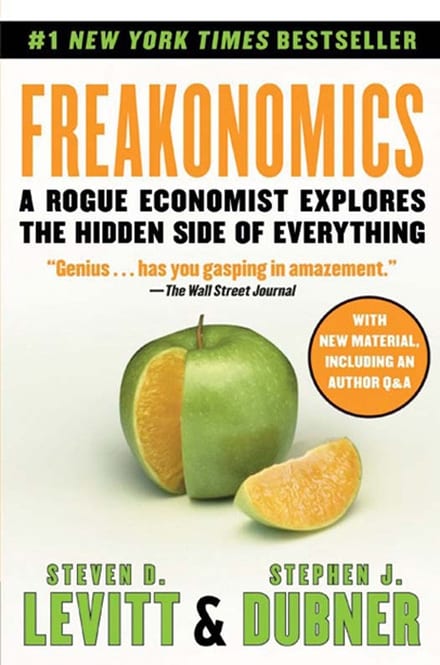
Freakonomics: A Rogue Economist Explores the Hidden Side of Everything
The full book runs ~320 pages — roughly 6 hours of reading. You get the key ideas here in 4 minutes.
The key ideas
- Incentives replace old motives instead of adding to them
- Experts exploit what they know and you don't
- Humans fear vivid dangers, ignore quiet common ones
- Correlation misleads; the true cause is usually distant
- Who parents are matters more than what they do
- Money follows winning candidates, it doesn't create them
The summary
Most explanations for human behavior are wrong. We reach for the obvious cause—money, good intentions, the visible policy—and miss the quieter truth sitting in the data. Steven Levitt and Stephen Dubner’s argument is that behavior is driven by incentives people actually respond to, not the ones we assume, and that the real reason for almost any outcome tends to be distant, hidden, and unglamorous. Get curious about the mechanism, and the world starts to look very different.
Incentives replace, they don’t add
Incentives come in three kinds—economic, social, and moral—and the strongest combine all three. Prison deters crime because it threatens your freedom, your standing, and your conscience at once. But bolt on an incentive without thinking and you can make a problem worse. A group of daycare centers tried fining parents $3 for late pickups; late pickups doubled. The fine was too small to hurt, yet big enough to erase the guilt parents had felt about keeping staff waiting—they could now simply buy off their conscience. Worse, when the centers scrapped the fine, lateness stayed high. The moral pressure, once displaced, didn’t come back.
That’s the pattern: a new incentive tends to replace an old motive rather than stack on top of it, and the results can flip. Teachers cheat on standardized tests when their raises hinge on scores. Sumo wrestlers with a 7-7 record beat 8-6 opponents far more often than chance allows, because the wrestler who’s already safe can afford to throw the match for a bribe. Even generosity bends to the moment: an experiment tracking voluntary payments for office bagels found that weather, holidays, and morale all moved the numbers, and payment rates rose after 9/11, when a wave of empathy briefly outweighed self-interest.
The expert’s edge is what you don’t know
Whenever one side knows more than the other, that information asymmetry becomes power. Real estate agents leave their own homes on the market longer and sell them for more than they get for clients, because the agent’s real incentive is a quick sale and the next commission, not the last few thousand dollars of your price. So the friendly nudge—“this is a strong offer, I’d take it”—quietly serves them. Car dealers, stockbrokers, and mechanics run the same play, and they lean on social fear too: you don’t want to look cheap or clueless, so you go along.
The fix is to close the gap. When life-insurance comparison sites appeared in the 1990s, premiums fell sharply because buyers could finally see what everyone charged. Missing information cuts the other way, though. A new car sheds value the instant it leaves the lot, not because anything broke but because buyers assume the seller knows something they don’t and brace for the worst. Online daters who post no photo get the worst responses for the same reason—an empty space invites the darkest guess. What you leave out speaks as loudly as what you say.
The real cause is usually far away
Our intuitions about cause and danger are unreliable. We fear what we can picture and what we can’t control, which is why a backyard pool feels safer than a gun in the house even though a child is far more likely to drown, and why flying frightens people more than driving despite similar odds—a steering wheel feels like control. Vivid, rare events get overweighted; the slow, common killers get a pass.
We also confuse correlation with cause. Washington, DC has three times Denver’s police and eight times its homicides—obviously the officers didn’t create the murders, they responded to them. The same error tells us money buys elections: candidates who outspend rivals usually win. But doubling your spending buys only about one percent more of the vote, and halving it costs about one percent. Money follows winners; it doesn’t manufacture them. The most striking case is the great crime drop of the early 1990s, which experts pinned on the booming economy, gun laws, and clever policing. The data pointed elsewhere—to the 1973 legalization of abortion under Roe v. Wade, which shrank the cohort most likely to grow up into crime, an effect that surfaced roughly eighteen years later. The true cause was remote and uncomfortable, so almost no one wanted to name it.
Who your parents are beats what they do
Parenting advice mostly misses the same way. Studies suggest at least half of a parent’s influence is genetic, and most of the rest comes from who the parents are—their education, their age, their stability—rather than the techniques they apply. Reading aloud nightly or capping screen time barely moves the outcomes. A child’s name matters, but as a signal, not a cause: identical résumés with stereotypically black names draw fewer interview callbacks, because employers read the name as a proxy for background. And even the data has limits. Roland Fryer grew up poor with an abusive father and became a Harvard economist; Ted Kaczynski grew up comfortable with loving parents and became the Unabomber.
The bottom line
People chase the reward in front of them, not the one you wish they valued, and the real explanation for an outcome is usually distant, hidden, and dull enough that everyone overlooks it. Read this if you’re ready to stop trusting the obvious story and start asking what the numbers actually show.
Fact check
Popular books repeat findings that later research has complicated. Where Freakonomics makes a testable claim, here's what the evidence actually shows.
The 1973 legalization of abortion, not policing or the economy, was the main cause of the US crime drop that began in the early 1990s.
The original 2001 paper attributed a large share of the decline to legalization, but a comment published in the same journal in 2008 found a coding mistake in the key regressions comparing age cohorts within states and years; corrected and expressed per capita, those results came out substantially weaker, and the cross-state estimates were fragile once states were allowed to have different crime trends predating legalization. Donohue and Levitt returned in 2020 with seventeen more years of data and reported that legalized abortion accounted for a 17.5% fall in overall crime between 1998 and 2014, about 1% a year. The hypothesis has survived its authors' own extended series, but the confident magnitudes in the book predate a published correction to the analysis behind them.
- Donohue JJ, Levitt SD. The impact of legalized abortion on crime. Q J Econ. 2001;116(2):379-420. Source
- Foote CL, Goetz CF. The impact of legalized abortion on crime: comment. Q J Econ. 2008;123(1):407-423. Source
- Donohue JJ, Levitt SD. The impact of legalized abortion on crime over the last two decades. Am Law Econ Rev. 2020;22(2):241-302. Source
A small fine for collecting children late from day care made parents later rather than earlier, and lateness stayed high even after the fine was scrapped.
This is what the Israeli day-care experiment found. Late arrivals rose after the fine was introduced, contradicting straightforward deterrence, and removing the fine produced no return to the earlier behaviour — the authors argued the penalty was read as a price that dissolved the moral obligation, and that once dissolved it did not come back. The generalization the book draws from it is the part to hold loosely: a later review of the incentive literature by the same lead author finds that monetary incentives crowd out intrinsic and social motivation under particular conditions and frequently work exactly as intended in others.
Identical resumes sent out under stereotypically Black names draw fewer interview callbacks, because employers read the name as a proxy for the applicant's social background.
The callback gap is one of the most replicated findings in labor economics: the Boston and Chicago audit behind the book found white-sounding names drew 50% more callbacks, and a meta-analysis of 28 field experiments covering 55,842 applications since 1989 found white applicants received 36% more callbacks than African Americans, with no decline over 25 years. The mechanism is where the book's account slips. Bertrand and Mullainathan reported little evidence that employers were inferring social class from the names, and found that better resumes raised callbacks much more for white applicants than for Black ones — a pattern a pure background-signal story does not explain. A later audit of 108 large US employers found distinctively Black names cut the contact rate by 2.1 percentage points, with a small group of firms responsible for most of the shortfall.
- Bertrand M, Mullainathan S. Are Emily and Greg more employable than Lakisha and Jamal? A field experiment on labor market discrimination. Am Econ Rev. 2004;94(4):991-1013. Source
- Quillian L, Pager D, Hexel O, Midtbøen AH. Meta-analysis of field experiments shows no change in racial discrimination in hiring over time. Proc Natl Acad Sci U S A. 2017;114(41):10870-10875. PubMed
- Kline P, Rose EK, Walters CR. Systemic discrimination among large U.S. employers. Q J Econ. 2022;137(4):1963-2036. Source
Doubling campaign spending moves a candidate's vote share by only about one percentage point, so money follows winners instead of creating them.
The number is Levitt's own, from US House races in which the same two candidates faced each other more than once — a design that differences out candidate quality and district effects. An extra $100,000 of challenger spending bought 0.3 percentage points of the vote, and under a tenth of a point for incumbents, an order of magnitude below the 1.6% to 4.2% that cross-sectional models had produced. The estimate is narrower than the book's framing suggests. Using instrumental variables on Senate races, Gerber found the marginal effects of challenger and incumbent spending were roughly equal and that incumbent spending was worth about 6% of the vote in an average race. The underlying point — that raw correlations between spending and winning mostly reflect who was already a strong candidate — holds up better than the one-percent figure.
- Levitt SD. Using repeat challengers to estimate the effect of campaign spending on election outcomes in the U.S. House. J Polit Econ. 1994;102(4):777-798. Source
- Gerber A. Estimating the effect of campaign spending on Senate election outcomes using instrumental variables. Am Polit Sci Rev. 1998;92(2):401-411. Source
Frequently asked questions
What is Freakonomics about?
Most explanations for human behavior are wrong because we reach for the obvious cause and miss the quieter truth in the data. The book's argument is that behavior is driven by the incentives people actually respond to, and the real reason for almost any outcome tends to be distant, hidden, and unglamorous.
What are the key takeaways from Freakonomics?
Incentives come in three kinds, economic, social, and moral, and a new one tends to replace an old motive rather than stack on top of it, which is why a $3 daycare fine doubled late pickups. Information asymmetry is power, so real estate agents, car dealers, and experts exploit what you don't know. Correlation isn't cause: more police didn't create more murders, and legalized abortion, not clever policing, best explains the 1990s crime drop. And who parents are matters more than the techniques they apply.
Who should read Freakonomics?
Read it if you're ready to stop trusting the obvious story and start asking what the numbers actually show.
Is Freakonomics worth reading?
It's entertaining and genuinely changes how you read cause and effect, with memorable case studies from sumo wrestlers to real estate agents. Some conclusions, like the abortion-and-crime link, are contested, and the chapters jump between unrelated topics, so treat it as a way of thinking rather than settled fact.