Book summary
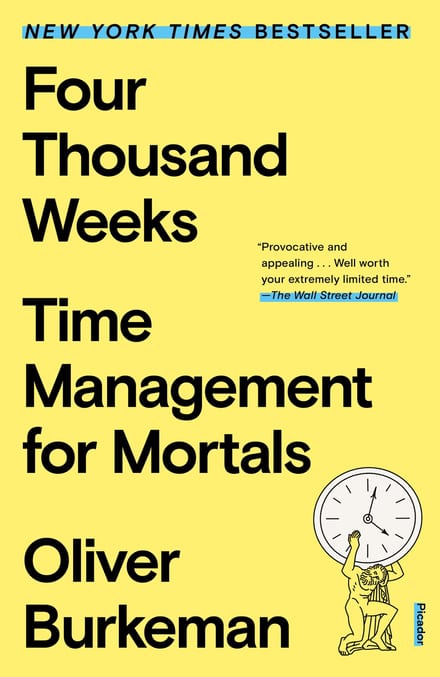
Four Thousand Weeks: Time Management for Mortals
The full book runs ~280 pages — roughly 5 hours of reading. You get the key ideas here in 5 minutes.
The key ideas
- Accept finitude—no system fits everything in, and that's freeing.
- Limit yourself to three major projects; say no to the rest.
- Embrace trade-offs; every choice means abandoning appealing alternatives.
- Face distraction as avoidance of hard, meaningful, limit-revealing work.
- Reclaim leisure for pure enjoyment, not disguised self-improvement.
- Find meaning in ordinary acts; cosmic insignificance liberates you.
The summary
You get about four thousand weeks. That’s roughly eighty years, if you’re lucky — an absurdly short run. And no productivity system, no app or morning routine or time-blocking scheme, will ever let you fit everything in. Oliver Burkeman’s argument is that the sooner you accept that, the sooner you can stop treating your life as a rehearsal for some better-organized version of it and commit to what actually matters.
Burkeman knows the trap firsthand: he spent years as a productivity writer, refining systems to wring more out of every hour, before noticing that most of what he was optimizing didn’t matter to him at all. And efficiency backfires. Clear the inbox and it refills faster; finish the list and three new tasks appear. “Productivity is a trap. Becoming more efficient just makes you more rushed.” Nobody in history has achieved “work-life balance,” and the day when you finally have everything under control is never going to arrive. His counterintuitive verdict: that’s excellent news. Once you quit chasing the fantasy of total control, you’re free to actually live.
Finitude is the point, not the problem
Our anxiety about time is surprisingly recent. Medieval peasants didn’t fret over schedules — they worked by the sun and trusted in an afterlife that made earthly time feel less scarce. Mechanical clocks and then the industrial revolution turned time into a resource to be measured, allocated, and sold by the hour, and as religious certainty faded, your finite weeks on Earth became all you could be sure of. That could have been freeing. Instead most of us respond with denial: frantic busyness, endless distraction, and the belief that enough optimization will let us cheat the limit.
But the limit is exactly what gives life meaning. Your experiences are precious because they run out — the bittersweet awareness of impermanence the Japanese call mono no aware. As Burkeman notes, everything you do, you’re eventually doing for the last time — the last time you pick up your child, though you’ll almost never know it’s the last. Treating each moment merely as a stepping stone to a future one, he writes, shows “a level of obliviousness to our real situation that would be jaw-dropping if it weren’t for the fact that we all do it, all the time.” Once a moment passes, your supply is one smaller than before.
Choose less, and choose it now
Accepting finitude isn’t surrender; it’s what lets you commit. The practical rule is brutal and simple: keep no more than three big projects going at once. Do the most meaningful work first, and don’t wait for the “right time” — Hofstadter’s Law promises everything takes longer than you expect, even after you account for Hofstadter’s Law. This means saying no to nearly everything and disappointing people, because entire categories of experience — languages you won’t learn, places you won’t see — are permanently off the table. That’s the cost of doing anything well.
The philosopher Henri Bergson noticed why we stall: an undecided future glitters with appealing possibilities, while any real choice forces trade-offs and imperfection. Recognizing that some loss of potential is unavoidable is what frees you to move. So does patience for the true pace of things; rushing burns you out and slows you down. And the future was never yours to control anyway — where you were born, who your parents are, the chance encounters that shaped your life all happened without your direction, and you managed.
Distraction is a way of dodging reality
“What you pay attention to will define, for you, what reality is.” That’s why the attention economy fights so hard for it, engineering distractions to capture and monetize your focus. But the deeper pull toward distraction isn’t just the algorithms. Focusing on work that matters forces you to confront your own limits — that you might not be good enough, that it might fail — and looking away feels safer. When you catch yourself reaching for the escape, Burkeman suggests turning toward the task instead: attend to its details and sensations, and accept that some discomfort simply comes with the territory. The resistance eases.
The same avoidance has hollowed out rest. We fill free time with “productive” hobbies — learning a language for the résumé, training to optimize the body — when real leisure means doing something purely for pleasure and letting yourself be mediocre at it. A Swedish study found antidepressant use dropped when people were on vacation, and time spent connecting socially reliably improves mental health, yet we keep treating rest as one more box to check.
Cosmic insignificance therapy
Your life doesn’t need a grand purpose. On the scale of the universe, it makes no difference whether you’re an ordinary parent or the next Michelangelo — and Burkeman means that as relief, not despair. Freed from the pressure to do something world-historically consequential, you can find meaning in ordinary acts that make life a little better for the people near you. From this angle, he writes, “preparing nutritious meals for your children might matter as much as anything could ever matter.” You also don’t have to strain to “live in the present,” as if presence were a state to be achieved. The present is always already happening. The only question is whether you keep treating it as a stepping stone or accept it as all you have — and enough.
The bottom line
You will never get to everything, and that impossibility is precisely what makes your choices matter. Stop optimizing for a future that never comes, pick a few things, and give them your finite weeks now. Read this if productivity culture has left you exhausted and you’re ready to stop treating your life as a problem to solve.
Frequently asked questions
What is Four Thousand Weeks about?
You get about four thousand weeks, and no productivity system will ever let you fit everything in. Oliver Burkeman's argument is that accepting that limit, instead of treating your life as a rehearsal for some better-organized version, is what frees you to commit to what actually matters.
What are the key takeaways from Four Thousand Weeks?
Efficiency backfires, since clearing the inbox only makes it refill faster, so "productivity is a trap." Finitude is the point, not the problem: the limit is what gives your moments meaning. Choose less and choose now, keeping no more than three big projects at once and doing the most meaningful work first, which means saying no and disappointing people. Distraction is a way of dodging your own limits, and "cosmic insignificance therapy" frees you to find meaning in ordinary acts rather than straining for a grand purpose.
Who should read Four Thousand Weeks?
Read it if productivity culture has left you exhausted and you're ready to stop treating your life as a problem to solve.
Is Four Thousand Weeks worth reading?
It's a thoughtful, well-written reframe that trades life hacks for philosophy, and it lands hard if you're burned out on optimization. Readers wanting concrete tactics may find it light on step-by-step method, since its real offer is a change of mindset rather than a system.