Book summary
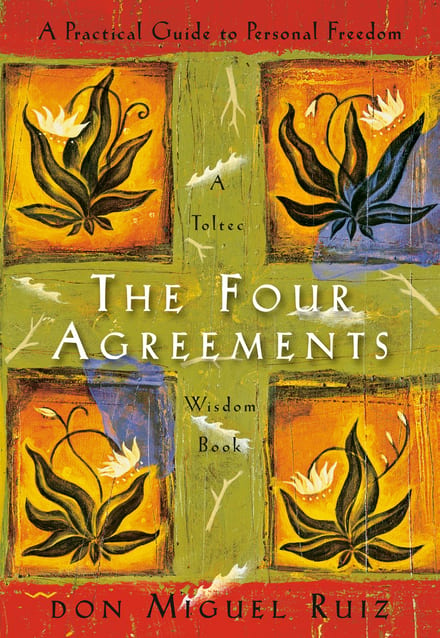
The Four Agreements: A Practical Guide to Personal Freedom
The full book runs ~152 pages — roughly 3 hours of reading. You get the key ideas here in 2 minutes.
The key ideas
- Recognize your domestication: society scripted your beliefs through reward and punishment
- Speak impeccably: words build or destroy, so avoid untrue negativity
- Stop taking things personally: others' words reflect their state, not your worth
- Ask questions instead of assuming, which poisons relationships on false premises
- Do your best, a shifting standard, not perfection
- Break old agreements through awareness, forgiveness, and living each day fully
The summary
Most of your suffering runs on rules you agreed to before you were old enough to object. Don Miguel Ruiz, drawing on the Toltec tradition of ancient Mexico, calls this domestication. From birth, family and society punish you for breaking their rules and reward you for keeping them, until you’ve traded your own individuality for their approval and forgotten you ever had a choice. These invisible agreements — about what you’re worth, what’s expected, what’s forbidden — come to feel like simply who you are. The book offers four new ones to replace the old, fear-based script: commitments that are simple to state and hard to live — the sort of inspirational spiritual wisdom that fits on a card yet takes years to embody — but powerful enough to loosen the whole inheritance.
Be impeccable with your word
Words are not neutral. They shape how you think, what you believe, and how others see themselves, so the first agreement is to stop using them to spread untrue, negative things — about others or yourself. Ruiz’s example is quietly devastating: a mother comes home exhausted, snaps at her singing daughter that the noise is annoying, and that offhand sentence lodges in the girl for years, eroding her sense of worth. What felt like venting became a verdict. To be impeccable is to use language to build rather than wound.
Don’t take anything personally
When you take things personally, you assume everything is about you — and you swallow both the insults and the praise as if they were accurate reports on your value. They aren’t. What people say and do reflects their own state far more than yours; people insult when they feel bad and flatter when they feel good. The antidote is self-knowledge. Know yourself well enough and other people’s judgments lose their grip, because you can already tell they’re untrue. Seeking your own acceptance turns out to be far more productive than chasing everyone else’s.
Don’t make assumptions
Most assumptions are imagination dressed up as fact. Someone doesn’t return your greeting and you conclude you’ve wronged them, when they simply didn’t hear you or are preoccupied with something of their own. Left alone, these invented stories quietly poison relationships, letting resentment build on a foundation that was never real. The fix is unglamorous and effective: ask. A plain “I noticed this — what’s going on?” replaces a private drama with actual information. The same applies inward; don’t assume what you can or can’t do without testing it.
Always do your best
The fourth agreement holds the others together. If you don’t do your best, you leave the door open to guilt and self-criticism. But “your best” is not a fixed bar — it shifts with the day, your health, your energy. Your best when you’re rested differs from your best when you’re sick, and expecting a constant peak is a recipe for burnout. Do your best especially in the things you love; work purely for a paycheck and it feels like drudgery, but work at something that matters to you and the effort turns almost effortless. The agreement asks for honest effort, not perfection.
Breaking the old agreements
Adopting new agreements means dismantling the old ones first, and Ruiz names three ways. Become aware of the self that others built for you in childhood — what he calls the dream of the first attention — and see the fear-based beliefs driving your unhappiness clearly enough to replace them. Practice forgiveness, of others and yourself, to starve the “parasite” of negativity the Toltecs say feeds on your mind. And live each day as if it were your last, since everything real exists only in the present. When you’re tempted to spend this moment worrying about what others think, ask whether it’s worth it.
The bottom line
Nearly all of your suffering rests on agreements you never consciously chose, and four new ones — speak truthfully, don’t take things personally, ask instead of assuming, and always do your best — hand the choice back to you. Read this if you’re tired of living by a script someone else wrote before you could read it.
Frequently asked questions
What is The Four Agreements about?
Most of your suffering runs on rules you agreed to before you were old enough to object, what Don Miguel Ruiz, drawing on the Toltec tradition, calls domestication. The book offers four new agreements to replace that old, fear-based script and hand the choice back to you.
What are the key takeaways from The Four Agreements?
Be impeccable with your word, using language to build rather than wound. Don't take anything personally, since what people say reflects their own state far more than your worth. Don't make assumptions, because most of them are imagination dressed up as fact, so ask instead. And always do your best, where "your best" shifts with your energy and health, so it asks for honest effort rather than a constant peak. Breaking the old agreements takes awareness of the childhood self, forgiveness, and living each day as if it were your last.
Who should read The Four Agreements?
Read it if you're tired of living by a script someone else wrote before you could read it.
Is The Four Agreements worth reading?
It's short, memorable, and the four rules are easy to carry with you into everyday conversations and reactions. The ideas are simple and the spiritual framing is light, so readers wanting depth or evidence may find it thin, but as a clear reset on how you speak and respond it does its job.