Book summary
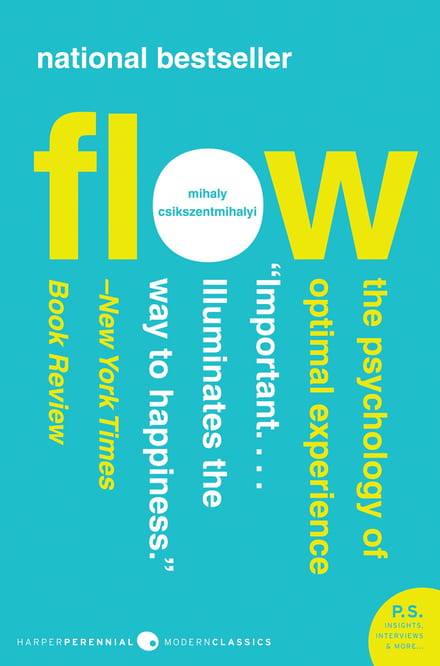
Flow: The Psychology of Optimal Experience
The Psychology of Optimal Experience
The full book runs ~317 pages — roughly 6 hours of reading. You get the key ideas here in 5 minutes.
The key ideas
- Guard attention: your nervous system processes only 126 bits per second.
- Separate pleasure from enjoyment — only enjoyment makes the self more complex.
- Match challenges to skills; flow sits between boredom and anxiety.
- Set clear goals and demand immediate feedback, like a surgeon.
- Expect flow at work, not leisure — 54 percent versus 18.
- Convert adversity into a goal, as paralyzed Lucio became an archery champion.
The summary
Happiness is not something that happens to you. Csikszentmihalyi spent twenty-five years assembling the evidence: over a hundred thousand snapshots of ordinary people’s inner lives, collected by paging them at eight random moments a day to ask what they were doing and how they felt. The pattern held from Korean grandmothers to Chicago assembly-line workers. The best moments are not the passive, relaxing ones. They arrive when your body or mind is stretched to its limit in a voluntary effort to accomplish something difficult and worthwhile.
Attention is the only currency you have
The nervous system handles about seven bits of information at a time, and needs roughly an eighteenth of a second to tell one set from the next — about 126 bits per second. Over seventy years of waking hours that’s some 185 billion bits: every thought and feeling you will ever have, paid out of it.
That budget is why the mind’s default state is disorder. Julio Martinez, soldering connections on a line assembling movie projectors, spent three days barely keeping up because one of his tires was flat and payday was a week off. He snapped at his coworkers and slowed the line. Nothing about the tire touched him physically; the information alone did the damage. Csikszentmihalyi calls this psychic entropy, and most people escape it the cheapest way — television, which structures attention at almost no cost and returns almost nothing.
Pleasure keeps you level, enjoyment makes you bigger
Pleasure is what you feel when an expectation set by biology or culture gets met: food when you’re hungry, rest at day’s end, a drink in front of a screen. It restores order without asking anything of you, which is why it leaves you unchanged.
Enjoyment demands an unusual investment of attention and returns novelty and accomplishment — a close tennis match, a book that shows you something in a new light, a conversation that pulls out ideas you didn’t know you had. None of it is necessarily pleasant at the time; afterward you are more complex. A Naples antique dealer refused a rich tourist’s money for a pair of baroque cherubs because she accepted his inflated price without flinching. “If I were starving, I would have taken her money. But since I am not, why should I make a deal that isn’t any fun?”
The conditions that produce it
Long-distance swimmers, chess players, climbers, and teenagers in a championship game described their best moments in nearly identical words. Eight things recur: a task you have a chance of completing, deep concentration, clear goals, immediate feedback, effortless involvement that pushes daily worry out of awareness, a sense of control, the disappearance of self-consciousness, and a warped sense of time.
The load-bearing one is the fit between challenge and skill. Enjoyment appears at the boundary between boredom and anxiety, so it never sits still — a boy is in flow the first time he gets a tennis ball over the net, and bored a month later unless he raises the difficulty. Feedback matters as much, and needn’t be profound: surgeons who love operating wouldn’t switch to internal medicine at ten times the pay, because no blood in the incision means it is going well. The activity must also be autotelic, from auto, self, and telos, goal. Playing the stock market for money is not; playing it to test your read on the future is.
Your job is better than your weekend
Over a hundred full-time workers wore pagers for a week and logged 4,800 moments. At work, 54 percent met the criteria for flow; in leisure only 18 percent did, and more than half fell into apathy. Yet asked whether they wished they were doing something else, they said yes far more often at work. People disregard the evidence of their senses in favor of the cultural story that work is an imposition.
Rico Medellin’s job was a forty-three-second operation repeated almost six hundred times a day. Five years in he had trained himself down to a twenty-eight-second average, and rarely mentioned he was ahead: “It’s a whole lot better than watching TV.” Joe Kramer welded railroad cars in South Chicago for thirty years, turned down promotions, and could fix any machine in the plant. At home he built a rock garden with sprinklers he designed to throw rainbows, then added floodlights so he could raise them at midnight.
Adversity is raw material
Fausto Massimini’s group in Milan interviewed paraplegics and people who had lost their sight; a startling number named the accident as both the worst and one of the best things in their lives. Catastrophe hands you unmistakable goals and strips out inessential choices. Lucio was a twenty-year-old gas station attendant when a motorcycle wreck paralyzed him below the waist; he went on to a languages degree and a regional archery championship from his wheelchair. “When I became paraplegic, it was like being born again.”
Prisons produce the same pattern. In Hungary’s Visegrád jail, hundreds of inmates spent over a year on a poetry translation contest, passing nominations cell to cell until they settled on Whitman’s “O Captain! My Captain!” With no paper, the poet Tollas Tibor smeared soap on his shoe sole and carved the lines with a toothpick. What such people share is attention pointed outward at the situation rather than inward at the injury, and a willingness to invent a new goal instead of battering at the blocked one.
The bottom line
Flow is not a reward you get once life is going well — it is what makes a life go well, and you can build it into a job, a conversation, or a broken-down car. Absorption alone isn’t enough: the episodes add up to a meaningful life only when one chosen purpose runs through them and you hold to it under pressure. Read this if you suspect you’re spending your attention badly and want the mechanics, not another list of tips.
Fact check
Popular books repeat findings that later research has complicated. Where Flow makes a testable claim, here's what the evidence actually shows.
People reach flow far more often on the job than in their free time — 54 percent of sampled work moments against 18 percent of leisure moments — yet they say they would rather be elsewhere while working.
The study behind those figures paged 78 adult workers at random for a week, and its own report of the result is unambiguous: the great majority of flow experiences came while working, not while at leisure, and the quality of a moment was shaped more by whether the person was in flow than by whether they were on the clock. The motivation paradox is in the same data — respondents reported wanting to be doing something else more often at work regardless of how the moment actually felt. The one caveat is definitional: flow was scored as any moment of above-average challenge combined with above-average skill, a bar that a job clears more readily than television does.
- Csikszentmihalyi M, LeFevre J. Optimal experience in work and leisure. J Pers Soc Psychol. 1989;56(5):815-22. PubMed
The nervous system can process only about 126 bits of information per second, which is the hard budget every thought and feeling is paid out of.
The bottleneck is real and, if anything, tighter than the book says — but 126 bits per second is arithmetic rather than measurement. It comes from multiplying Miller's "seven items at a time" by an eighteenth-of-a-second discrimination interval, and the seven-item figure was revised down to roughly four chunks in Cowan's 2001 reconsideration of short-term storage. A 2025 review in Neuron puts human behavioural throughput at about 10 bits per second, against sensory systems gathering data at around a billion bits per second. Csikszentmihalyi's argument that attention is a scarce budget survives intact; the specific number carries more precision than its inputs support.
Flow appears where the difficulty of a task matches your skill — the narrow band between boredom and anxiety is what produces it.
A meta-analysis of 28 studies found the challenge–skill balance moderately related to flow and among the sturdier predictors, alongside clear goals and a sense of control. The awkward part is where the relationship weakens: in work and education settings, in experience-sampling data, and when researchers measure flow as a momentary state rather than a personal trait — that is, under exactly the conditions Csikszentmihalyi's own method uses. A two-study field investigation of outdoor-education students found no support for the challenge–skill ratio as a predictor of how good a moment felt. Balance looks like one contributor among several rather than the switch that turns flow on.
- Fong CJ, Zaleski DJ, Leach JK. The challenge–skill balance and antecedents of flow: A meta-analytic investigation. The Journal of Positive Psychology. 2015;10(5):425-446. Source
- Løvoll HS, Vittersø J. Can balance be boring? A critique of the "challenges should match skills" hypotheses in flow theory. Social Indicators Research. 2014;115(1):117-136. Source
Frequently asked questions
What is Flow about?
Csikszentmihalyi spent twenty-five years paging ordinary people at random moments to ask what they were doing and how they felt, collecting over a hundred thousand snapshots of inner life. The pattern held from Korean grandmothers to Chicago assembly-line workers: the best moments aren't the relaxing ones but the ones where body or mind is stretched to its limit in a voluntary effort at something difficult. Happiness, on this evidence, is something you construct out of attention rather than something that happens to you.
What are the key takeaways from Flow?
Attention is a hard budget — roughly 126 bits per second, about 185 billion bits over a lifetime — and everything you'll ever think or feel is paid out of it. Distinguish pleasure, which restores order and leaves you unchanged, from enjoyment, which demands investment and leaves you more complex. Flow itself has eight recurring conditions, but the load-bearing one is the fit between challenge and skill, sitting right at the boundary between boredom and anxiety, plus immediate feedback of the kind a surgeon gets from a clean incision. And the findings are counterintuitive: at work 54 percent of moments met the flow criteria against only 18 percent in leisure, yet people still said they'd rather be elsewhere.
Who should read Flow?
Read it if you suspect you're spending your attention badly and want the mechanics of how absorption works, not another list of productivity tips.
Is Flow worth reading?
The research base is unusually strong for the genre, and the case studies stay with you: Rico Medellin cutting a forty-three-second task down to twenty-eight over five years, Joe Kramer building a rock garden with sprinklers that throw rainbows, Lucio taking a regional archery championship from his wheelchair. It's a psychology book rather than a manual, so the practical steps are yours to extract. Skip it if you want a quick prescription; read it if you want to understand why the prescriptions you've tried didn't hold.