Book summary
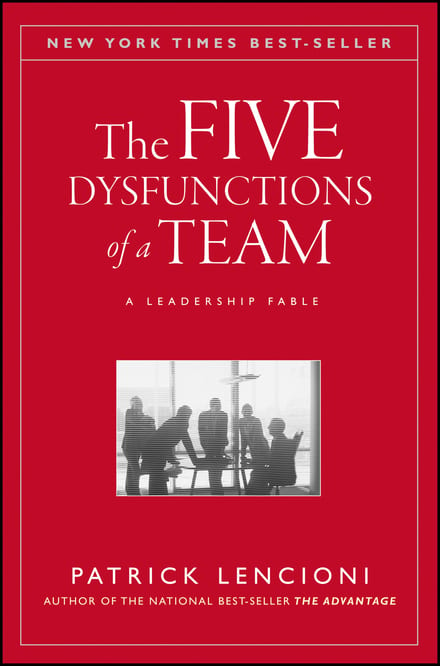
The Five Dysfunctions of a Team: A Leadership Fable
The full book runs ~240 pages — roughly 4 hours of reading. You get the key ideas here in 5 minutes.
The key ideas
- Trust on a team isn't predicting that a colleague will deliver — it's admitting weaknesses and mistakes without fear they'll be used against you.
- The absence of arguing isn't harmony but tension, and issues that never get debated resurface forever as back-channel politics.
- People commit to decisions they didn't win as long as their view was heard, which makes consensus and certainty the two enemies of buy-in.
- Peers enforce standards better than any boss can, but only for plans they clearly bought in to in the first place.
- A team needs a scoreboard specific enough that no one can quietly trade collective results for individual status.
The summary
DecisionTech had everything a Silicon Valley start-up is supposed to need: the most experienced and expensive executive team imaginable, more cash than its rivals, better technology, top-tier investors. Two years in, it trailed two competitors on revenue and customers and had a reputation as one of the most political places to work in the Valley. Patrick Lencioni’s fable drops a former car-plant executive, Kathryn Petersen, into the CEO chair, and her diagnosis never changes: the problem isn’t strategy, technology, or money. The eight people at the top aren’t a team. At an off-site in Napa she draws a pyramid on the whiteboard, filled in from the bottom:
- Absence of trust
- Fear of conflict
- Lack of commitment
- Avoidance of accountability
- Inattention to results
The order is the argument: each one produces the next, so a single broken link takes down the chain.
Trust means vulnerability, not predictability
The everyday sense of trust is prediction: she always hits her deadlines, so you trust her to. That isn’t enough. A team needs people willing to be exposed — to admit a weakness, a mistake, a need for help — and confident that none of it comes back at them later. Careers reward the opposite instinct, teaching successful people to compete with their peers and guard their reputations.
Kathryn starts absurdly small: five harmless questions about hometown, siblings, childhood hobbies, first job. Forty-five minutes later the team is looser than it had been in a year. Then she raises the stakes and goes first, naming her own weakness — she’s a poor public spokesperson who dismisses PR. A leader who won’t risk losing face sets the ceiling for everyone else, and staged vulnerability is worse than none.
Artificial harmony is the expensive kind
Nick objects that the team has plenty of conflict. Kathryn corrects him: they have tension. Nobody argues, so frustration leaks out as eye-rolls and sarcasm. The kind that matters is ideological — about ideas, not personalities — and from outside it can look like a brawl while leaving no wreckage behind.
The efficiency case for avoiding it runs backwards. Outsourcing IT, Jan points out, comes up at every meeting, half the room for and half against, and never moves because nobody wants to annoy anyone. “And ironically,” Carlos says, “that is exactly what pisses us off.” Ducking the argument means revisiting it forever, and rerouting the disagreement into back-channel attacks nastier than any clash over a decision. So Kathryn promises that every staff meeting will be loaded with conflict, and that if there’s nothing worth debating, there’s no meeting.
People weigh in before they buy in
Commitment rests on clarity and buy-in, and two appetites block it: consensus and certainty. Reasonable people don’t need to win an argument; they need to know their view was heard. Consensus chased for its own sake becomes an attempt to please everyone, which, as Jeff puts it, usually turns into displeasing everyone equally. Waiting for certainty just breeds paralysis.
The team fights over market share, revenue, cost containment, and new customers as the single goal for the year. “If everything is important, then nothing is,” Kathryn says, refusing to let them keep two. Once everyone has argued, she sets the number herself: eighteen new customers by December 31, at least ten willing to be active references. Nobody voted; everyone had spoken. Carlos names the rule: people need to weigh in before they can buy in. Skip it and small gaps between executives become open contradictions by the time they reach the employees below.
Peer pressure beats a boss with a whip
Accountability here means one narrow thing: telling a peer their performance or behavior is hurting the team. Interpersonal discomfort stops it, and people are hard to confront for opposite reasons — Carlos is so helpful that nobody challenges him when he admits he never started the competitive analysis; others get defensive, or are intimidating. When the leader is the only source of discipline, the team quietly outsources the job.
Kathryn’s own story lands hardest. Early in her career she inherited an analyst, Fred, who out-produced everyone and made sure they knew it. Complaints came; she ignored them rather than come down on her best performer. Output slid, so she promoted him. Three of her seven analysts quit and her boss fired her. “They fired the right person,” she tells the group. What cost the department half its output wasn’t Fred’s behavior. It was her tolerance of it.
Make the score too clear for ego to hide behind
The top of the pyramid isn’t about killing ego; the key, Kathryn says, is to make the collective ego greater than the individual ones. Teams drift toward two substitutes: team status, where belonging to something prestigious is satisfying enough, and individual status, where a career quietly outranks the group’s goals. Her husband Ken, a high-school basketball coach, benched his most talented player — a kid content after a loss as long as his own points were up — and won more without him.
It’s also why she insists the executive staff be everyone’s first team, ahead of the departments they built and love — not dismantled, but made secondary, which to most of her reports feels like abandonment. Mikey, the gifted marketing VP who rolls her eyes through meetings and rates her own department a success while the company fails, never makes that shift, and Kathryn moves her out.
The bottom line
Building a team is simple and brutally hard, and the difficulty is behavioral, not intellectual: obvious practices sustained with unusual discipline. Because the pyramid is sequential, there’s no jumping to accountability or results. You start at the bottom, and as the leader that means being first to say something unflattering about yourself. Read it if your meetings are polite and your hallways are not, or if you’ve ever shielded a high performer whose behavior was draining everyone around them.
Fact check
Popular books repeat findings that later research has complicated. Where The Five Dysfunctions of a Team makes a testable claim, here's what the evidence actually shows.
A team's results depend more on whether members can admit weaknesses and mistakes without fear of reprisal than on how strong the individuals are.
The construct Lencioni is describing — psychological safety, the shared belief that interpersonal risk is safe on this team — is well evidenced: a meta-analysis pooling 136 independent samples covering more than 22,000 individuals and nearly 5,000 groups places it at the centre of a broad network of team antecedents and outcomes, including task performance. The route to results, though, is usually indirect rather than the direct lever the fable implies. Across 104 field sales and service teams, psychological safety had no direct effect on team effectiveness at all and worked only through learning behaviour and team efficacy — the authors describe it as the engine of performance, not the fuel. Safety looks like what lets a team use the talent it has, not a replacement for having any.
- Frazier ML, Fainshmidt S, Klinger RL, Pezeshkan A, Vracheva V. Psychological safety: a meta-analytic review and extension. Pers Psychol. 2017;70(1):113-165. doi:10.1111/peps.12183 Source
- Kim S, Lee H, Connerton TP. How psychological safety affects team performance: mediating role of efficacy and learning behavior. Front Psychol. 2020;11:1581. PubMed
Conflict over ideas improves a team's decisions, and it is the avoidance of it that costs them.
The first large meta-analysis found the opposite of what textbooks predicted: De Dreu and Weingart reported task conflict correlating negatively with both team performance and member satisfaction, and more negatively on complex decision-making work than on routine production. A bigger follow-up across 116 studies and 8,880 groups found no strong negative association and a conditional picture instead — task conflict related more positively to performance when it stayed weakly correlated with relationship conflict, in top management teams rather than lower-level teams, and when the outcome was decision quality or financial results rather than overall performance. Those conditions match the fable's setting of an executive team arguing over a decision, so the mechanism is plausible where Lencioni applies it. The caveat is his own: the benefit survives only while the argument stays about ideas and not people.
Shielding a high performer whose behaviour damages the team costs the organisation more than their output is worth.
Housman and Minor tracked more than 50,000 workers across 11 firms and priced the induced turnover cost of a single toxic worker — the expense of replacing colleagues who leave because of them — at $12,489. Replacing an average worker with a top-1% performer saved only $5,303 by comparison, so avoiding one toxic worker was worth better than two-to-one against landing a superstar. Their data also explains why such people survive: toxic workers were measurably faster than average, though not more productive once quality was accounted for. The authors call the $12,489 a lower bound, since it excludes litigation, regulatory penalties and lost morale.
- Housman M, Minor D. Toxic Workers. Harvard Business School Working Paper 16-057. Boston, MA: Harvard Business School; 2015. Source
Frequently asked questions
What is The Five Dysfunctions of a Team about?
Patrick Lencioni's fable about DecisionTech, a start-up with the best-paid executives, the best technology and the most cash in its market, losing to two competitors because the eight people at the top aren't a team. New CEO Kathryn Petersen draws a pyramid: absence of trust, fear of conflict, lack of commitment, avoidance of accountability, inattention to results. The order is the argument — each dysfunction produces the next, so one broken link takes down the chain.
What are the key takeaways from The Five Dysfunctions of a Team?
Trust means vulnerability, not predictability: admitting a weakness or mistake without fear it comes back at you, and the leader has to go first. The absence of arguing is tension, not harmony, and ducked debates return forever as back-channel politics. People commit to decisions they didn't win as long as they were heard, which makes consensus and certainty the enemies of buy-in. And accountability is peer-to-peer — Kathryn's own story is being fired for shielding a star analyst whose behavior cost her department half its output.
Who should read The Five Dysfunctions of a Team?
Read it if your meetings are polite and your hallways are not, or if you've ever protected a high performer whose behavior was draining everyone around them. It's aimed squarely at leadership teams, though it works for any group that keeps revisiting the same undecided issue.
Is The Five Dysfunctions of a Team worth reading?
Yes, mainly for the model: because the pyramid is sequential, it doubles as a diagnostic order and stops you jumping to accountability or results. The fable format makes it fast, and the scenes — Nick insisting the team has conflict, Mikey rating her own department a success while the company fails — stick better than a framework diagram would. Lencioni concedes the practices are obvious; the difficulty is behavioral, so don't come for novel ideas.