Book summary
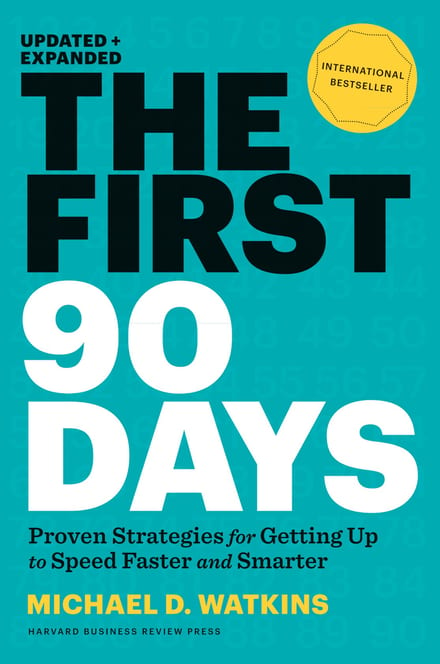
The First 90 Days: Proven Strategies for Getting Up to Speed Faster and Smarter
Proven Strategies for Getting Up to Speed Faster and Smarter
The full book runs ~304 pages — roughly 6 hours of reading. You get the key ideas here in 5 minutes.
The key ideas
- Aim at the break-even point, where you stop costing more than you return.
- Diagnose with STARS: start-up, turnaround, accelerated growth, realignment, sustaining success.
- Treat culture as an immune system — impose an old style and it expels you.
- Negotiate five conversations with your boss: situation, expectations, resources, style, feedback.
- Bank credibility in the first 30 days, then deliver visible results over the next 60.
- Set a deadline for team decisions — 90 days, 60 in a turnaround.
The summary
Getting hired for a job and being any good at it are two different problems, and the second one has a start date. Michael Watkins treats the weeks after that date as a management problem with known failure modes and a measurable finish line: the break-even point, where you have contributed as much value to the organization as you have consumed from it. Until then you are a net drain, and the whole method exists to pull that date closer.
The clock runs longer than anyone admits
The title is not a promise. Readers assume transitions take ninety days; how long you actually have depends on what you walked into. What stays constant is the cost. An IMD survey of 1,350 HR professionals put transitions at the hardest stretch of a leader’s working life, and in an Egon Zehnder survey of more than 500 senior executives, 57 percent said their most recent move took six months or more before they had genuinely taken the role on — 18 percent said nine months or more. And transitions are routine: more than a quarter of leaders change roles in a typical year, each move rippling through the working lives of about a dozen others.
Diagnose the situation before you prescribe
The central diagnostic is STARS — five business situations, each rewarding a different approach:
- Start-up — building the team, the processes and the strategy from nothing.
- Turnaround — a business in visible trouble, where speed and decisiveness are licensed.
- Accelerated growth — scaling fast while complexity outruns the structure.
- Realignment — an organization that still looks healthy but has drifted.
- Sustaining success — inheriting something that works and having to keep it working.
Watkins describes realignment as a slow puncture: the tire is still round, nobody sees a problem, and without intervention the car ends up in a ditch. Turnarounds are easier in one respect — everyone already agrees something is wrong. In a realignment your first job is to get people to see the leak, which means building a shared diagnosis rather than announcing one — benchmarking against rivals, bringing customer complaints into the room.
The framework also earns its keep as vocabulary: you will read the situation one way, your boss another, your peers a third, and naming it out loud makes the disagreement discussable. Most leaders also have a favorite mode. Asked which they would rather lead, managers overwhelmingly choose accelerated growth; nobody volunteers to sustain somebody else’s legacy.
The classic traps are versions of acting too soon
Watkins’s list of transition traps is short and repetitive: arriving with the answer already written, manufacturing a crisis to justify change, attempting too much at once, and not taking time to understand the culture. The last carries the sharpest warning. Culture behaves like an immune system — impose an old operating style on a new body and it provokes a reaction that expels you.
The learning new leaders do is skewed twice over. They study the business — markets, products, numbers — because that is the comfortable part, and shortchange the politics, which is where they get hurt. And they learn vertically, banking on the boss and the direct reports while neglecting peers. In work by Genesis Advisers and Egon Zehnder, newly hired leaders reported getting the least support from exactly the peers whose backing mattered most; a separate Egon Zehnder survey of more than 500 experienced executives found that those who struggled struggled over politics and culture, not competence or experience.
The other adjustment is personal. A country manager who becomes a regional VP with no direct reports has traded positional authority for pure influence — a shift Watkins calls warrior to diplomat. What got you here is the least reliable guide to what happens next.
Negotiate success rather than wait to be graded
Build the relationship with your new boss through a deliberate sequence of five conversations. Start with the situational one: do you both agree on what you are here to do — turn something around, or sustain it? Then expectations — what success looks like, measured how, over what period. Then resources: headcount, funding, and how much of your boss’s time you can count on. Then style, where the burden falls on you; Watkins is unsentimental that adapting to how your boss prefers to communicate is the junior party’s job.
He holds the fifth, on personal development and feedback, until roughly day ninety, when there is something concrete to discuss; people in new roles usually get feedback too late to act on it. Around the same point, ask for an informal 360 — colleagues rarely offer a new boss an honest read unless invited.
Early wins buy the right to make bigger moves
Credibility is the currency, and the schedule is specific: spend the first 30 days building it and picking your targets, then deliver visible performance improvements over the following 60. Choose them for what they set in motion, not how they look.
The team is the harder call. Watkins suggests setting a deadline for making team decisions rather than for making changes: 90 days by default, compressed to 60 in a start-up or turnaround, stretched toward 120 in a realignment or when you’re sustaining success. The regret executives raise with him most often is not having moved fast enough to get the right people in place. Map the political ground too — who your allies are, who will follow them, who is opposed, and who is waiting on the fence.
The bottom line
A transition is a problem in its own right, and treating it as one — diagnose the situation, match your approach to it, spend credibility only after earning it — shortens the stretch where you cost the organization more than you return. The instinct to prove yourself fast is what sinks people.
Read it before you start the job, not after the first month has gone badly. It works best as a plan, second-best as an explanation of why the improvised one isn’t working.
Fact check
Popular books repeat findings that later research has complicated. Where The First 90 Days makes a testable claim, here's what the evidence actually shows.
Moving to a new role inside your own company is harder than joining from outside, because you arrive assuming you already know how the place works.
This is a real finding about how transitions feel, and it is worth taking seriously — internal movers get less onboarding support and less permission to ask basic questions. But the outcome data run the other way. Matthew Bidwell's study of six years of personnel records at an investment bank found that people hired from outside were paid roughly 18 percent more than people promoted into the same jobs, scored significantly worse on formal performance reviews for their first two years, and were more likely to leave both voluntarily and involuntarily. Internal moves may be underrated in difficulty; they are not the ones that fail more often.
New leaders get into trouble over politics and culture rather than competence, and they suffer most from neglecting their peers.
Egon Zehnder's spring 2013 survey of more than 500 senior executives found the top reasons a new role went badly were a poor grasp of how the organization actually works (69 percent), cultural misfit (65 percent) and difficulty forming alliances with peers (57 percent) — functional skill barely featured. A meta-analysis of 70 samples of organizational newcomers points the same way: role clarity, self-efficacy and social acceptance carried the effect of socialization onto job satisfaction, commitment, performance and turnover. The caveat is that the executive data are retrospective self-reports from a population that already cleared the competence bar at hiring, so the comparison is between capable people, not between the capable and the incapable.
- Egon Zehnder. Executive integration efforts failing to meet the needs of senior leaders, according to Egon Zehnder global survey. Press release, 2013. Source
- Bauer TN, Bodner T, Erdogan B, Truxillo DM, Tucker JS. Newcomer adjustment during organizational socialization: a meta-analytic review of antecedents, outcomes, and methods. J Appl Psychol. 2007;92(3):707-21. PubMed
A new leader is a net drain on the organization for roughly the first six months, and reaches break-even around the half-year mark.
The six-month figure holds up as a self-report and it replicates: in Egon Zehnder's global executive panel, 57 percent of more than 500 senior executives said their most recent move took six months or more to reach full impact, and 18 percent said nine months or more. Harder data suggest the ramp is longer than the headline number. Bidwell's personnel-record study found externally hired employees still rated below internal promotees on formal performance reviews through the whole of their first two years. Watkins presents six months as an average to be shortened rather than a fixed schedule, which is the right way to read it — but a reader should not expect the drain to end on day 180.
- Egon Zehnder. Executive integration efforts failing to meet the needs of senior leaders, according to Egon Zehnder global survey. Press release, 2013. Source
- Bidwell M. Paying more to get less: the effects of external hiring versus internal mobility. Administrative Science Quarterly. 2011;56(3):369-407. Source
Frequently asked questions
What is The First 90 Days about?
It treats the weeks after you start a new role as a management problem with known failure modes and a measurable finish line: the break-even point, where you have contributed as much value to the organization as you have consumed from it. Until then you're a net drain, and the whole method exists to pull that date closer. The title isn't a promise either — how long the transition actually takes depends on what you walked into.
What are the key takeaways from The First 90 Days?
Diagnose before you prescribe, using the STARS framework: start-up, turnaround, accelerated growth, realignment, sustaining success, each rewarding a different approach. The classic traps are versions of acting too soon — arriving with the answer already written, manufacturing a crisis, attempting too much at once, and ignoring culture, which behaves like an immune system and expels an imposed operating style. Build the relationship with your new boss through five deliberate conversations: the situation, expectations, resources, working style, and personal development around day ninety. Then plan early wins in the first 30 days, start implementing in the next 30, and have something visible by day 90; set a deadline for making team decisions, 90 days by default, 60 in a start-up or turnaround, 120 in a realignment.
Who should read The First 90 Days?
Anyone stepping into a new role, ideally before the start date rather than after the first month has gone badly. It works best as a plan, second-best as an explanation of why the improvised one isn't working.
Is The First 90 Days worth reading?
It's strong where new leaders are weakest: naming the situation you've inherited, matching your approach to it, and spending credibility only after you've earned it. The research behind it is pointed too, including the Egon Zehnder finding that executives who struggle struggle over politics and culture rather than competence. It is squarely a book for people taking on new leadership roles, so if you're settled where you are, most of it stays on the shelf until your next move.