Book summary
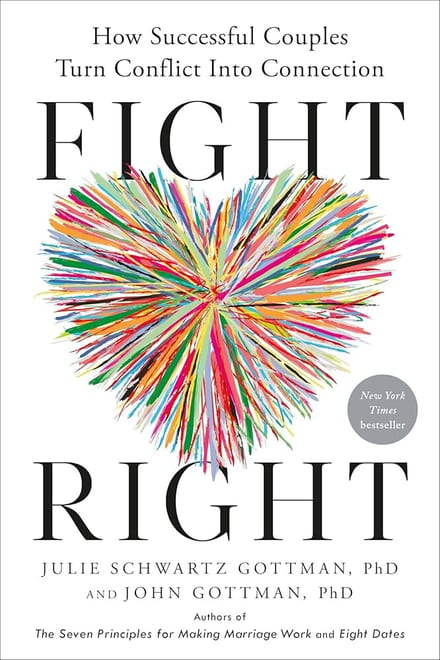
Fight Right
How Successful Couples Turn Conflict Into Connection
The key ideas
- Watch the first three minutes—soft starts save relationships.
- Kill the Four Horsemen: criticism, contempt, defensiveness, stonewalling.
- Accept that 69% of conflicts are perpetual, not solvable.
- Maintain five positive interactions for every negative one.
- Decode surface fights—they hide deeper values, needs, and dreams.
- Stop when flooded, validate before persuading, share power.
The summary
Couples don’t split because they fight. They split because of how the fight opens and whether anyone repairs the damage afterward. The Gottmans found that the first three minutes of an argument predict the state of the relationship six years later — the tone you set in those opening seconds tends to decide where the whole thing lands. And most of what you’re fighting about was never going to be solved anyway. Sixty-nine percent of a couple’s conflicts are perpetual, rooted in lasting differences of personality, values, or lifestyle. The task isn’t to win them or erase them. It’s to manage them with enough warmth that they don’t poison the bond.
The trouble is that a typical fight escalates fast into what the Gottmans call the Four Horsemen: criticism that attacks character, contempt that signals disgust, defensiveness that dodges responsibility, and stonewalling that shuts down and withdraws. Those four are what corrode a marriage. Anger itself is not the enemy — it signals a blocked goal and a wish to engage, and handled well it’s a road toward understanding. Conflict only turns toxic when the anger arrives dressed as one of the Horsemen. As the Gottmans put it, it isn’t whether you fight that makes or breaks you. It’s how.
You’re built to clash
Some of the friction is biological. Humans are often drawn to partners who are genetically different, particularly around the MHC genes that shape the immune system — one Swiss zoologist showed that “chemistry” is partly a real pull toward difference, a survival mechanism. So you and your partner are wired to diverge, in body and in temperament. Disagreement isn’t a sign the relationship is broken. It’s the baseline condition of two distinct people sharing a life.
There are three healthy ways to fight, and all of them work. Avoiders sidestep confrontation and lean on the positives. Validators argue politely and aim for compromise. Volatiles run hot — passionate debate, big emotion, plenty of humor. What separates any of these from a failing marriage isn’t the style but the ratio: happy, stable couples keep five positive interactions for every negative one during a fight. Hostile couples can look like validators or volatiles from the outside, but strip away the surface and there’s no positivity underneath, only the Horsemen. Friction also comes from clashing “meta-emotions” — feelings about feelings. A volatile who believes anger should be aired lands hard against an avoider who believes it should be swallowed, and the two only make peace once each sees where the other’s instinct came from, often a childhood fear of rage.
The blueberry bush isn’t about the blueberry bush
The number one thing couples fight about, the Gottmans say, is nothing — given the right conditions, almost anything will do. A spat over whether to plant a blueberry bush in a pot or in the ground turns out to be about money fear and whether the relationship is permanent. Surface arguments sit on top of unspoken values, unmet needs, and hidden dreams. When a perpetual problem keeps grinding painfully over the same ground, it hardens into gridlock, and gridlock always means a core value or an unrequited dream is buried in there somewhere.
You can’t fix gridlock by debating logistics. When Julie once snapped at John for asking whether she’d paid the plumber, John was baffled — until they slowed down and dug. “When I was a kid growing up,” she told him, “I’d come home and my mother would always have some criticism for me… When you came in just now, you sounded exactly like her.” Her real request was small and human: come in, kiss me, ask how my day was — then ask about the plumber.
Start soft, stay curious, share power
If you open a fight negatively, it’s nearly impossible to turn it around, so lead with your own experience instead of your partner’s flaws. Swap “You always…” for a clean formula: I feel [emotion] about [situation], and I need [positive need]. It isn’t your job to improve your partner — that’s their job. Yours is to be the best version of yourself, and kindness during conflict tends to draw cooperation back.
Most people rush to persuade. The best diplomats and the best couples hold off: the listener validates the speaker and shows real understanding before arguing their own side. Validation isn’t agreement — it’s granting that the other person’s view makes sense from where they stand. And when a heart rate climbs past 100 beats a minute, the body floods into fight-or-flight and loses the capacity to process or empathize; a flooded partner can only attack or withdraw. The move is to stop, name the physical signs — clenched jaw, racing pulse — and take at least twenty minutes to self-soothe, with an agreed time to return. In that state the goal shifts from resolving the issue to keeping the interaction positive.
Treating conflict as win-or-lose raises stress and, in men, mortality; if one partner wins and the other loses, both lose. Partners who accept influence hold more power — men who refuse to share it carry an 81 percent chance of divorce. To break a standoff, each names their non-negotiable core and where they can flex, which usually reveals more room to move than either expected. And regrettable incidents have to be processed, not buried, or they linger and warp memory: share the feelings, describe and validate each reality, name the old triggers, own your part, and plan to do better next time.
The bottom line
Conflict is connection — it’s how you learn who you are, what you want, and who your partner is becoming, and your worst fights can become your best chance at intimacy. Manage the perpetual problems warmly, start soft, repair fast, and leave room for two valid realities. Read this if you love someone and keep damaging the relationship every time you disagree.
Fact check
Popular books repeat findings that later research has complicated. Where Fight Right makes a testable claim, here's what the evidence actually shows.
How an argument opens — its first three minutes — predicts where the relationship stands six years later.
The study behind this is real: Carrère and Gottman coded 15-minute conflict discussions from 124 newlywed couples and found that the balance of positive and negative affect in the opening 3 minutes predicted marital outcome over 6 years, and for wives those first 3 minutes were as predictive as the full 15. What is shakier is the precision. The headline accuracy of Gottman's divorce-prediction models came from equations fitted and evaluated on the same couples; when Heyman and Smith Slep re-ran that kind of analysis with proper crossvalidation, accuracy and predictive value dropped precipitously. The direction of the finding holds up better than any specific hit rate attached to it.
Men who refuse to accept influence from their wives have an 81 percent chance of divorce.
The 81 percent traces to Gottman's newlywed lab research, whose prediction models were built and scored on the same sample rather than tested on fresh couples. Heyman and Smith Slep took that literature — naming Gottman, Coan, Carrère and Swanson's 1998 newlywed study — and showed that once such equations are crossvalidated, accuracy and positive predictive value fall sharply, in part because divorce is uncommon enough that a confident-looking model throws off many false alarms. Sharing power is a defensible thing to work on; the number is a within-sample fit statistic, not an individual man's odds.
Attraction is partly a biological pull toward genetic difference, especially at the MHC immune genes.
Wedekind's 1995 T-shirt experiment did find that women rated the body odour of MHC-dissimilar men as more pleasant, and that the preference reversed among women taking oral contraceptives — but it rested on students rating six shirts. Genetic tests of actual couples split: Chaix and colleagues found European American spouses were more MHC-dissimilar than random pairs (relatedness R = -0.043, p = 0.015) while African spouses showed no such pattern, and a later analysis of 872 European-ancestry spousal pairs from the Health and Retirement Study found no significant dissimilarity at SNPs, HLA alleles or amino acid polymorphisms. If the pull exists it is small and population-specific, not a settled human survival mechanism.
- Wedekind C, Seebeck T, Bettens F, Paepke AJ. MHC-dependent mate preferences in humans. Proc Biol Sci. 1995;260(1359):245-249. PubMed
- Chaix R, Cao C, Donnelly P. Is mate choice in humans MHC-dependent? PLoS Genet. 2008;4(9):e1000184. PubMed
- Qiao Z, Powell JE, Evans DM. MHC-dependent mate selection within 872 spousal pairs of European ancestry from the Health and Retirement Study. Genes (Basel). 2018;9(1):53. PubMed
Frequently asked questions
What is Fight Right about?
Couples don't split because they fight, but because of how the fight opens and whether anyone repairs the damage afterward. Since sixty-nine percent of a couple's conflicts are perpetual and were never going to be solved, the task isn't to win them but to manage them with enough warmth that they don't poison the bond.
What are the key takeaways from Fight Right?
The first three minutes of an argument predict the relationship six years later. Watch for the Four Horsemen: criticism, contempt, defensiveness, and stonewalling, and keep five positive interactions for every negative one. Surface fights (the blueberry bush) usually hide deeper values, needs, or dreams. Start soft with "I feel [emotion] about [situation], and I need [positive need]", validate before you persuade, and when a heart rate passes 100 beats a minute you're flooded, so stop and take at least twenty minutes to self-soothe. Partners who accept influence hold more power.
Who should read Fight Right?
Read it if you love someone and keep damaging the relationship every time you disagree.
Is Fight Right worth reading?
It's grounded in the Gottmans' research and full of concrete moves you can use in the middle of an argument, like the soft start-up and the twenty-minute break. Some of it echoes their earlier work, but the repair tools are specific enough to actually change how a fight goes.