Book summary
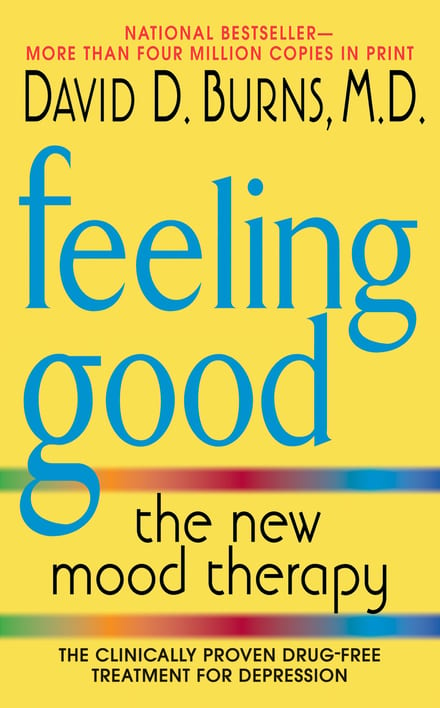
Feeling Good: The New Mood Therapy
The full book runs ~416 pages — roughly 8 hours of reading. You get the key ideas here in 4 minutes.
The key ideas
- Recognize ten cognitive distortions that manufacture depression
- Write down negative thoughts, name the error, answer with evidence
- Remember feelings are not facts or proof of truth
- Act first; motivation follows action, not the reverse
- Ground self-worth internally, not in approval or achievement
- Strive for good, not perfect, and embrace being human
The summary
You feel depressed because of what you think, not because of what happened to you. That claim sits at the heart of cognitive therapy, and it flips two thousand years of common sense on its head. As Epictetus said, people are disturbed “not by things, but by the views we take of them.” When you feel terrible, you assume the world is terrible — but David Burns shows that your internal monologue is running predictable errors, and those errors, not your circumstances, generate the despair. Write the thought down, name the mistake, answer it, and the emotion loses its footing.
Ten distortions that bend reality
Depression runs on ten recurring distortions. All-or-nothing thinking forces experience into black-and-white boxes: you didn’t get straight As, so you’re a total failure. Overgeneralization stretches one bad event into a permanent rule — she said no, so no one will ever want you. Mental filter fixes on a single negative detail until it darkens everything, so one overheard insult proves the whole human race is cruel. Disqualifying the positive turns compliments into nothing: they were only being nice.
Jumping to conclusions splits in two — mind reading (he didn’t say hi, he must hate me) and the fortune-teller error (therapy won’t work, I’ll be miserable forever). Magnification and minimization inflate your mistakes while shrinking your wins. Emotional reasoning treats feelings as proof: I feel guilty, so I must have done something bad; I feel inadequate, so I must be worthless. Should statements bind you to rigid rules that breed pressure and resentment when reality won’t comply. Labeling collapses your entire self into one word — “I am a loser” — ignoring how complicated a human being actually is. And personalization loads you with blame for events you didn’t cause.
Rewriting the script
The engine underneath all ten is simple: your thoughts create your emotions, so your emotions can’t prove your thoughts are true. Feelings are not facts. Burns turns that insight into a mechanical exercise. Write down the automatic negative thought — “I never do anything right.” Identify the distortion driving it — overgeneralization. Then answer it with evidence — “Nonsense, I do plenty of things right.” Naming the error strips away its authority. You’re not arguing with the world; you’re correcting a glitch in your own thinking, on paper, where you can see it — a disciplined self-examination that echoes the Japanese practice of naikan.
Procrastination follows the same logic. You put things off because hopelessness, fear of failure, or a discounted reward has already drained your motivation. The usual advice — wait until you feel like it — has the sequence backward. Motivation doesn’t come first; action does. You have to prime the pump, so schedule small tasks, start before you feel ready, and let the momentum build.
Anger, guilt, and the approval trap
Anger usually springs from irrational beliefs — inflated expectations, overgeneralization, and the habit of confusing your personal wants with universal moral law. Much everyday anger comes from exactly that confusion. Guilt inflates both your responsibility and the size of your mistake; you can deflate it by generating alternative explanations, forgiving yourself, and shifting from rumination to problem-solving. And keep the categories straight: sadness is a passing response to a real loss, while depression is pervasive hopelessness fed by distortion.
The hunger for other people’s approval fuels anxiety because it rests on a false premise — that your worth depends on outside validation. It doesn’t. As Burns puts it, ultimately you, and only you, can make yourself consistently happy. The same holds for love: needing constant romantic validation creates dependency and turmoil. A healthy relationship asks you to arrive already whole.
Work, worth, and being average
Tying your value to professional achievement is another trap. Perfectionism and relentless ambition lead straight to burnout and shrinking self-esteem. Achievements can bring satisfaction, but not happiness — you can check every box and still feel empty if your thinking stays distorted. Burns suggests you embrace being average: identify the unrealistic demands you’ve internalized, accept that flaws confirm you’re human rather than diminish you, and aim for good instead of perfect. The pressure drops and the mood lifts.
On the biology, he’s measured. Some scientists trace clinical depression to a chemical imbalance, pointing to physical symptoms and family patterns, but the evidence is inconclusive. What’s clear is that thoughts and body affect each other in both directions, so address both. Combining medication with therapy is reasonable, but aim for full recovery rather than partial relief, and weigh the trade-offs of long-term drug use.
The bottom line
Your thoughts create your emotions, and depressed thinking runs on ten identifiable errors — so write the thought down, name the distortion, and answer it with evidence until the feeling loses its grip. Read this if you’re depressed, prone to guilt or perfectionism, or tired of waiting for a motivation that never shows up on its own.
Fact check
Popular books repeat findings that later research has complicated. Where Feeling Good makes a testable claim, here's what the evidence actually shows.
Cognitive therapy relieves depression about as well as antidepressant medication.
A network meta-analysis of 101 randomised trials covering 11,910 patients found no difference between psychotherapy alone and medication alone in response rate (RR 0.99, 95% CI 0.92-1.08). Patients were also more likely to stay in psychotherapy than on drugs. The one qualification the book understates is that combining the two beat either on its own — RR 1.27 against psychotherapy alone and 1.25 against medication alone.
- Cuijpers P, Noma H, Karyotaki E, Vinkers CH, Cipriani A, Furukawa TA. A network meta-analysis of the effects of psychotherapies, pharmacotherapies and their combination in the treatment of adult depression. World Psychiatry. 2020;19(1):92-107. PubMed
Working through the book's exercises on your own, without a therapist, measurably reduces depression.
Trials using this specific book do show a benefit. In a randomised study of 31 depressed adults aged 60 and over, those given the book beat a delayed-treatment control, kept improving after the reading period ended, and had caught up with 16 sessions of individual cognitive therapy by three-month follow-up — though the therapy group was ahead immediately after treatment. A meta-analysis of self-help for anxiety and depressive disorders put bibliotherapy at an effect size of 0.84 against waiting-list controls and -0.03 against therapist-delivered treatment. The samples are small and the comparison is usually a waiting list rather than an active treatment, so this supports self-help as a real option, not as an equal substitute for care in severe depression.
- Floyd M, Scogin F, McKendree-Smith NL, Floyd DL, Rokke PD. Cognitive therapy for depression: a comparison of individual psychotherapy and bibliotherapy for depressed older adults. Behav Modif. 2004;28(2):297-318. PubMed
- den Boer PCAM, Wiersma D, Van den Bosch RJ. Why is self-help neglected in the treatment of emotional disorders? A meta-analysis. Psychol Med. 2004;34(6):959-971. PubMed
The evidence that clinical depression is caused by a chemical imbalance in the brain is inconclusive.
Burns's caution has aged better than the popular version of the story he was hedging against. A 2022 umbrella review pulled together the main strands of serotonin research — serotonin and metabolite concentrations, receptor and transporter imaging, tryptophan depletion, and genetic association studies — and found no consistent evidence linking serotonin to depression, and no support for depression being caused by lowered serotonin activity. That is a verdict on one specific mechanism, not on biology generally or on whether antidepressants help.
- Moncrieff J, Cooper RE, Stockmann T, Amendola S, Hengartner MP, Horowitz MA. The serotonin theory of depression: a systematic umbrella review of the evidence. Mol Psychiatry. 2023;28(8):3243-3256. PubMed
Motivation follows action rather than preceding it, so starting the task is what gets you moving.
Behavioural activation — scheduling and doing the activity before you feel like it — performs as well as full cognitive therapy. In the 440-patient COBRA non-inferiority trial, patients randomised to behavioural activation and to CBT both averaged 8.4 on the PHQ-9 at 12 months, a difference of 0.1 points (95% CI -1.3 to 1.5), and behavioural activation cost less to deliver because it can be given by staff without specialist therapy training. What the trials establish is that acting first works; the tidier statement that motivation arrives afterwards describes how it feels rather than a mechanism that was measured.
- Richards DA, Ekers D, McMillan D, et al. Cost and Outcome of Behavioural Activation versus Cognitive Behavioural Therapy for Depression (COBRA): a randomised, controlled, non-inferiority trial. Lancet. 2016;388(10047):871-880. PubMed
Frequently asked questions
What is Feeling Good about?
You feel depressed because of what you think, not because of what happened to you. Cognitive therapy's claim is that your internal monologue runs predictable errors, and those errors, not your circumstances, generate the despair, so writing a thought down, naming the mistake, and answering it takes away its power.
What are the key takeaways from Feeling Good?
Depression runs on ten distortions: all-or-nothing thinking, overgeneralization, mental filter, disqualifying the positive, jumping to conclusions (mind reading and fortune-telling), magnification and minimization, emotional reasoning, should statements, labeling, and personalization. Feelings are not facts. The core exercise is mechanical: write the automatic negative thought, name the distortion, then answer it with evidence. Beat procrastination by acting first, since motivation follows action, and drop perfectionism by aiming for good instead of perfect.
Who should read Feeling Good?
Read it if you're depressed, prone to guilt or perfectionism, or tired of waiting for a motivation that never shows up on its own.
Is Feeling Good worth reading?
It's a practical, well-structured toolkit whose write-it-down method has held up for decades and is genuinely usable on your own. The writing can feel dated and formulaic, and severe depression may need more than a book, but the technique at its center is concrete and effective.