Book summary
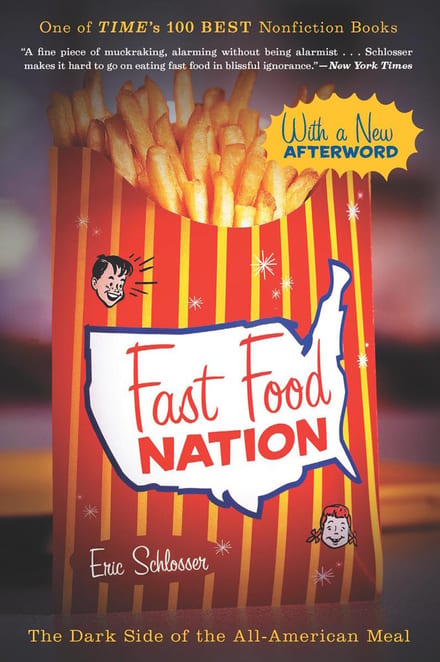
Fast Food Nation: The Dark Side of the All-American Meal
The full book runs ~385 pages — roughly 7 hours of reading. You get the key ideas here in 4 minutes.
The key ideas
- Assembly-line kitchens deskill jobs to justify minimum wages
- Franchisees absorb the risk while corporations stay protected
- Lab-made 'natural flavors' replace real taste in processed food
- Slaughterhouses maim desperate workers in America's most dangerous jobs
- Centralized meat production spreads one tainted batch nationwide
- Exported fast food reshapes local farms and fuels obesity
The summary
A burger and fries costs a few dollars at the counter, but the price on the menu isn’t the real price. Eric Schlosser’s argument is that fast food’s speed and cheapness are subsidized by everyone the system touches — the teenager on minimum wage, the slaughterhouse worker who loses a finger, the farmer locked into a lopsided contract, and the customer eating from a supply chain where one contaminated batch can reach millions. The convenience is genuine. So is the bill, and most of it comes due somewhere you can’t see from the drive-thru window.
A kitchen run like a factory
In the 1940s the McDonald brothers rebuilt the restaurant on factory principles. They cut the menu to a few items you could eat without cutlery, gave each worker one repetitive task on an assembly line, and wrapped it all in disposable paper. Speed and consistency followed, and every other chain copied the design. The hidden payoff was labor: when a job can be learned in minutes, workers become interchangeable, which is exactly what lets these companies pay the lowest wages in the country and shrug off turnover that would sink another business. The industry leans on the most vulnerable people it can find — teenagers after a first paycheck, immigrants with few options — and a larger share of its workers earn minimum wage than in any other American industry. Training is thin, the work is numbing, and robberies are common, many of them committed by current or former employees. Corporations keep building machines to deskill the work further and fight unions at every turn.
The franchise model extends the same trick to the people who run the stores. It’s sold as independence with a safety net, but franchisees put up hundreds of thousands of dollars, operate under rigid corporate rules, and carry most of the risk. If a location fails they lose everything, while the corporation — better protected legally — walks away. Fast food franchises go bankrupt more often than independent businesses, yet the marketing keeps drawing hopeful owners in.
Engineered to hook kids
Fast food advertising aims squarely at children and teenagers, who are impressionable and can nag their parents into a purchase. Chains build playgrounds and tuck free toys into meals, and it works: ninety percent of American kids between three and nine visit McDonald’s every month. The reach extends into schools through contracts with soda and fast food companies, corporate-sponsored teaching materials, even sponsored textbooks — one study guide funded by the American Coal Foundation told students that carbon dioxide is good for the planet. Reaching children early builds a customer for life.
Flavor made in a lab
Most of what you taste in fast food isn’t the food. Artificial flavorings drive the choices, from the char-grilled smell of a burger to the sweetness of a strawberry shake, and they’re mixed in labs from chemicals that often double as industrial ingredients. The label may read “natural flavor,” but that distinction is about how the compound was derived, not what’s in it — a natural and an artificial flavor can be molecularly identical and come out of the same facility, so “natural” doesn’t mean healthier. This matters because processed foods, which make up ninety percent of American food spending, lose their taste during production and need these additives to taste like anything at all. The effect is a flattening of food culture, where quality stops mattering because flavor arrives in a vial.
Who really pays: farmers and slaughterhouse workers
The industry’s hunger for cheap, uniform ingredients has handed near-monopolies to a few giant suppliers in potatoes, poultry, and beef. Farmers sign contracts with almost no bargaining power, earn thin margins, and often go under — and when they do, the same companies that squeezed them buy up the land. The meatpacking plants are grimmer still. After breaking the unions, companies moved to small towns and hired undocumented immigrants, refugees, and the homeless. Slaughterhouse work is the most dangerous job in America, with an injury rate three times that of a normal factory: the cattle vary in size, the tools are dangerous, the training is minimal, and the line never slows. Some workers take drugs just to keep up, which makes them less careful still. When they’re hurt, the industry pressures them not to report it or to come back before they’ve healed, and pays out as little as $2,200 to $4,500 for a lost finger. Health insurance and paid holidays are dodged by keeping workers from staying long enough to qualify.
That same centralization turns a local failure into a national one. When beef is contaminated with cattle feces — routine given the pace and the conditions — it gets ground together with tons of other meat and shipped everywhere, so one bad batch reaches millions. E. coli spreads this way, and roughly 200,000 Americans get food poisoning every single day.
Exporting the all-American meal
Fast food is usually the first American industry into a newly opened market, and it brings more than burgers. Before opening in India, McDonald’s trained local farmers to grow lettuce and handed them seeds bred for the climate — reshaping a local food system to feed a foreign supply chain. The health effects travel with it. As the number of fast food outlets in Britain doubled between 1973 and 1993, so did the adult obesity rate, with heart disease and diabetes rising alongside.
The bottom line
Fast food is cheap at the register only because its true costs are pushed onto workers, farmers, and public health, in a system built to resist change. Read this if you want to know what you’re actually buying when you pull up to the window.
Fact check
Popular books repeat findings that later research has complicated. Where Fast Food Nation makes a testable claim, here's what the evidence actually shows.
Roughly 200,000 Americans get food poisoning every single day.
The number matched the official estimate current when the book was written: CDC researchers put foodborne illness at about 76 million cases a year, which works out to roughly 208,000 a day. CDC's 2011 rebuild of that estimate came out lower — 9.4 million illnesses a year from 31 known pathogens plus 38.4 million from unspecified agents, about 131,000 a day. The authors caution the two sets of figures are not directly comparable because the methods differ, so this is a revised estimate rather than a measured decline. Worth noting for the book's argument: norovirus, not beef, accounts for 58% of illness from the known pathogens.
- Mead PS, Slutsker L, Dietz V, et al. Food-related illness and death in the United States. Emerg Infect Dis. 1999;5(5):607-625. PubMed
- Scallan E, Hoekstra RM, Angulo FJ, et al. Foodborne illness acquired in the United States--major pathogens. Emerg Infect Dis. 2011;17(1):7-15. PubMed
- Scallan E, Griffin PM, Angulo FJ, Tauxe RV, Hoekstra RM. Foodborne illness acquired in the United States--unspecified agents. Emerg Infect Dis. 2011;17(1):16-22. PubMed
Slaughterhouse work is the most dangerous job in America, with an injury rate three times that of a normal factory.
Meatpacking remains, in the GAO's words, one of the most dangerous industries in the United States, but the three-times gap has closed since the book was reported. GAO found recorded injuries and illnesses in meat and poultry slaughtering and processing fell from 9.8 cases per 100 full-time workers in 2004 to 5.7 in 2013 — still above manufacturing generally, well short of triple. The official rate is probably an undercount: GAO found workers underreport for fear of losing their jobs, employers underreport over cost, and federal data misses musculoskeletal cases that end in restricted duty rather than time off.
- US Government Accountability Office. Workplace Safety and Health: Additional Data Needed to Address Continued Hazards in the Meat and Poultry Industry. GAO-16-337. Washington, DC: US Government Accountability Office; 2016. Source
- US Government Accountability Office. Workplace Safety and Health: Safety in the Meat and Poultry Industry, While Improving, Could Be Further Strengthened. GAO-05-96. Washington, DC: US Government Accountability Office; 2005. Source
As the number of fast food outlets in Britain doubled between 1973 and 1993, so did the adult obesity rate.
The obesity half is right — Prentice and Jebb reported that clinical obesity in Britain doubled over the decade to 1995. The pairing implies more than the data can carry, though: over the same stretch average recorded energy intake in Britain fell substantially, which led those authors to conclude that declining physical activity was at least as important as diet, and possibly the dominant factor. Fast food does have a measurable effect, but a local and modest one: a study of about 3 million schoolchildren found a fast food outlet within a tenth of a mile of a school raised ninth-grade obesity by at least 5.2%, with no effect at greater distances.
Frequently asked questions
What is Fast Food Nation about?
The few dollars you pay for a burger and fries isn't the real price. Fast food's speed and cheapness are subsidized by everyone the system touches, from minimum-wage teenagers to injured slaughterhouse workers to farmers locked into lopsided contracts, and most of that bill comes due somewhere you can't see from the drive-thru.
What are the key takeaways from Fast Food Nation?
The McDonald brothers rebuilt the restaurant on factory principles, deskilling the work so labor stays cheap and interchangeable. Advertising aims squarely at children, and ninety percent of American kids between three and nine visit McDonald's every month. Most of what you taste is manufactured in labs, where "natural" flavor doesn't mean healthier. The real cost falls on contract farmers and slaughterhouse workers, whose job is the most dangerous in America, and centralization means one contaminated batch can reach millions.
Who should read Fast Food Nation?
Read it if you want to know what you're actually buying when you pull up to the window.
Is Fast Food Nation worth reading?
It's a rigorous, unsettling investigation that connects a cheap meal to labor, farming, and food safety in a way that's hard to shake. It's now decades old, so some specifics have shifted, but the systemic argument and the reporting still hold up.