Book summary
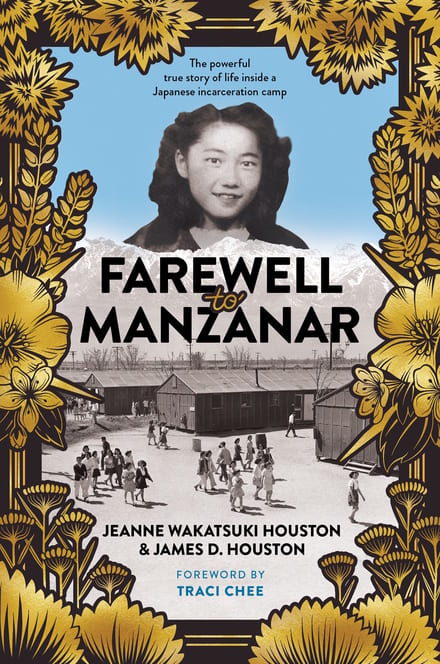
Farewell to Manzanar: A True Story of Japanese American Experience During and After the World War II Incarceration
A True Story of Japanese American Experience During and After the World War II Incarceration
The full book runs ~208 pages — roughly 4 hours of reading. You get the key ideas here in 5 minutes.
The key ideas
- Broke open when a nephew asked how she actually felt
- Started as tape recordings meant only for family children
- Separates the words: her father interned, her family incarcerated
- Tracks a father who came back from Bismarck bitter and drinking
- Shows the mess hall dissolving the family dinner, then the family
- Published in 1973, fifteen years before redress and an apology
The summary
Jeanne Wakatsuki Houston went almost twenty-five years without saying the word camp out loud — not to her husband of fifteen years, not even to the girls who had been behind the wire with her. She describes running into one of them, Akiko Shigetomi, in Long Beach after the war, and the two of them being too embarrassed to mention it. “We never mentioned camp,” she told a Japanese American National Museum interviewer in 2005. That silence, not the barracks, is what this memoir is about.
The question she could not answer
The book exists because of one question. Around 1971 her nephew Gary — born inside Manzanar, unable to get his own parents to discuss it — came to see her after a Berkeley sociology class mentioned the camp’s name. She gave him the family version: bad mess-hall food, the windstorms, we played baseball. “I just made it look like it was really some recreational camp,” she said. Then he pushed back. You’re talking about a prison like it was nothing — how did you feel about it?
“And for one moment, I allowed myself to feel,” she recalled. “No one ever asked me how I felt about that incident. And I just broke into tears and I just became hysterical.” She thought she was having a nervous breakdown.
She started talking into a tape recorder, meaning it only for the family’s nieces and nephews — seven of whom had been born in camp and knew nothing about it. Her husband, the novelist James D. Houston, heard the real story for the first time and told her it wasn’t a keepsake. Houghton Mifflin published it in 1973.
Two words for the same barbed wire
Which word you use for Manzanar is itself an open argument. Densho, the leading archive of this history, holds that “internment” is a legal term for detaining enemy aliens in wartime and becomes a euphemism when applied to citizens jailed by their own government — two-thirds of those held were US citizens by birth. Densho prefers “concentration camp.” The 50th-anniversary edition’s cover copy says “incarceration camp,” where the original 1973 subtitle said “Internment.”
The Wakatsukis are the rare family in which both words are literally accurate. Jeanne’s father, an Issei immigrant barred by race from ever becoming a citizen, was arrested as an enemy alien and held in a Department of Justice camp — internment in the strict sense. His wife and children were removed under Executive Order 9066, signed 19 February 1942, and held by the War Relocation Authority at Manzanar: 3,900 feet up in the Owens Valley, 10,046 people at its peak on 22 September 1942, closed on 21 November 1945. Nationally, the Park Service says over 110,000 people were ordered from their homes; Densho cites the WRA’s tally of 120,313.
What the camp did to Papa
Ko Wakatsuki was a commercial fisherman, accused of supplying oil to the Japanese. An FBI sweep took him to Fort Lincoln, the Justice Department camp outside Bismarck, North Dakota, where more than 1,100 Issei community leaders — Buddhist priests, language-school teachers, newspaper editors, heads of immigrant business and cultural organisations — arrived in February 1942. The hearings there went badly enough that an internal immigration-service inquiry found Issei had been unjustly abused.
Jeanne was seven. Her father, she said, was the powerful centre of a tight family of ten children, a proud man who spoke English with a British accent picked up studying in Japan — “you felt safe with him and then suddenly he’s gone.” He was gone about a year before rejoining them inside Manzanar, and the man who came back was not the same one. In her words: “it wasn’t an issue until after he came back from Bismarck and after Manzanar and you know, he began drinking and, oh, it was like total change. And he never spoke to a Caucasian after that. He was quite bitter. Quite bitter.”
That is the book’s real subject. Her own verdict: “He didn’t die there, but things finished for [my father] there, whereas for me it was like a birthplace. The camp was where our life lines intersected.”
The damage outlasted the camp
Houston is unusually good on the small mechanics of how confinement takes a family apart — a mess hall replacing the family dinner, until the household stops assembling at all. The camp’s wider history runs underneath without taking over: the December 1942 uprising, when military police fired into a crowd and killed 17-year-old James Ito and, days later, 21-year-old Jim Kanagawa; the 1943 loyalty questionnaire, whose Question 28 asked Issei to forswear allegiance to the Emperor when American law already barred them from any other citizenship.
The frame stays at child height. After release the family lived in a Long Beach housing project, her mother in a cannery, her father never re-establishing himself. Jeanne spent her school years working to be accepted and to put the whole thing behind her; it took three decades to find out she hadn’t.
She resisted calling it a camp story: “This is a human story.” She was right about why it travels: kids call her up and write to her about their fathers being alcoholics. Official acknowledgement came much later: a congressional commission blamed “race prejudice, war hysteria, and a failure of political leadership,” and Reagan signed the Civil Liberties Act in August 1988, granting $20,000 and an apology to each survivor. The book came fifteen years earlier, when Kirkus could report a friend calling the subject “a dead issue.”
The bottom line
The camp lasted three years for the Wakatsukis; the silence afterwards lasted almost twenty-five, and the silence is what Houston set out to write about. It’s the story of a father broken over a Dakota winter and a daughter who needed most of her life to notice.
Read it for American incarceration at human scale, or alongside Anne Frank’s diary, which it has long been compared to. Short, unsentimental, and much harder than its reading level suggests.
Fact check
Popular books repeat findings that later research has complicated. Where Farewell to Manzanar makes a testable claim, here's what the evidence actually shows.
"Internment" — the word in the book's original 1973 subtitle — accurately describes what was done to Japanese Americans in the wartime camps.
The word has a narrow legal meaning. The JACL's Power of Words handbook defines internment as "the confinement or impounding of enemy aliens in a time of war", which fits Jeanne's Issei father — one of a few thousand mostly Issei men held in the separate Army and Justice Department camps — but not his wife and children. Of the roughly 110,000 people forced from their homes under Executive Order 9066, nearly 70% were American citizens, and of those held in the War Relocation Authority camps the handbook concludes they "were American citizens and not enemy aliens; thus the term 'internee' does not apply." Its recommendation is incarceration for the WRA camps, the word the Park Service also uses for Manzanar.
- National JACL Power of Words II Committee. Power of Words Handbook: A Guide to Language about Japanese Americans in World War II. Revised August 2020 (V.4), pp. 4-5 and 10. Source
- National Park Service. Manzanar National Historic Site. U.S. Department of the Interior. Accessed August 17, 2026. Source
In December 1942 the soldiers guarding Manzanar fired into a crowd of the people they were confining, killing two of them.
The Park Service's own Manzanar timeline dates it to December 6, 1942: military police fired into a crowd at the camp police station that was demanding the release of Harry Ueno, arrested for allegedly assaulting Fred Tayama. Seventeen-year-old James Ito and 21-year-old Jim Kanegawa were killed and nine others injured; Kanegawa died of his wounds several days after the shooting. A military investigation in January 1943 cleared the two privates who had fired on their own initiative, finding them justified "because members of the mob were closing in and surging towards them."
The United States eventually acknowledged that the incarceration was driven by racism rather than military necessity, and paid reparations to survivors.
The Commission on Wartime Relocation and Internment of Civilians reported in the early 1980s that Executive Order 9066 "was not justified by military necessity" and that "the broad historical causes which shaped these decisions were race prejudice, war hysteria and a failure of political leadership." Congress then put that finding into statute. The Civil Liberties Act of 1988 (Public Law 100-383, signed August 10, 1988) records that the removal and detention were carried out "without any acts of espionage or sabotage documented by the Commission, and were motivated largely by racial prejudice, wartime hysteria, and a failure of political leadership", and directs payment of $20,000 to each eligible surviving individual.
- Commission on Wartime Relocation and Internment of Civilians. Personal Justice Denied: Summary. National Archives and Records Administration. Source
- Civil Liberties Act of 1988, Pub. L. 100-383, 102 Stat. 903; codified at 50 U.S.C. Sec. 4202 (statement of the Congress). Legal Information Institute, Cornell Law School. Source
- Civil Liberties Act of 1988, Pub. L. 100-383; codified at 50 U.S.C. Sec. 4215 (restitution). Legal Information Institute, Cornell Law School. Source
Frequently asked questions
What is Farewell to Manzanar about?
Jeanne Wakatsuki Houston was seven when her family was removed under Executive Order 9066 and held at Manzanar, and she went almost twenty-five years without saying the word camp out loud — not to her husband, not to the girls who had been behind the wire with her. The memoir is about that silence as much as the barracks. Its real subject is what the incarceration did to her father, and how long it took her to notice what it had done to her.
What are the key takeaways from Farewell to Manzanar?
The book exists because of one question: around 1971 her nephew Gary, born inside the camp, pushed back on the cheerful family version and asked how she actually felt, and she broke down. She started talking into a tape recorder for the family's nieces and nephews; her husband, the novelist James D. Houston, heard the story for the first time and told her it wasn't a keepsake. The Wakatsukis are the rare family where both contested words apply — her father, an Issei barred by race from citizenship, was arrested as an enemy alien and held at Fort Lincoln in North Dakota, while his wife and children were incarcerated by the War Relocation Authority. He returned about a year later a different man: drinking, bitter, never speaking to a Caucasian again. Houston is unusually good on the small mechanics of that damage, like a mess hall replacing the family dinner until the household stops assembling at all.
Who should read Farewell to Manzanar?
Read it for American incarceration at human scale, told at child height rather than as policy history. Houston resisted calling it a camp story — "this is a human story" — and she was right about why it travels: readers write to her about their own fathers.
Is Farewell to Manzanar worth reading?
It is short, unsentimental, and much harder than its reading level suggests, which is why it works both as a classroom text and as an adult read. The camp's wider history — the December 1942 uprising, the 1943 loyalty questionnaire — runs underneath without taking over, so readers wanting a full institutional account of the incarceration will need something else alongside it. It arrived in 1973, fifteen years before the Civil Liberties Act, when a friend could still call the subject a dead issue.