Book summary
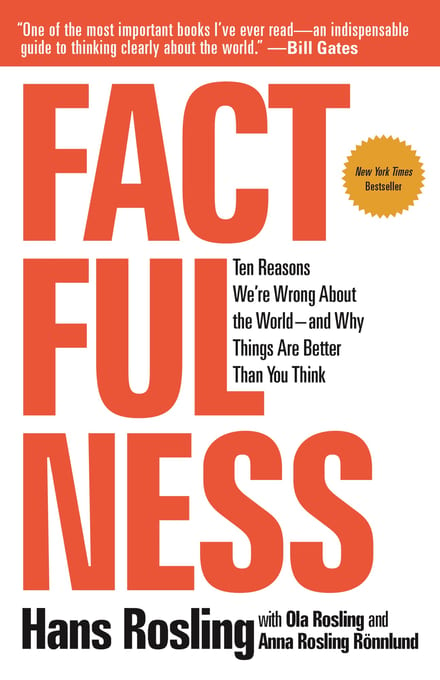
Factfulness: Ten Reasons We're Wrong About the World
The full book runs ~352 pages — roughly 6 hours of reading. You get the key ideas here in 3 minutes.
The key ideas
- Reject the gap myth—most people live in the middle.
- Notice slow progress that bad news never reports.
- Expect trends to bend, not continue straight forever.
- Check fear, scale, and urgency before judging any risk.
- Blame broken systems, not individuals, for hard problems.
- Distrust single explanations—most problems have many causes.
The summary
The world has improved enormously, and hardly anyone believes it. In 1800, about 85% of humanity lived in extreme poverty; today it’s around 9%. Child mortality has collapsed—in 1965, 125 nations had rates above 5%, and now only 13 do. Yet when Americans were asked whether extreme poverty had been halved over the previous twenty years, only 5% got it right. The Roslings’ point is not that we’re gloomy by temperament but that we’re systematically, measurably wrong about the basic facts. And the reason isn’t a lack of information. It’s ten overdramatic instincts, hardwired into how we think, that bend the data into a story of decline no matter what the numbers say.
The gap that isn’t there
The first culprit is the Gap Instinct, our habit of splitting the world into two opposed camps with a void between them: rich and poor, West and East, developed and developing. That framing made sense decades ago, but the Roslings show the categories have dissolved. They sort people instead into four income levels—Level 1 under $2 a day, Level 2 from $2 to $8, Level 3 from $8 to $32, and Level 4 above $32—and the great majority of countries now sit in the middle, at Level 2 or 3. We badly underestimate how far lower-income countries have come. The old “East versus West” story insists those societies are fundamentally different because of birth rates or religion, when in fact they’ve modernized fast. So whenever you hear a sweeping claim about “us” and “them,” look for the middle and ask whether there’s really a gap at all.
Bad news drowns out slow progress
The Negativity Instinct keeps our attention fixed on what’s going wrong, and the media happily feeds it, because disasters get reported while steady improvement never does. The improvements are real and large: 60% of girls in low-income nations now finish public school, 80% of the world’s one-year-olds are vaccinated, and deaths from natural disasters have fallen to a quarter of what they were a century ago as building materials improved. Accepting this doesn’t require pretending the world is finished or that problems don’t exist—the Roslings want you to hold progress and problems in the same hand. Their check is a simple question: if things quietly got better, would it ever make the news?
Closely related is the Straight-Line Instinct, the assumption that a current trend will run on forever in a straight line. The classic case is panic over population. Growth is real, but it isn’t linear: as poverty falls, birth rates fall with it, and the Roslings expect the population to peak around 11 billion and level off. Most real trends are curves, so when you see a line shooting up, ask why it wouldn’t bend.
Fear, size, and urgency distort risk
Three instincts warp how you judge danger and importance. The Fear Instinct makes vivid threats feel more likely than they are; it kept our ancestors alive but misfires in a far safer world, leaving us frightened of the wrong things. The antidote is to weigh risk with facts and avoid deciding anything while afraid. The Size Instinct makes a lone number look alarming until you give it context—four million infant deaths in a year sounds like a catastrophe until you learn that 14.4 million infants died in 1950, at which point it reads as remarkable progress. Always compare before you react. The Urgency Instinct pushes you toward rash decisions under pressure, and it tempts campaigners to exaggerate to force action. That may work for a moment, but overstatement destroys your credibility over time. Better to take small steps and adjust as you learn.
We lump people together and hunt for one villain
The last cluster of instincts distorts how we explain the world. The Generalization Instinct leads people in rich countries to treat all lower-income nations as a single mass of poverty, when reality is far more varied; travel and multiple perspectives help, and so does simply interrogating your own categories. The Destiny Instinct convinces us some cultures or regions are permanently stuck—that Africa can’t prosper because of religion or tradition—when the data shows steady change; the fix is to notice how slowly, but surely, things shift. The Blame Instinct makes us pin problems on a single salient person: blaming a pharmaceutical CEO ignores the board and shareholders behind the decisions, and blaming smugglers for refugee deaths ignores the strict European laws that push desperate people onto dangerous routes. Ask what system made the outcome possible. And the Single Perspective Instinct makes us crave one cause and one cure because simplicity is comfortable, even though most hard problems have many causes; stay skeptical of anyone selling a single tool for everything.
The bottom line
The world is in far better shape than you assume, but ten mental reflexes—imagining gaps, dwelling on bad news, extending straight lines, and fearing the wrong risks among them—keep you from seeing it. Reaching for the data over the instinct is a skill you can practice. Read this if you make decisions based on how you think the world works, because you’re almost certainly running on an outdated map.
Fact check
Popular books repeat findings that later research has complicated. Where Factfulness makes a testable claim, here's what the evidence actually shows.
Extreme poverty has fallen from about 85% of humanity in 1800 to roughly 9% today.
The World Bank now counts about 831 million people in extreme poverty, down from around 2.3 billion in 1990 — close to one person in ten today, against roughly two in five back then. Both endpoints are softer than a single figure implies: reconstructions of the early 1800s put the share at about 75% under a cost-of-basic-needs method and higher when modern dollar-a-day lines are projected backwards, and the World Bank has since moved its line from $1.90 (2011 PPP) to $3.00 (2021 PPP), which lifts the current rate to roughly 10%. The size and direction of the fall survive every one of those methodological choices.
World population will peak at around 11 billion and then level off.
The levelling off is right; the number has moved down. The UN projection available when the book was written, the 2017 revision, gave 9.8 billion in 2050 and 11.2 billion in 2100 with growth still continuing. The 2024 revision expects a peak near 10.3 billion in the mid-2080s followed by decline — about a billion lower and roughly two decades earlier, because fertility has fallen faster than forecast in several large countries. The book's actual argument, that the growth line bends rather than running straight, has been strengthened rather than weakened by the revision.
- United Nations Department of Economic and Social Affairs. World population projected to reach 9.8 billion in 2050, and 11.2 billion in 2100. World Population Prospects: the 2017 revision. Accessed July 30, 2026. Source
- United Nations. Global issues: population. World Population Prospects 2024. Accessed July 30, 2026. Source
Deaths from natural disasters have fallen to about a quarter of their level a century ago.
The decline is bigger than the summary's version of it. Disaster death rates have dropped by more than 90% over the past century: years with over a million deaths were not unusual in the early 1900s, while the last decade has averaged roughly 10,000 to 20,000 deaths a year. The one caveat runs in the book's favour — EM-DAT's early records captured mainly large, well-documented events and missed the small and medium ones that would be logged today, so the historical baseline is understated. Better warning systems, construction and coordinated response explain the change, not milder hazards.
- Our World in Data. Natural disasters. Global Change Data Lab and University of Oxford, using EM-DAT (Centre for Research on the Epidemiology of Disasters). Accessed July 30, 2026. Source
Frequently asked questions
What is Factfulness about?
The world has improved enormously and hardly anyone believes it, and the reason isn't a lack of information. The book names ten overdramatic instincts, hardwired into how we think, that bend the data into a story of decline, and shows how reaching for the facts corrects the picture.
What are the key takeaways from Factfulness?
Ten instincts to catch and correct: the Gap Instinct (look for the middle and think in four income levels, not rich versus poor), Negativity (bad news drowns out slow progress), the Straight-Line Instinct (trends curve, and population likely peaks around 11 billion), Fear, Size (always give a lone number context), Urgency, Generalization, Destiny, Blame (ask what system made the outcome possible), and Single Perspective. The remedy is a practiced skill: reach for the data over the instinct.
Who should read Factfulness?
Read it if you make decisions based on how you think the world works, because you're almost certainly running on an outdated map.
Is Factfulness worth reading?
It's data-rich, genuinely hopeful, and useful for calibrating how you read the news, with the four income levels a lasting mental tool. The ten-instinct structure can feel repetitive and it moves past some real problems quickly, but the core habit it teaches is worth the price of admission.