Book summary
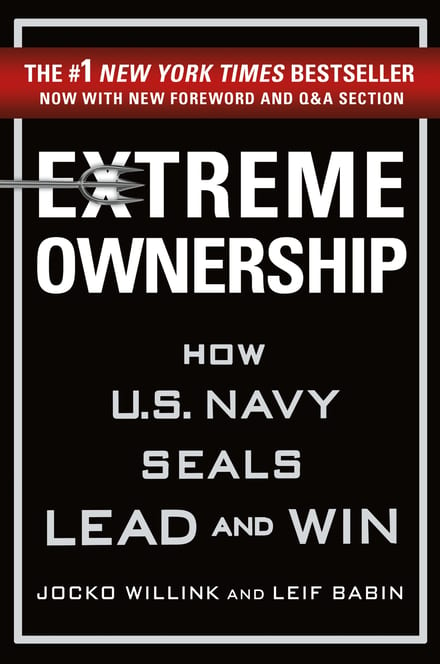
Extreme Ownership: How U.S. Navy SEALs Lead and Win
The full book runs ~325 pages — roughly 6 hours of reading. You get the key ideas here in 4 minutes.
The key ideas
- Own every outcome; blaming others surrenders your power to improve
- Believe the mission first, then explain why to your team
- Check your ego; adopt the best idea regardless of source
- Keep plans simple; prioritize and execute one problem at a time
- Empower junior leaders through clear intent and decentralized command
- Lead up and sideways; decide fast without perfect information
The summary
When a team fails, look at the leader. That’s the whole spine of Extreme Ownership, drawn from Jocko Willink and Leif Babin’s years leading Navy SEALs in the brutal fighting around Ramadi. The instinct after a failure is to spread the blame—bad luck, a weak subordinate, vague orders from above. Willink and Babin argue that this reflex is exactly what keeps you stuck. The moment you push failure outside yourself, you give away any power to fix it. Owning everything, including the things that weren’t obviously your fault, is what lets you demand accountability from everyone else.
There are no bad teams, only bad leaders
Willink learned it after a friendly-fire incident, when his men mistakenly engaged another friendly unit. In the debrief he could have blamed the chaos or another team’s communication. Instead he stood up and said he had failed. That admission kept him in command and reset the standard for his unit: no excuses, just problems to solve. Blame works the other way too—when a leader points fingers, the attitude trickles down until the whole team is useless. The authors prove the point with a SEAL boat race, where the crew that always lost and the crew that always won swapped leaders, and the losing crew immediately started winning. The people hadn’t changed. The leadership had. And standards are set by what you tolerate: “if substandard performance is accepted and no one is held accountable… that poor performance becomes the new standard.”
Conviction first, ego last
You can’t lead people toward a mission you don’t believe in yourself. Willink’s SEALs resented orders to operate alongside poorly trained Iraqi soldiers—it felt like dangerous babysitting. Willink was frustrated too, until he worked out why it mattered: training Iraqi forces was the only route to lasting stability and the only way American troops would ever get to leave. Once he believed it, he could explain not just what his team was doing but why, and they carried out six months of joint missions that helped cut violence and let Iraqi units start operating on their own.
The other half of good judgment is keeping your ego out of it. Effective leaders put the mission above their pride, admit their blind spots, and take the best idea in the room no matter who has it. Babin found out how easily ego blinds you during a sniper overwatch: pinned down, his team fought its way back to base in daylight, and only afterward did the team chief point out that Babin had never coordinated with a nearby SEAL element that could have covered them. He’d been so fixed on his own unit that he forgot he wasn’t fighting alone. Teams that compete with each other instead of working together lose.
Keep it simple, then prioritize and execute
Complex plans fall apart under fire. If the team can’t repeat the plan back in a sentence or two, they won’t execute it when it counts, so leaders have to strip objectives down to simple, clear tasks. Just as important is the discipline to handle emergencies one at a time. Babin’s platoon once held a building under heavy fire, discovered an IED blocking the exit, then had a SEAL crash through a roof mid-evacuation—several crises at once. Rather than flail, Babin used “Prioritize and Execute”: set security, find a way off the roof, confirm the headcount, rescue the fallen man, in that order. The mantra is “Relax, look around, make a call.” Try to solve everything at once and you solve nothing.
Push decisions down, and lead in every direction
No leader can make every call, so the SEALs rely on decentralized command: give people clear intent and priorities, then trust junior leaders to act inside it. Discipline makes this possible—a team bound by clear standards actually gains freedom, because everyone knows what good looks like and can move without waiting for permission. Ownership also runs upward and sideways. Leaders have to manage their own bosses, communicating clearly, asking for resources, and pushing back on unrealistic orders. And they have to decide without perfect information. Before one hostage rescue, Babin learned the target was ringed with explosives and heavily guarded, and he went ahead because he’d already planned for exactly that kind of risk. Overanalysis is its own failure; weigh the trade-offs, make the call, and own whatever happens.
The bottom line
Leadership comes down to a choice: accept total responsibility for your team’s results, because that’s the only place from which you can improve them. Absorb blame instead of spreading it, keep plans simple, and push decisions to the people closest to the fight. Read this if you lead anyone at all—the principles move straight from the battlefield to any team you’ll ever run.
Frequently asked questions
What is Extreme Ownership about?
Its whole spine is that when a team fails, you look at the leader. Drawn from Jocko Willink and Leif Babin's Navy SEAL combat in Ramadi, the book argues that owning everything, even the things that weren't obviously your fault, is the only position from which you can fix problems and demand accountability from everyone else.
What are the key takeaways from Extreme Ownership?
"There are no bad teams, only bad leaders" proven by a boat-crew race where swapping leaders flipped the loser into a winner. Keep your ego last and believe in the mission before you can lead people toward it. "Keep it simple" so a team can repeat the plan back, then "Prioritize and Execute" by handling crises one at a time ("Relax, look around, make a call"). And use decentralized command: give clear intent and priorities, push decisions to the people closest to the fight, and lead up and sideways as well as down.
Who should read Extreme Ownership?
Read it if you lead anyone at all, because the principles move straight from the battlefield to any team you'll ever run.
Is Extreme Ownership worth reading?
The combat stories are gripping and each principle is paired with a concrete business parallel, which makes the lessons easy to remember and apply. Some readers may find the military framing heavy-handed or the ideas obvious once stated, but that simplicity is the point the authors are making.