Book summary
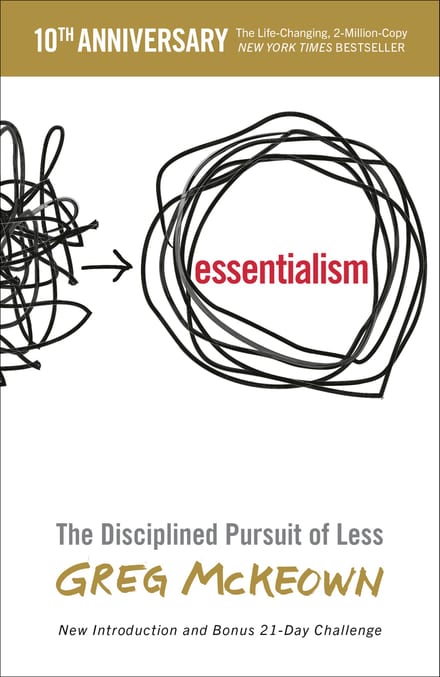
Essentialism: The Disciplined Pursuit of Less
The full book runs ~266 pages — roughly 5 hours of reading. You get the key ideas here in 5 minutes.
The key ideas
- Most activity is trivial; a vital few things produce nearly all the results.
- Trade-offs are unavoidable, so choose them by design, not by default.
- Use the 90 Percent Rule: if it isn't a clear yes, it's a clear no.
- Say no gracefully; respect outlasts the momentary comfort of yes.
- Protect sleep and play, build in buffers, and edit relentlessly.
The summary
Most of what fills your day doesn’t actually matter. That’s the uncomfortable premise Greg McKeown builds on: in a world drowning in options, the gap between people who make real progress and people who are merely busy isn’t effort, it’s selection. The Nonessentialist tries to do everything, says yes on reflex, and ends up making “a millimeter of progress in a million directions.” The Essentialist does the reverse. She pauses to ask which few things genuinely count, chooses them on purpose, and lets the rest fall away. This isn’t a tidier inbox or a slicker calendar. It’s living by design instead of by default, treating “less but better” as a discipline rather than a nice idea you nod at now and then.
Less but better
The phrase comes from Dieter Rams, the longtime lead designer at Braun, who believed almost everything is noise and his job was to filter down to the essence: “Weniger aber besser.” As a young designer he stripped a record player down to a clear plastic lid and nothing more, a design so bare that people feared it would bankrupt the company. It became the template every rival copied. The same instinct drives Ferran Adria, who reduced dishes to their core at El Bulli and turned away roughly two million reservation requests a year to serve just fifty people a night. Behind all of this sits the Law of the Vital Few, Joseph Juran’s expansion of Pareto’s observation that a small fraction of effort produces most of the results. McKeown learned it young: a paper route paid one pound an hour until he switched to washing neighbors’ cars and made six. Working hard matters, but past a point more effort stops producing more. The right effort, aimed at the right few things, does.
The reality of trade-offs
You cannot have it all, and pretending otherwise is where most people come undone. Southwest Airlines is McKeown’s model of doing this well. Herb Kelleher chose point-to-point flights only, no meals, no assigned seats, coach alone, each one a deliberate trade-off in service of staying cheap. Critics were baffled; the profits followed. When competitors tried to copy the surface without the commitment, Continental Lite “straddled” its strategy, bolting some low-cost features onto an old model, and lost hundreds of millions before its CEO was fired. The Nonessentialist meets every choice with “How can I do both?” The Essentialist asks the harder, freeing question: “Which problem do I want?” Trade-offs get made either way. The only thing you control is whether you make them on purpose or let them happen at the margins. Remember, McKeown notes, that the word “priority” stayed singular for five hundred years; we only pluralized it recently, as if renaming reality could let us hold many first things at once.
The disciplined “no”
Choosing the vital few means turning down plenty of good things, so McKeown hands you tools sharp enough to do it. The 90 Percent Rule: as you weigh an option, score it 0 to 100 on its single most important criterion, and if it lands below 90, treat it as a zero and reject it. No more agonizing over the 60s and 70s. Put simply, “If it isn’t a clear yes, then it’s a clear no.” Saying no is the hard part, because we’re rewarded in the moment for the yes and punished for the refusal. But it can be done gracefully, often without the word “no” at all. Peter Drucker credited his productivity to keeping “a VERY BIG waste paper basket” for other people’s requests. And when courage feels beyond you, McKeown points to Rosa Parks, whose quiet “No, I’m not” carries a lesson that scales down to any meeting invitation: a clear no earns more respect than a vague, stringing-along yes, and respect outlasts popularity.
Protect the asset, then clear the way
Cutting the nonessential is only half the work; the other half is protecting your capacity and smoothing the path for what’s left. Geoff, a driven CEO whose organization reached twelve million families, slept four to six hours a night and traveled most of the year until his organs began shutting down, a brutal way to learn his one-line lesson: “protect the asset.” Sleep and play aren’t indulgences the Essentialist skips; they’re the fuel that makes clear thinking possible. Then comes preparation. In the race to the South Pole, Roald Amundsen packed four thermometers to Robert Falcon Scott’s one and planted twenty trail markers to Scott’s single flag. Amundsen built in buffers and lived; Scott hoped for the best and died. Finally, edit. McKeown calls elimination “the invisible art,” the same craft that wins films the Best Editing award nobody stays up to watch. Jack Dorsey runs his companies as “chief editor,” and you can run your life the same way, using deliberate subtraction to give the few things that matter room to breathe.
The bottom line
You have enough time and energy for a great life, but not for everything, so the single most valuable skill is deciding, deliberately and often, what not to do. Choose the vital few, defend them with a disciplined “no,” and design your days so the essential gets clear passage. Read it if you feel busy but not productive, stretched too thin, and quietly certain you’re pouring yourself into things that don’t matter.
Fact check
Popular books repeat findings that later research has complicated. Where Essentialism makes a testable claim, here's what the evidence actually shows.
A small fraction of effort produces nearly all the results, so the Pareto "law of the vital few" holds broadly across domains.
Output really is concentrated. Across 198 samples covering 633,263 researchers, entertainers, politicians and athletes, individual performance fitted a Paretian (power-law) distribution rather than the normal curve that selection and appraisal practice assumes, so a small group does account for a disproportionate share of what gets produced. What the data do not deliver is a fixed 80/20 ratio: the degree of concentration varies by field, and what has been measured is the spread between people, not the split between the tasks on one person's to-do list. The vital-few pattern is real; the specific split is a rule of thumb rather than a law.
- O'Boyle E Jr, Aguinis H. The best and the rest: revisiting the norm of normality of individual performance. Pers Psychol. 2012;65(1):79-119. Source
Trading sleep for extra working hours is a bad deal, because short sleep degrades performance more than the extra waking time is worth.
In a controlled study of 48 adults, holding time in bed to 6 or 4 hours for 14 nights produced cumulative, dose-dependent deficits on every cognitive task, reaching the impairment seen after one to two nights of total sleep deprivation. Subjective sleepiness told a different story: it rose sharply at first, then barely moved, and never distinguished the 6-hour group from the 4-hour group, so participants could not feel how impaired they had become. A meta-analysis of 70 studies and 147 cognitive tests put the largest effect on lapses of simple attention (g = -0.78). The damage is uneven, though, since reasoning accuracy barely shifted (g = -0.13, with the confidence interval crossing zero) — vigilance goes well before careful reasoning does.
- Van Dongen HP, Maislin G, Mullington JM, Dinges DF. The cumulative cost of additional wakefulness: dose-response effects on neurobehavioral functions and sleep physiology from chronic sleep restriction and total sleep deprivation. Sleep. 2003;26(2):117-26. PubMed
- Lim J, Dinges DF. A meta-analysis of the impact of short-term sleep deprivation on cognitive variables. Psychol Bull. 2010;136(3):375-89. PubMed
Frequently asked questions
What is Essentialism about?
The book argues that almost everything we do is nonessential noise and only a few things truly matter. Greg McKeown makes the case for the disciplined pursuit of less: cutting relentlessly to the vital few, choosing deliberately, and pursuing 'less but better' instead of trying to do it all.
What are the main lessons in Essentialism?
Essentialism teaches you to tell the vital few from the trivial many and act on the difference. Its core lessons: accept that trade-offs are real and choose them on purpose; apply the 90 Percent Rule so anything short of a clear yes becomes a clear no; say no gracefully because respect beats popularity; and protect your energy with sleep, play, and buffers while editing out whatever gets in the way.
Who should read Essentialism?
Anyone who feels busy but not productive, overworked and underutilized, or stretched across too many commitments. The book speaks to executives, managers, and anyone whose default answer has quietly become yes and who wants to reclaim control of their time and focus.
Is Essentialism worth reading?
Yes. The book turns a simple idea into a practical system, grounded in memorable examples from Southwest Airlines to Roald Amundsen's race to the South Pole. If you want fewer, better choices and a life run by design rather than by other people's agendas, it earns its place.