Book summary
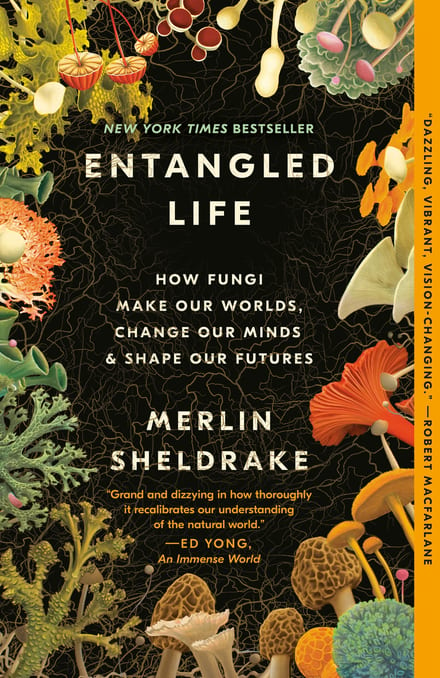
Entangled Life
How Fungi Make Our Worlds, Change Our Minds & Shape Our Futures
The full book runs ~368 pages — roughly 7 hours of reading. You get the key ideas here in 3 minutes.
The key ideas
- Rethink intelligence: mycelium solves problems without brains or central control
- Fungi built the underground economy that made plant life possible
- Wood wide webs trade nutrients and warnings between linked plants
- Chemicals let fungi puppet insects, lure animals, and reshape human minds
- Symbiosis dissolves boundaries: every organism is a process, not a thing
- Harness fungi to clean pollutants, replace plastics, and grow materials
The summary
A mushroom is just the fruit. The organism itself is a web — mycelium, a mesh of fine filaments called hyphae that threads through soil, wood, and the bodies of other creatures. Merlin Sheldrake’s argument is that fungi quietly demolish one of our most basic assumptions: that life comes packaged as separate, self-contained individuals. Mycelium has no brain, no center, no body plan, yet it solves problems, trades goods, and manipulates animals. Follow the fungi and the neat boundary around “an organism” starts to dissolve.
Intelligence without a brain
“Mycelium is a body without a body plan,” Sheldrake writes. It’s a decentralized network that navigates complex environments with no central controller. In experiments, a wood-rotting fungus laid out among scattered blocks of wood found the most efficient path between them — a computation with no computer. These networks coordinate across large distances using fast signals, probably electrical, letting a fungus respond to its world in real time.
That reframes what a living thing even is. A mycelial network is a map of the fungus’s recent history, a reminder that organisms are processes rather than objects. The “you” of five years ago was built from different atoms than today’s you. As William Bateson, who coined the word “genetics,” put it, “We commonly think of animals and plants as matter, but they are really systems through which matter is continually passing.”
The underground market that built the world
Around 500 million years ago, the algal ancestors of plants hauled themselves onto land with no roots to pull water and minerals from bare rock. Mycorrhizal fungi became their root systems and did that job for tens of millions of years. Plants fed the fungi sugars from photosynthesis; the fungi returned water and minerals. The partnership set off an explosion of plant life that dropped atmospheric carbon dioxide by 90 percent and cooled the planet. More than 90 percent of plant species still depend on these fungal relationships today.
The exchange behaves like a market. Plants reward the more cooperative fungal partners with more sugar, while fungi shuttle resources across their network to “sell high” wherever nutrients are scarce. These mycorrhizal webs — the “wood wide web” — physically link plants, sometimes across different species, moving carbon, nitrogen, phosphorus, and water from the resource-rich to the struggling. They even carry warnings: when insects attack one plant, connected neighbors switch on their own chemical defenses without any direct contact with the pest. Modern farming breaks this open system. Tilling, chemical fertilizers, and fungicides thin out soil fungi, leaving crops more dependent on inputs and more fragile in drought and disease.
Chemical puppeteers
Fungi manipulate other organisms mostly through scent and chemistry. Truffles, the underground fruiting bodies of certain fungi, can’t launch their spores into the air, so they produce alluring scents that get animals to dig them up and eat them, spreading the spores instead. Others are far more sinister. The “zombie fungus” Ophiocordyceps unilateralis infects carpenter ants, seizes control of their muscles with chemicals, and drives them to leave the nest, climb a plant, and clamp their jaws down before dying — after which the fungus fruits from the ant’s head and rains spores on the colony below. The ant’s brain stays intact; this is chemical puppetry, not mind control.
Magic mushrooms run a subtler chemistry on us. Psilocybin stimulates serotonin receptors and quiets the brain’s default mode network, the circuitry tied to ego and self-reflection, which can dissolve the sense of a separate self. Clinical trials show a single dose producing lasting drops in severe depression and anxiety, especially in terminally ill patients — apparently not by pushing biochemical buttons but by opening people to new ways of thinking about their lives. The compound likely evolved as a defense against insects; its modern fame traces to Gordon Wasson’s 1957 article “Seeking the Magic Mushroom.”
We are all lichens
A lichen isn’t one thing but a partnership — a fungus joined with algae or bacteria — and that symbiosis lets lichens survive where almost nothing else can, including radiation, extreme temperatures, and the vacuum of space. For Sheldrake they’re the clearest lesson of the book: “There have never been individuals… We are all lichens.” What we call a single organism is usually a collaboration, a process through which matter keeps passing rather than a fixed, bounded thing.
Fungi as tools
Fungi also rewrote the planet’s chemistry, and may help us fix it. During the Carboniferous, wood didn’t rot because no fungus could yet break down lignin, so unrotted plant matter piled up and became coal. Now fungi are master decomposers, and we’re learning to point that talent at our messes: mycoremediation uses fungi to break down crude oil, pesticides, explosives, and plastics, while mycofabrication grows mycelium into packaging, leather-like textiles, and building materials. Paul Stamets has shown that extracts from certain wood-rotting fungi sharply cut deadly viruses in honeybees, a possible lever against colony collapse. And yeast, another fungus, helped anchor the Neolithic shift to settled farming through baking and brewing — so much so that “you might argue, yeasts have domesticated us.” Even our taste for alcohol may be fungal in origin: the drunken monkey hypothesis says we followed the scent of fermenting fruit long before we brewed anything.
The bottom line
Fungi are networked, brainless problem-solvers that made land life possible and blur the line between the individual and the ecosystem — proof that the living world is less solid and more entangled than it looks. Read this if you want the ground under your feet, and your sense of where “you” ends, to feel a lot stranger.
Fact check
Popular books repeat findings that later research has complicated. Where Entangled Life makes a testable claim, here's what the evidence actually shows.
Mycorrhizal "wood wide webs" move meaningful amounts of carbon and nutrients between trees and carry warnings of insect attack between connected plants.
A 2023 review in Nature Ecology & Evolution tested the three popular claims and found that field results on how widespread these networks are, and on whether resources moving through them help seedlings, vary too widely and have alternative explanations; for the idea that mature trees preferentially feed their own offspring it found no peer-reviewed evidence at all. The same review reports that unsupported claims about these networks have doubled over 25 years. The warning-signal result is genuine but narrow: a 2013 experiment showed bean plants linked by mycorrhizal mycelium to aphid-infested neighbours switched on volatile defences before being attacked — one controlled system with one crop and one pest, not a forest.
- Karst J, Jones MD, Hoeksema JD. Positive citation bias and overinterpreted results lead to misinformation on common mycorrhizal networks in forests. Nat Ecol Evol. 2023;7(4):501-511. PubMed
- Babikova Z, Gilbert L, Bruce TJA, Birkett M, Caulfield JC, Woodcock C, et al. Underground signals carried through common mycelial networks warn neighbouring plants of aphid attack. Ecol Lett. 2013;16(7):835-843. PubMed
More than 90 percent of plant species still depend on mycorrhizal fungi.
A 2018 survey of global host-plant diversity puts the figure at 92% of vascular plant species forming mycorrhizal associations — 72% arbuscular, 10% orchid, 2% ectomycorrhizal, 1.5% ericoid, and 7% inconsistently mycorrhizal. The remaining 8% are fully non-mycorrhizal, and most of those are nutritional or habitat specialists such as carnivorous plants, parasites, aquatics and epiphytes. The book's number is right.
- Brundrett MC, Tedersoo L. Evolutionary history of mycorrhizal symbioses and global host plant diversity. New Phytol. 2018;220(4):1108-1115. PubMed
The partnership between early plants and mycorrhizal fungi dropped atmospheric carbon dioxide by 90 percent and cooled the planet.
The long-term decline is well established: proxy reconstructions across the past 420 million years show atmospheric CO2 falling by enough to almost entirely cancel a roughly 9 W/m2 increase in radiative forcing from a brightening sun, and the steepest part of that fall coincides with the spread of land plants. What is contested is the attribution. The standard carbon-cycle paradigm credits plants and their roots; the case that mycorrhizal fungi did much of the mineral weathering is a hypothesis argued by Taylor and colleagues, who note it is precisely what the existing models leave out. A specific figure such as 90 percent depends on which reconstruction you pick, and the fungal share of the effect has not been quantified.
- Foster GL, Royer DL, Lunt DJ. Future climate forcing potentially without precedent in the last 420 million years. Nat Commun. 2017;8:14845. PubMed
- Taylor LL, Leake JR, Quirk J, Hardy K, Banwart SA, Beerling DJ. Biological weathering and the long-term carbon cycle: integrating mycorrhizal evolution and function into the current paradigm. Geobiology. 2009;7(2):171-191. PubMed
Clinical trials show a single dose of psilocybin producing lasting drops in severe depression and anxiety, especially in terminally ill patients.
The terminal-illness case is the strongest one: in a randomised double-blind crossover trial of 51 patients with life-threatening cancer, a high dose produced large falls in depressed mood and anxiety, with about 80% still showing clinically significant improvement six months later. Durability outside that setting is shakier. In a 233-patient trial for treatment-resistant depression, 25 mg beat the 1 mg control on depression score at three weeks (a fall of 12.0 points versus 5.4) but the advantage was gone by week 12, and 77% of participants had adverse events, with suicidal ideation or self-harm appearing in all three dose groups.
- Griffiths RR, Johnson MW, Carducci MA, Umbricht A, Richards WA, Richards BD, et al. Psilocybin produces substantial and sustained decreases in depression and anxiety in patients with life-threatening cancer: A randomized double-blind trial. J Psychopharmacol. 2016;30(12):1181-1197. PubMed
- Goodwin GM, Aaronson ST, Alvarez O, Arden PC, Baker A, Blom RE, et al. Single-Dose Psilocybin for a Treatment-Resistant Episode of Major Depression. N Engl J Med. 2022;387(18):1637-1648. PubMed
Frequently asked questions
What is Entangled Life about?
Fungi are networked, brainless organisms that quietly demolish the assumption that life comes packaged as separate, self-contained individuals. Through mycelium, underground plant partnerships, and lichens, the book shows fungi solving problems, trading nutrients, and blurring the line between an organism and its ecosystem.
What are the key takeaways from Entangled Life?
Mycelium is "a body without a body plan" a decentralized network that finds efficient paths with no brain. Mycorrhizal fungi became plants' first root systems around 500 million years ago and still connect more than 90% of plant species in a "wood wide web" that moves carbon, nitrogen, and even chemical warnings. Fungi manipulate animals through scent and chemistry, from truffles to the zombie-ant fungus to psilocybin quieting the brain's default mode network. And lichens make the book's clearest point, that "we are all lichens" and organisms are collaborations and processes, not fixed things.
Who should read Entangled Life?
Read it if you want the ground under your feet, and your sense of where "you" ends, to feel a lot stranger.
Is Entangled Life worth reading?
It's a wonder-filled tour that reframes biology through vivid, concrete examples, from path-finding fungi to lichens that survive the vacuum of space. The ideas range widely across many topics rather than building one tight argument, so readers wanting a linear thesis may find it loose, but the curiosity is contagious.