Book summary
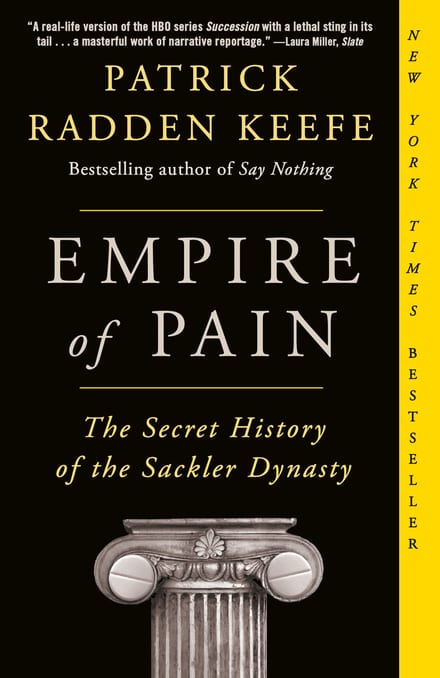
Empire of Pain: The Secret History of the Sackler Dynasty
The full book runs ~720 pages — roughly 13 hours of reading. You get the key ideas here in 4 minutes.
The key ideas
- Perfected drug marketing by selling to doctors, not patients
- Built a vertically integrated empire shaping medical opinion
- Justified mass-marketing opioids with a five-sentence letter, not science
- Captured the FDA official who approved OxyContin's abuse claims
- Blamed addicted users while ignoring internal abuse reports
- Siphoned wealth offshore, avoided prison, admitted no wrongdoing
The summary
Isaac Sackler lost his businesses in the Great Depression and couldn’t pay for his sons’ education, but he told Arthur, Mortimer, and Raymond he’d given them something more valuable than money: “a good name.” That name would one day hang over wings of the Met and the Guggenheim. It would also become shorthand for one of the deadliest corporate scandals in American history. The Sacklers didn’t invent the opioid crisis, but they built the machine that made it possible — and then engineered their own escape from the consequences.
Arthur wrote the playbook
Arthur, the eldest, was the architect. A doctor by training, he made his fortune in medical advertising, where he pioneered tactics that would later sell OxyContin. His breakthrough came with the tranquilizer Valium, which he helped turn into the most prescribed drug in America through aggressive, morally questionable campaigns aimed squarely at physicians. The lesson embedded in everything that followed: you don’t sell drugs to patients, you sell them to doctors, with data and repetition.
In 1952 Arthur bought the small firm Purdue Frederick with his brothers, but his real genius was integration. He wove together his advertising agency, medical publications, and pharmaceutical data collection so that he could shape medical opinion at every layer while boosting Purdue’s influence and profits. Mortimer and Raymond ran the company day to day — Mortimer expanding lavishly in Europe, Raymond keeping a low profile in Connecticut — and their first major success, a British morphine pill called MS Contin, genuinely helped cancer patients manage pain without hospitalization. Arthur died in 1987, before OxyContin existed, but the machine he built outlived him.
OxyContin was built to be a blockbuster
MS Contin faced a looming patent expiration, and the family needed a replacement. Richard Sackler, Raymond’s son, drove the development of a far stronger opioid with obsessive focus. In 1994, Purdue’s head of marketing, Michael Friedman, sent a secret memo laying out the strategy: reshape attitudes toward opioid prescriptions so the drug could be sold far beyond cancer treatment, for routine pain of every kind.
Purdue then cultivated Curtis Wright, the FDA official overseeing approval, who fast-tracked the drug. Under his review the label acquired an unsubstantiated line — that OxyContin’s “delayed absorption” was “believed to reduce the abuse liability of the drug” — which became central to the marketing. Barely a year after approval, Wright resigned from the FDA and joined Purdue on a first-year package of nearly $400,000.
The science was a lie
Purdue’s sales force told doctors that patients rarely get addicted to opioids. The source was a five-sentence letter to the editor of the New England Journal of Medicine — an observation about hospitalized patients, not a study of people taking pills at home. One of its authors, Hershel Jick, later said he was “amazed” that companies used this minor academic note to justify the mass marketing of strong opioids. To manufacture the appearance of consensus, Purdue also funded deceptive astroturf advocacy groups pushing for looser pain-management standards.
Meanwhile, the company’s own people were sounding alarms. Sales reps noticed abuse as early as 1997. A legal secretary monitoring online forums found users describing how they crushed tablets, sucked off the time-release coating, and snorted, cooked, or injected the drug; her memo circulated to senior officials and to “all the Sacklers” then active in the company. Purdue dismissed the concern and blamed users, recasting addiction as a matter of individual behavior and law enforcement rather than a flaw in the drug or its marketing.
The escape hatch
A 2007 criminal investigation ended in a guilty plea and a $600 million fine, but key evidence was sealed, no Sackler was charged, and three executives took pleas without felonies. As the patent expired, Purdue rolled out a “tamper-proof” version, OxyContin OP, that made no dent in the crisis. Internally, executives admitted the abuse-deterrence claims were at best theoretical: staff had told the Sacklers that the leading method of abuse was simply swallowing the pills whole, which the reformulation did nothing to prevent.
By then many users had passed the point of no return, and a cheaper, stronger substitute was everywhere — heroin. According to the American Society of Addiction Medicine, four out of five people who took up heroin in this period had started by abusing prescription painkillers. In the two decades after its 1996 launch, OxyContin generated some $35 billion. As outrage grew, museums stripped the Sackler name from their walls. Purdue declared bankruptcy and was restructured; the family contributed billions to the settlement, much of it drawn from selling another firm after withdrawing funds from Purdue, yet admitted no wrongdoing, faced no criminal charges, and kept their personal wealth.
The bottom line
The Sacklers used Arthur’s playbook — aggressive marketing, a captured regulator, manufactured science, strategic philanthropy — to push a drug they knew was killing people, then walked away rich. Read this if you want to understand how wealth and regulatory capture can insulate the powerful from accountability, even in a mass-casualty crisis.
Fact check
Popular books repeat findings that later research has complicated. Where Empire of Pain makes a testable claim, here's what the evidence actually shows.
Purdue's sales pitch that patients rarely get addicted rested on a brief 1980 letter to the editor about hospitalized patients, not on a clinical study.
Porter and Jick's piece is indexed by PubMed as a Letter and occupies a single page — N Engl J Med. 1980;302(2):123 — and described narcotics given to supervised inpatients, not people taking pills at home for months. A 2017 analysis in the same journal counted 608 later citations of it, of which 439 (about 72%) treated it as substantive evidence that addiction was rare in patients treated with opioids. On the point that matters, the book is accurate: a one-page letter carried a weight no letter can bear.
Four out of five people who took up heroin in this period had started by misusing prescription painkillers.
The era-specific number is close to right: among 2,797 treatment-seeking heroin users, 75.0% of those who began in the 2000s were introduced to opioids through prescription drugs, against roughly 80% of 1960s initiates who started with heroin itself. But the figure only describes people who already ended up on heroin, so it cannot tell you the risk a given painkiller user faces. Run the other way, a 36-month prospective study of young people misusing pharmaceutical opioids found 7.5% went on to try heroin, about 2.8% a year.
- Cicero TJ, Ellis MS, Surratt HL, Kurtz SP. The changing face of heroin use in the United States: a retrospective analysis of the past 50 years. JAMA Psychiatry. 2014;71(7):821-826. PubMed
- Carlson RG, Nahhas RW, Martins SS, Daniulaityte R. Predictors of transition to heroin use among initially non-opioid dependent illicit pharmaceutical opioid users: A natural history study. Drug Alcohol Depend. 2016;160:127-134. PubMed
The tamper-resistant reformulation of OxyContin made no dent in the opioid crisis.
The reformulation did cut abuse of OxyContin itself — rates among people entering treatment fell from 45.1% in early 2009 to 26.0% by late 2012 — but then flattened, with 34% of continuing abusers defeating the tamper-resistant mechanism and most of the rest simply swallowing pills, exactly as Purdue staff had told the Sacklers. Net harm did not fall, it moved: one economic analysis estimates that without the reformulation there would have been roughly 76% fewer hepatitis C and 53% fewer hepatitis B cases from 2011 to 2015, as users switched to injected heroin. The book's conclusion about the crisis holds; the narrower statement that the new pill changed nothing does not.
- Cicero TJ, Ellis MS. Abuse-Deterrent Formulations and the Prescription Opioid Abuse Epidemic in the United States: Lessons Learned From OxyContin. JAMA Psychiatry. 2015;72(5):424-430. PubMed
- Beheshti D. Adverse health effects of abuse-deterrent opioids: Evidence from the reformulation of OxyContin. Health Econ. 2019;28(12):1449-1461. PubMed
Frequently asked questions
What is Empire of Pain about?
It traces how the Sackler family built the marketing machine behind OxyContin and then engineered their own escape from the consequences. The Sacklers didn't invent opioids, but they pioneered selling drugs to doctors, captured regulators, and funded misleading science, then walked away rich after Purdue declared bankruptcy.
What are the key takeaways from Empire of Pain?
Arthur Sackler wrote the playbook: sell drugs to physicians, not patients, with data and repetition, first proven with Valium. OxyContin was designed as a blockbuster and pushed for routine pain of every kind, aided by a secret 1994 strategy memo and an FDA reviewer, Curtis Wright, whom Purdue later hired. The claim that patients rarely get addicted rested on a five-sentence letter to the editor, and the company blamed users even as its own reps flagged abuse. A 2007 guilty plea and $600 million fine left no Sackler charged.
Who should read Empire of Pain?
Read it if you want to understand how wealth and regulatory capture can insulate the powerful from accountability, even in a mass-casualty crisis.
Is Empire of Pain worth reading?
It's a thorough, damning account of how a family pushed a drug they knew was killing people, with OxyContin generating some $35 billion over two decades. If you already know the broad opioid story, parts will feel familiar, but the detail on the Sacklers' tactics and their legal escape hatch is what makes it land.