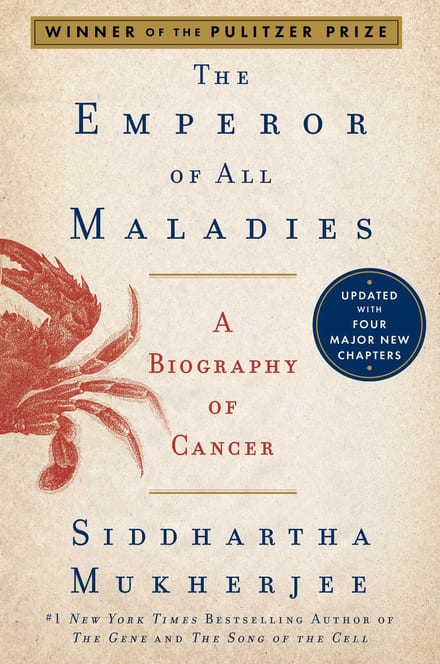
Book summary
The Emperor of All Maladies: A Biography of Cancer
A Biography of Cancer
The full book runs ~582 pages — roughly 11 hours of reading. You get the key ideas here in 5 minutes.
The key ideas
- Farber's 1947 antifolate gave the first remission in childhood leukemia — it lasted months.
- Halsted cut wider for ninety years; his own 1907 numbers said it wouldn't help.
- The 1971 War on Cancer was declared before anyone could describe the enemy.
- Doll and Hill's 41,024 doctors: every lung-cancer death in the cohort was a smoker.
- Varmus and Bishop found the cancer gene already living inside normal cells.
- Gleevec proved targeted therapy works; resistance proved the fight never ends.
The summary
In December 1947, Sidney Farber waited in a basement room under Boston’s Children’s Hospital for vials of aminopterin, a chemical mimic of folic acid. He injected it into Robert Sandler, a two-year-old whose leukemia had already snapped a bone in his thigh. Within weeks the boy’s white-cell count fell toward normal, and for a month he looked just like his healthy twin, Elliott. Then the leukemia returned and killed him. Farber published anyway: sixteen children, ten responses, five alive at six months. In leukemia, six months was an eternity. A chemical had pushed back a cancer — and that door opening, slamming, and a profession deciding it already knew why, is the pattern of this whole history.
Galen’s black bile never really left
Galen taught that cancer was trapped black bile, a systemic fluid, so cutting it out was futile — and surgeons obeyed for fourteen centuries, until Vesalius went hunting for black bile and found none in the body, nor Matthew Baillie inside tumors.
William Halsted then inverted Galen exactly. Cancer, he argued, spun outward from one point like a pinwheel, so a surgeon who cut wide enough would catch it. His radical mastectomy took the breast, the pectoral muscles, the nodes under the armpit, eventually the collarbone, leaving shoulders caved inward and arms swollen — surgical elephantiasis, he called it. His own 1907 figures held the refutation: of sixty women whose lymph nodes were clean, forty-five were alive at five years; of forty whose nodes held cancer, three. Survival tracked how far the disease had already traveled, not how much tissue came out. Halsted saw it and turned away. Not until 1981 did Bernard Fisher’s randomized trial show that radical mastectomy and lumpectomy-with-radiation gave identical outcomes. Half a million women had the operation first.
A war declared before anyone could describe the enemy
Farber’s second discovery was political: a disease has to be sold before it can be cured. In 1948 he and the Variety Club renamed a boy with intestinal lymphoma “Jimmy,” put him on the radio with the Boston Braves crowding his hospital room, and raised $231,000. Mary Lasker, who thought research deserved the advertising budget of toothpaste, supplied the rest. After Apollo 11 the campaign had its metaphor: a moon shot for cancer. Ann Landers ran one column in April 1971, a million letters buried the Senate mailroom, and Nixon signed the National Cancer Act that December.
Nobody could yet say what cancer was. James Watson predicted “a massive expansion of well-intentioned mediocrity,” and the hunt for human cancer viruses swallowed close to $500 million and produced almost nothing. The era’s largest real win came from a mailed questionnaire: Richard Doll and Austin Bradford Hill wrote to 59,600 British doctors, 41,024 answered, and by 1954 thirty-six of them had died of lung cancer — every one a smoker. Prevention research got a fifth of the institute’s grants.
Poison has a ceiling, and the ceiling is us
The cures were real. Frei and Freireich’s four-drug VAMP regimen was called insane and cruel — “we could have killed all of those kids,” Freireich admitted — yet it cured about one child in twenty. Pinkel’s two-year “total therapy” in Memphis left 80 percent of 278 children disease-free, MOPP cured more than half of forty-three advanced Hodgkin’s patients, and cisplatin made metastatic testicular cancer curable.
Then came the generalization: if hard works, harder must work better. “The smiling oncologist,” Rose Kushner wrote, “does not know whether his patients vomit or not.” Across 1984 and 1985, six thousand chemotherapy papers appeared without a single new cure for an advanced solid tumor. The end of the road was STAMP — megadose chemotherapy rescued by the patient’s own frozen marrow — a $4 billion business with waiting lists before any randomized trial reported. The trial that seemed to vindicate it was fabricated; the real one found no survival benefit, nine women dead of transplant complications, and nine more with leukemias caused by their treatment. In 1986, age-adjusting the national figures, John Bailar found cancer mortality had risen 8.7 percent since 1962 and called thirty-five years of effort “a qualified failure.”
The enemy turned out to be a copy of us
The correction came from a chicken tumor: Rous sarcoma virus carried a gene, src, that forced cells to divide. Harold Varmus and Michael Bishop went looking for src’s distant relatives in normal cells and found src itself — in ducks, quail, sheep, cows, a newborn emu at the Sacramento zoo, and in us. The virus had not delivered a cancer gene; it had stolen one on the way out. Cancer, Varmus said in Stockholm, is “a distorted version of our normal selves.”
That explained the ceiling. Chemotherapy attacked rapid growth, which is what living cells do; the way past it was to find something a cancer cell needs and a normal cell does not. Brian Druker spent years pushing a reluctant Novartis to make enough of a kinase inhibitor to test; 53 of his first 54 patients went into complete remission on Gleevec. Herceptin, aimed at the Her-2 gene, lifted survival in early breast cancer by about a third. But when Jerry Mayfield’s leukemia relapsed in 2003, it had changed the shape of the target so the drug could no longer bind. A differently shaped drug put him back into remission. We run to stay in place.
The bottom line
Cancer is not an invader. It is our own growth machinery with the accelerator jammed and the brakes cut, which is why every approach that treated it as a foreign object — bile to purge, tissue to excise, poison to escalate — met the same wall, and why the drugs that finally worked came out of decades of biology nobody could sell as a war. Mukherjee’s measure of victory, borrowed from Richard Doll, is deliberately modest: death in old age is inevitable, death before old age is not.
Read it to watch medicine correct itself in real time — slowly, expensively, and almost always over the objections of the people who were most certain.
Fact check
Popular books repeat findings that later research has complicated. Where The Emperor of All Maladies makes a testable claim, here's what the evidence actually shows.
A randomized trial showed radical mastectomy and lumpectomy-with-radiation gave identical outcomes, ending ninety years of ever-wider surgery.
Twenty-year follow-up of Fisher's NSABP B-06 trial found no significant survival difference: the hazard ratio for death was 1.05 for lumpectomy alone versus total mastectomy (95% CI 0.90-1.23; P = 0.51) and 0.97 for lumpectomy plus irradiation (95% CI 0.83-1.14; P = 0.74). Veronesi's Milan trial of 701 women, published in 1981, had already reported no difference in disease-free or overall survival between Halsted mastectomy and breast-conserving surgery with radiotherapy. The date attaches to the wrong trial, though: Fisher's own randomized results first appeared in 1985, and 1981 belongs to Veronesi. The conclusion the summary draws from them is exactly right.
- Fisher B, Anderson S, Bryant J, et al. Twenty-year follow-up of a randomized trial comparing total mastectomy, lumpectomy, and lumpectomy plus irradiation for the treatment of invasive breast cancer. N Engl J Med. 2002;347(16):1233-1241. PubMed
- Veronesi U, Saccozzi R, Del Vecchio M, et al. Comparing radical mastectomy with quadrantectomy, axillary dissection, and radiotherapy in patients with small cancers of the breast. N Engl J Med. 1981;305(1):6-11. PubMed
In Doll and Hill's cohort of British doctors, every death from lung cancer was a smoker.
That result describes the first snapshot, not the cohort. Doll and Hill's 1954 preliminary report covered barely two and a half years of follow-up, and the clean split it showed did not survive the full fifty years: by 2001 there had been 18 lung cancer deaths among the lifelong non-smokers, against 218 among current cigarette smokers, whose lung cancer mortality ratio was 15.9 where the non-smokers' was 0.9. The underlying finding is one of the most thoroughly confirmed results in epidemiology. Cigarette smokers born between 1900 and 1930 who kept smoking died on average about ten years younger than lifelong non-smokers, and quitting at 30, 40, 50 or 60 bought back roughly 10, 9, 6 and 3 of those years.
Age-adjusting the national figures in 1986, John Bailar found US cancer mortality had risen since 1962 and called decades of effort a qualified failure.
Bailar and Smith's verdict was accurate for the moment they wrote it: judged by age-adjusted mortality they concluded that "we are losing the war against cancer," and argued research emphasis had to move from treatment toward prevention. The trend since has gone the other way. US age-adjusted cancer death rates have been falling about 1.5% a year over 2015-2024, reaching 143.2 per 100,000, and the American Cancer Society's 2025 report estimates nearly 4.5 million deaths averted since 1991 through reduced smoking, earlier detection and better treatment. Bailar's diagnosis was sound and his prescription — prevention — is a large part of why the number eventually turned.
- Bailar JC 3rd, Smith EM. Progress against cancer? N Engl J Med. 1986;314(19):1226-1232. PubMed
- Siegel RL, Kratzer TB, Giaquinto AN, Sung H, Jemal A. Cancer statistics, 2025. CA Cancer J Clin. 2025;75(1):10-45. PubMed
- National Cancer Institute Surveillance, Epidemiology, and End Results Program. SEER Cancer Stat Facts: Cancer of Any Site. Accessed July 30, 2026. Source
Gleevec put 53 of Druker's first 54 patients into complete remission.
The number is exact for the response that was measured. In the phase 1 report, complete hematologic responses occurred in 53 of 54 patients given 300 mg a day or more, usually within four weeks. Remission at the level of the Philadelphia chromosome itself was far rarer at that point: 7 of those 54 reached a complete cytogenetic response. Longer follow-up vindicated the drug on the deeper measure anyway — in the IRIS trial 82.8% of imatinib patients eventually achieved a complete cytogenetic response, and estimated 10-year overall survival was 83.3%.
- Druker BJ, Talpaz M, Resta DJ, et al. Efficacy and safety of a specific inhibitor of the BCR-ABL tyrosine kinase in chronic myeloid leukemia. N Engl J Med. 2001;344(14):1031-1037. PubMed
- Hochhaus A, Larson RA, Guilhot F, et al. Long-Term Outcomes of Imatinib Treatment for Chronic Myeloid Leukemia. N Engl J Med. 2017;376(10):917-927. PubMed
Frequently asked questions
What is The Emperor of All Maladies about?
It is a four-thousand-year history of cancer, told as the biography of a disease. Siddhartha Mukherjee traces how each era built a confident theory of cancer — trapped black bile, a tumor spreading outward from one point, a hidden virus, one cause with one cure — and pushed that theory far past the evidence before someone counted and proved it wrong. The answer that finally held is that cancer is not an invader at all but our own growth genes running unchecked.
What are the key takeaways from The Emperor of All Maladies?
Three ideas carry the book. First, medicine's most disciplined-looking practices can rest on untested belief: William Halsted's radical mastectomy was performed on roughly half a million women before a randomized trial in 1981 showed it added nothing, and his own 1907 numbers had already hinted at that. Second, political momentum can outrun science — the 1971 War on Cancer was declared before anyone could describe the enemy, and the search for human cancer viruses burned close to $500 million for almost no return. Third, the ceiling on chemotherapy was biological, not a matter of nerve: drugs that attack rapid growth also attack every healthy cell that grows. Real precision arrived only after Harold Varmus and Michael Bishop found the cancer gene living inside normal cells, which led to targeted drugs like Gleevec and Herceptin.
Who should read The Emperor of All Maladies?
Anyone facing cancer or caring for someone who is, and anyone who wants to understand how medical knowledge actually gets made and corrected. It also rewards readers with no science background who like history told through people — Sidney Farber in his basement lab, Mary Lasker working Congress, Richard Doll mailing questionnaires to 59,600 doctors.
Is The Emperor of All Maladies worth reading?
Yes. It is unusually good at holding two things at once: the science of what cancer is, and the human cost of every wrong turn along the way, told by a working oncologist who was treating patients while he wrote. The price is length and density: hundreds of pages of names, trials, and molecular detail. If you want a quick practical guide to treatment options, this is not it; if you want to understand the disease and the people who fought it, few books come close.