Book summary
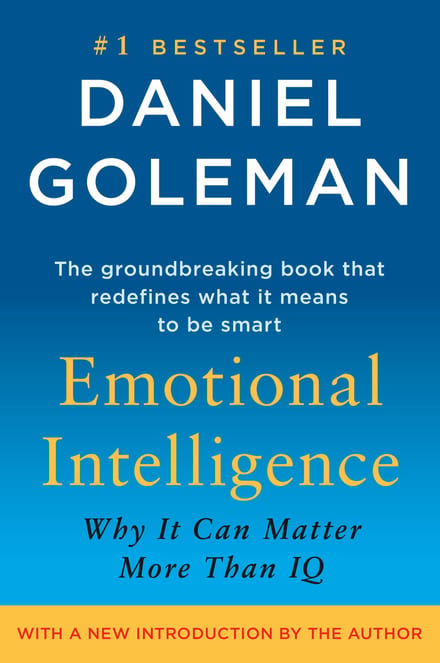
Emotional Intelligence: Why It Can Matter More Than IQ
The full book runs ~368 pages — roughly 7 hours of reading. You get the key ideas here in 4 minutes.
The key ideas
- Recognize the amygdala hijack that erupts before reason weighs in
- Reset by labeling feelings, tracing causes, reframing charitably
- Read nonverbal cues and mirror others to build empathy
- Listen when people vent instead of rushing to fix
- Impulse control and empathy predict grades, health, relationships
- Emotionally intelligent parenting shapes calmer, better-liked kids
The summary
We’ve been measuring the wrong kind of smart. Daniel Goleman’s argument is that the ability to notice your own feelings, name them, and steer them—while reading them accurately in other people—predicts how your life turns out at least as well as IQ does, and often better. A brilliant mind that floods with rage in every meeting or misreads every room will underperform a merely average one that stays composed. The hopeful half of the claim is that these skills, unlike raw intelligence, can be learned. Their near-absence from how we school and raise children is a cost that compounds over a lifetime.
Emotions are tools, not obstacles
Strip away feeling and you don’t get cool rationality; you get a person who can’t decide anything. Emotions do real work. They help you learn—a child who breaks a vase remembers the guilt and doesn’t do it again. They let you predict others—angry body language warns you someone might turn violent. And they move you to act, as fear moves you out of danger. The problem is bandwidth. When emotion floods in, there’s no room left for thought. Some incoming information bypasses the neocortex, the brain’s logical processor, and hits the amygdala directly, producing what Goleman calls an emotional hijacking: a burst of fury or panic that fires before reason gets a say. Old wounds make it worse. A person bullied as a child can carry that fear into a successful adulthood, letting an obsolete threat shape how they react today.
The three-step reset
Emotional intelligence is largely the practice of catching a hijack in progress and working through it. Say a friend passes you on the street and doesn’t say hello. First, acknowledge and label the feeling—not a vague “bad,” but “I feel disappointed.” Second, find the cause and reason it out: you’re disappointed because you value the friendship and it seems unreciprocated. Third, shift toward a more generous read—maybe she was preoccupied and simply didn’t see you. This isn’t denial; it’s refusing to let the amygdala write the whole story. Students who can do this tend to thrive even with average IQs, because they recover from setbacks and get along with people.
Reading other people
Much of your happiness runs through your relationships, and emotional intelligence is what keeps them healthy. It builds the social skills that matter—teaching, resolving conflict, running a team—by training you to take another person’s perspective and read their nonverbal cues. Mirroring someone’s body language deepens empathy, because posture and expression don’t only reveal feelings, they create them: you laugh because you’re happy, and laughing also makes you happier. One easy win is knowing when someone venting wants solutions and when they just want to be heard. Rushing to fix can land as dismissal; often the most useful thing you can offer is attention.
The wiring underneath is a partnership between the thinking brain and the feeling brain, joined by thick neural pathways. Cut them and you lose both, as lobotomy patients did—along with emotion went the drive to act at all. Healthy self-regulation is the thinking brain checking the feeling brain: the loud sneeze startles your amygdala, then your neocortex rules it harmless and settles you down. Without that check you’re prone to flooding, where anger feeds on itself. Goleman notes men flood more easily and tend to cope by withdrawing or stonewalling, which can quietly wreck a relationship.
The evidence that it matters
The famous Stanford marshmallow experiment offered four-year-olds a treat now or two treats if they could wait. The children with better impulse control turned out years later to be more successful, socially and academically. Another study found students high in empathy earned notably better grades than peers with matching IQs but less of it. Emotional intelligence guards your health too, blunting the stress that drives high blood pressure, weak immunity, and heart disease. Genetics set a starting point—some people are born more anxious or more sunny—but the brain stays malleable. Even babies come equipped with the seed of empathy, crying when other babies cry and laughing when they laugh.
The absence of these skills carries a social price. Violent offenders tend to score low on self-control and struggle to read faces, missing the pain they cause; people prone to addiction may be medicating unmanaged anxiety or anger. Children of emotionally attuned parents regulate themselves better and are better liked, while children whose parents ignore or dismiss feelings face more trouble at school and higher risk of mental-health problems. A few practical habits go a long way. When you criticize, be specific, add praise, and offer a fix. When you’re overwhelmed, take a break before you say something you’ll regret. And keep an encouraging inner voice—blame setbacks on things you can change, not on some fixed flaw in you.
The bottom line
Managing your own emotions and reading others accurately matters as much as being clever, and because it’s a skill rather than a fixed trait, anyone can get better at it. Read this if you’re a parent, teacher, or manager—or just want fewer regrets and better relationships—and want to understand why feeling well is its own form of intelligence.
Fact check
Popular books repeat findings that later research has complicated. Where Emotional Intelligence makes a testable claim, here's what the evidence actually shows.
Four-year-olds who could wait for a second marshmallow turned out years later to be markedly more successful academically and socially.
The largest conceptual replication, using a diverse sample rather than the original Stanford campus preschool, found an extra minute of waiting at age 4 predicted about one tenth of a standard deviation in achievement at age 15. That bivariate correlation was half the size reported in the original studies and shrank by two thirds once family background, early cognitive ability and home environment were controlled. Links to behavioural outcomes at 15 were smaller still and rarely statistically significant. Delay of gratification does track later achievement, but much of that association appears to be a marker of the household a child grows up in.
- Watts TW, Duncan GJ, Quan H. Revisiting the Marshmallow Test: A Conceptual Replication Investigating Links Between Early Delay of Gratification and Later Outcomes. Psychol Sci. 2018;29(7):1159-1177. PubMed
- Mischel W, Shoda Y, Rodriguez MI. Delay of gratification in children. Science. 1989;244(4907):933-938. PubMed
Emotional intelligence predicts how your life turns out at least as well as IQ does, and often better.
A meta-analysis of 1,246 effect sizes across 158 studies and 42,529 students put the emotional intelligence to academic performance correlation at rho = .20, and found EI ranked third as a predictor, behind intelligence and conscientiousness. Once intelligence and personality were controlled, EI added between 0.7% and 2.3% of extra variance depending on the type of measure. Work on job performance is more equivocal still: ability-based EI predicts performance positively in high emotional labour jobs and negatively in low emotional labour ones. The skills are real and worth having, but the evidence puts them alongside cognitive ability rather than ahead of it.
- MacCann C, Jiang Y, Brown LER, Double KS, Bucich M, Minbashian A. Emotional intelligence predicts academic performance: A meta-analysis. Psychol Bull. 2020;146(2):150-186. PubMed
- Joseph DL, Newman DA. Emotional intelligence: an integrative meta-analysis and cascading model. J Appl Psychol. 2010;95(1):54-78. PubMed
Some emotional input bypasses the neocortex and hits the amygdala directly, producing a hijacking that fires before reason gets a say.
The fast subcortical shortcut that made this story compelling has not held up well in humans. A review of the evidence argues the colliculus-pulvinar-amygdala route does not play the prominent role usually assigned to it, and proposes instead that the amygdala coordinates cortical networks while they evaluate what a stimulus means. Patient S.M., who has complete bilateral amygdala damage, still shows non-conscious processing of fearful faces. Emotional reactions genuinely can outrun deliberate appraisal, which is what the book's practical advice rests on; the anatomy behind it is many interacting pathways rather than one bypass around the thinking brain.
- Pessoa L, Adolphs R. Emotion processing and the amygdala: from a 'low road' to 'many roads' of evaluating biological significance. Nat Rev Neurosci. 2010;11(11):773-783. PubMed
Frequently asked questions
What is Emotional Intelligence about?
The book argues that noticing your own feelings, naming them, and steering them, while reading them accurately in other people, predicts how your life turns out at least as well as IQ does, and often better. The hopeful half of the claim is that these skills, unlike raw intelligence, can be learned.
What are the key takeaways from Emotional Intelligence?
Emotions are tools, not obstacles, but a flood of feeling can cause an "emotional hijacking" when information bypasses the neocortex and hits the amygdala directly. A three-step reset helps you recover: label the feeling, reason out its cause, then shift toward a more generous read. Reading nonverbal cues and offering attention over quick fixes keeps relationships healthy, and evidence like the Stanford marshmallow experiment shows self-control and empathy predict later success.
Who should read Emotional Intelligence?
Read it if you're a parent, teacher, or manager, or just want fewer regrets and better relationships, and want to understand why feeling well is its own form of intelligence.
Is Emotional Intelligence worth reading?
It's a foundational, readable case for treating feelings as a skill you can build, rich with brain science and studies like the marshmallow experiment. As the older book that popularized the idea, some of its research is dated and it can meander, but the central argument and its practical habits still hold up.