Book summary
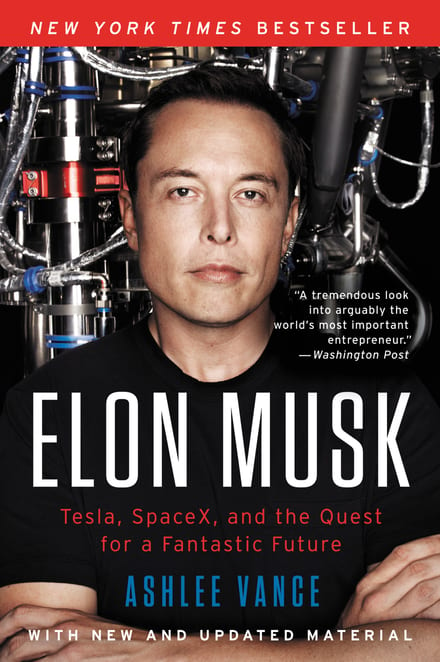
Elon Musk: Tesla, SpaceX, and the Quest for a Fantastic Future
The full book runs ~396 pages — roughly 7 hours of reading. You get the key ideas here in 4 minutes.
The key ideas
- Frame problems as urgent deadlines with no room for negotiation
- Treat failure as a line item, not a stop sign
- Set impossible timelines as forcing functions against complacency
- Build interlocking companies where each reinforces the others
- Refuse to accept that hard industries are impossible to crack
- Sacrifice marriages, staff, and loyalty for the mission
The summary
Elon Musk builds companies by taking an implausible mission — getting humanity to Mars, getting transport off fossil fuels — and treating it as a literal deadline that reality has no right to negotiate. Ashlee Vance’s biography argues that this single move explains everything else: the rockets that land themselves and the trail of ruined marriages, discarded assistants, and burned-out engineers behind them. Musk absorbs failure and expense that would stop anyone else because, to him, the schedule is not optional.
The kid who learned to absorb punishment
The capacity to take a beating and keep going started early. Growing up in Pretoria, South Africa, Musk stayed with his father after his parents separated and was bullied so viciously that one attack left him out of school for a week. He escaped into books, using a near-photographic memory to swallow huge amounts of knowledge; The Hitchhiker’s Guide to the Galaxy left him convinced that asking the right question mattered more than having the answer. By twelve he had already coded and sold a video game called Blastar for $500, and even as a boy he was turning over the ideas — solar power, space travel, paperless banking — that would later become companies. In 1988 he left South Africa to avoid military service, routing through Canada and Queen’s University on his way to the United States.
His stubbornness showed up everywhere, including romance: when Justine Wilson, his future first wife, stood him up on their first date, he found out where she was and her favorite ice cream and turned up with chocolate-chip cones. That same refusal to accept a “no” carried into business. In 1995 he and his brother founded Zip2, an online city guide that collected rejection after rejection until Mohr Davidow Ventures finally invested; Compaq bought it in 1999 for $307 million. Musk splurged on sports cars and a prop plane, then sank most of the money into X.com, an early online bank. X.com merged with Confinity, the maker of PayPal, in 2000, but Musk feuded with colleagues over branding while the site crashed, and executives used his honeymoon to stage a coup and reinstall Peter Thiel as CEO. The renamed PayPal sold to eBay in 2002 for $1.5 billion, handing Musk $250 million and a hard lesson about who holds control.
Impossible timelines as a forcing function
Just after turning thirty, Musk moved to Los Angeles and founded SpaceX in 2002, aiming to become the Southwest Airlines of space by making rockets cheap and routine. He scheduled the first launch for fifteen months out; it took four years. What kept the company alive was his refusal to read failure as a verdict — he treated it as a natural part of the process, and SpaceX went on to become the first commercial outfit to send its Dragon capsule to orbit and recover it from the ocean. The wildly optimistic deadlines weren’t delusion so much as a tool, a way to keep the team from sinking into the industry’s usual glacial pace.
The same nerve built Tesla. Founded in 2003 by Martin Eberhard and Marc Tarpenning, it drew Musk’s $6.5 million and made him chairman and largest shareholder despite his having no experience in car manufacturing. The 2012 Model S — always-connected, touchless startup, and good enough to take Motor Trend’s Car of the Year and the highest rating Consumer Reports had ever given — proved Silicon Valley could break into an industry it had no business entering. Musk’s companies were also designed to feed each other. When his cousins, the Rive brothers, went looking for a business, he pointed them at the installation hassle blocking solar adoption; the result, SolarCity, became the largest solar installer in the country, and the loop closed neatly, with Tesla’s battery packs sold to SolarCity’s customers and SolarCity’s panels powering Tesla’s chargers (Tesla absorbed it in 2016). He kept stacking bets on top, among them the Hyperloop, a pneumatic-tube system pitched to move people and cars at 800 miles per hour.
What the mission costs everyone else
The same intensity wrecks the people around him. Musk has married three times, twice to the same woman, Talulah Riley. When Justine once reminded him during a fight that she was his wife, not his employee, he shot back that he’d have fired her if she were; in 2008 he told her to fix the marriage that day or he’d file the next, and when she asked for a week, he filed anyway. He married Riley soon after, divorced her in 2012, remarried within months, then divorced again in 2014, remarking that a woman needs at least ten hours a week he simply couldn’t spare — though Riley says he still made dinners and played computer games with the kids. Staff fare no better. Mary Beth Brown, his assistant of more than twelve years, was let go two weeks after asking for a raise, and he once berated an employee for skipping a company event to attend his own child’s birth. Splitting each week between SpaceX in Los Angeles and Tesla in Silicon Valley, he demands total commitment and is widely described as tough, volatile, and unempathetic — and offers no apology for it.
The bottom line
Musk’s companies exist because he genuinely believes humanity’s survival is on the line and will spend money, sleep, and relationships without hesitation to hit the deadline. Read this if you want to understand how an impossible mission gets turned into a real business; look elsewhere if you want a model for a balanced life.
Frequently asked questions
What is Elon Musk about?
Ashlee Vance's biography argues that Musk builds companies by taking an implausible mission, getting humanity to Mars or transport off fossil fuels, and treating it as a literal deadline reality has no right to negotiate. That single move, the book says, explains both the rockets that land themselves and the trail of ruined marriages and burned-out engineers behind them.
What are the key takeaways from Elon Musk?
A brutally bullied childhood taught Musk to absorb punishment and keep going, and that stubbornness carried from Zip2 and PayPal into SpaceX and Tesla. Wildly optimistic timelines work as a forcing function, a tool to keep teams from the industry's usual glacial pace, and his companies were designed to feed each other, as Tesla, SolarCity, and SpaceX did. The same intensity that fuels the mission wrecks the people around him.
Who should read Elon Musk?
Read it if you want to understand how an impossible mission gets turned into a real business; look elsewhere if you want a model for a balanced life.
Is Elon Musk worth reading?
It's an absorbing, even-handed account that explains the method behind Musk's results without hiding the human cost to the people around him. It's a portrait rather than a playbook, and one man's extreme approach doesn't transfer neatly to a normal life or career, so read it for understanding more than imitation.