Book summary
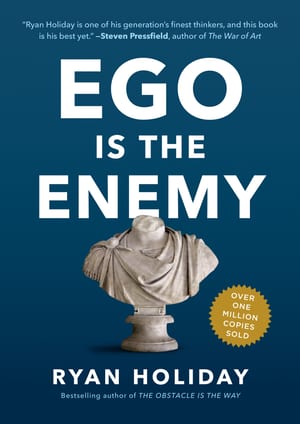
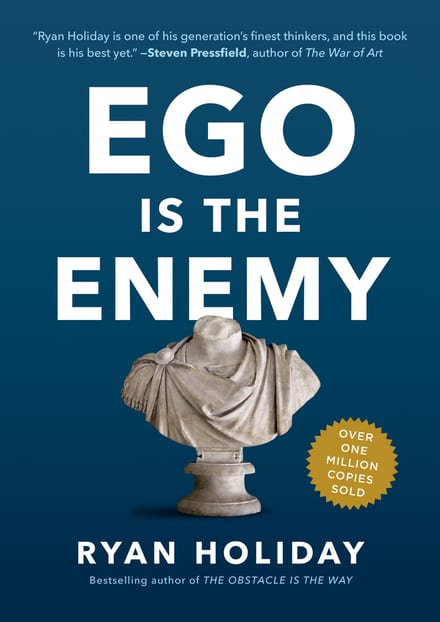
Ego Is the Enemy
The full book runs ~238 pages — roughly 4 hours of reading. You get the key ideas here in 5 minutes.
The key ideas
- Distinguish ego from confidence: one is stolen, one is earned
- Choose to do something over to be somebody
- Stay a student even after you succeed
- Beware success—the most dangerous moment is right after winning
- Turn adversity into alive time, not dead time
- Keep your own scorecard, not the crowd's applause
The summary
Ego — not your rivals, not bad luck, not a shortage of talent — is the thing most likely to wreck what you set out to build. Ryan Holiday defines the enemy plainly: ego is an unhealthy belief in our own importance, the petulant need to be recognized far past any reasonable use. It is not the same as confidence. Confidence is earned; ego is stolen. And because it feels good — it soothes fear, it tells you what you want to hear — it slips in exactly when you can least afford it. Holiday tracks it across the three phases every ambitious life moves through: aspiration, success, and failure. The aim is to be humble in your aspirations, gracious in your success, and resilient in your failure.
Talk is cheap; the work is everything
When you are just starting out, ego’s favorite disguise is talk. Holiday opens with Upton Sinclair, who during his 1934 run for governor of California published a book describing, in the past tense, the brilliant policies he would enact once elected. He lost by a landslide — and observers noticed he had lost interest well before the votes came in. Having narrated the victory, he no longer needed to win it. That is the trap. Announcing your plans feels like progress while it quietly drains the energy the work demands. Bo Jackson decided he would win the Heisman and go first in the NFL draft, and told no one but his girlfriend.
Two habits protect you here. The first is choosing to do over to be. Holiday tells the story of John Boyd, the fighter pilot known as “Forty-Second Boyd,” who reshaped modern air combat yet retired a colonel with a pension and a small apartment. Boyd made every promising young officer choose: to be somebody, or to do something. Chase the title, the parking space, the easy promotions — or do work that matters and accept that you may go unrecognized. The second habit is staying a student. Kirk Hammett had just landed his dream gig in Metallica when he sought out the guitar teacher Joe Satriani and submitted to two years of harsh weekly drilling. Revising your estimate of your own ability downward is one of the hardest things a person can do, and it is almost always where mastery begins. William Tecumseh Sherman is the model for the whole phase: a slow, cautious rise, a willingness to waive his own rank to reinforce Grant, and eventually a refusal of the presidency itself. Poise, not pose.
The most dangerous moment is right after you win
Success is intoxicating, and that is precisely the danger. The pull now is to stop learning and start believing your own press. Holiday’s counter-model is Genghis Khan — not the barbarian of legend but a perpetual student whose conquests came from absorbing every useful thing each culture offered, from the decimal system to siege engines. As the physicist John Wheeler put it, as our island of knowledge grows, so does the shore of our ignorance.
The other temptation is narrative. When Bill Walsh took the 49ers from the worst team in football — 2 and 14 the year before he arrived — to a Super Bowl in three seasons, everyone wanted him to claim he had planned it all along. He refused. He had installed what he called the Standard of Performance: exacting rules about practice, dress, and drilling, on the theory that if the players took care of those details, the score would take care of itself. He shrugged off being called “the Genius.” His players did not, and after letting the story go to their heads they promptly lost 12 of their next 22 games. Holiday sets Angela Merkel against all of this as a study in sobriety — unpretentious, unglamorous, and durable for exactly that reason.
In failure, keep your own scorecard
Fate eventually dashes everyone’s plans, and the ego so useful for inflating success turns fatal in a crisis. Katharine Graham inherited the Washington Post and, after her husband’s suicide, found herself running the company in 1963 at forty-six, timid and unprepared. Against her board’s advice she published a cache of stolen government documents and backed the reporting that became Watergate. What carried her was not swagger but fortitude.
Two ideas anchor this phase. The first is alive time versus dead time. Malcolm X went to prison a criminal and used the years to read voraciously and teach himself, turning confinement into an education. You can spend adversity passive and resentful, or learning and building. The second is keeping your own scorecard. When the Patriots drafted Tom Brady in the sixth round and he became one of the greatest players in the game, they did not celebrate — they interrogated how their own scouting had nearly missed him. Warren Buffett calls this the inner scorecard versus the external one: measure yourself against your own potential, not the applause. Do that, and defeat loses much of its power to crush you.
The bottom line
Ego is a short-term comfort with a long-term cost — it severs you from reality, and reality is the only place real work gets done. Strip it away and what remains is not weakness but earned confidence: humble while you build, gracious while you win, steady when it all falls apart. Read this if you are ambitious enough to be at risk — setting out, riding a hot streak, or picking yourself up after a fall.
Frequently asked questions
What is Ego Is the Enemy about?
The book makes the case that ego, an unhealthy belief in your own importance, is the thing most likely to wreck what you set out to build, and that it's not the same as earned confidence. It tracks how ego sabotages you across the three phases of an ambitious life, arguing you should be humble in your aspirations, gracious in your success, and resilient in your failure.
What are the key takeaways from Ego Is the Enemy?
When starting out, choose to do over to be and stay a student, because talk quietly drains the energy real work demands, as Upton Sinclair, John Boyd, and Kirk Hammett show. The most dangerous moment is right after you win, so keep learning like Genghis Khan and resist your own flattering narrative, the way Bill Walsh did. In failure, treat adversity as "alive time" to build, like Malcolm X, and keep your own inner scorecard rather than chasing applause, as Warren Buffett urges.
Who should read Ego Is the Enemy?
Read it if you're ambitious enough to be at risk, whether you're setting out, riding a hot streak, or picking yourself up after a fall.
Is Ego Is the Enemy worth reading?
It's a bracing, well-told set of historical stories that drive home a genuinely useful warning about self-importance. The lessons can feel like variations on one theme, stay humble and do the work, so if you want a systematic method rather than motivational case studies, temper your expectations, but the examples are hard to forget.