Book summary
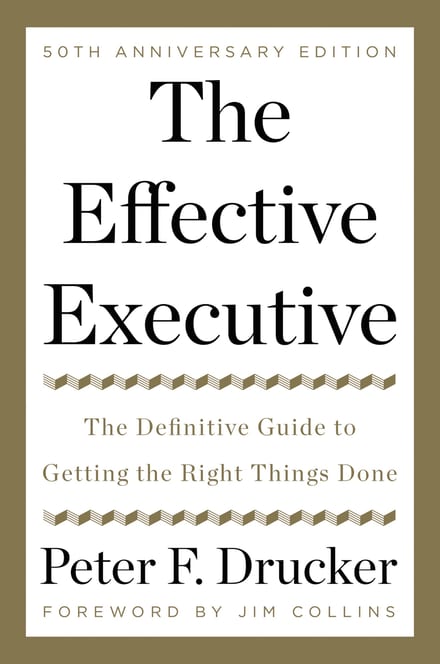
The Effective Executive: The Definitive Guide to Getting the Right Things Done
The full book runs ~166 pages — roughly 3 hours of reading. You get the key ideas here in 6 minutes.
The key ideas
- Track where your time actually goes, then consolidate it into uninterrupted blocks
- Ask what results you owe, not what work exists
- Hire and build on strengths; tolerate weakness that doesn't matter
- Concentrate on one important thing; do first things first
- Make few fundamental decisions well, testing opinions against reality
- Choose opportunity over problems, and the future over the past
The summary
Effectiveness is not a talent you’re born with. It’s a set of habits, and Peter Drucker’s whole case is that anyone can learn them. His definition of “executive” is broader than a corner office: if your work runs on judgment rather than muscle, and your decisions affect the organization’s results, you’re an executive—even if you manage no one. And the knowledge worker’s output is measured by results, not hours logged or memos produced. Intelligence, imagination, and knowledge are raw material; only effectiveness turns them into anything that matters.
Time is the resource you can’t buy back
Everything starts with time, because it’s the one input you can’t purchase more of. Drucker’s method is unsentimental: don’t guess how you spend your hours, record them. The log almost always holds surprises, and once you can see the truth you can act on it. Cut the tasks that produce nothing by asking, “What would happen if this were not done at all?” Hand off anything a colleague could do just as well. And ask the people around you the uncomfortable question: “What do I do that wastes your time without contributing to your effectiveness?”
Organizations bleed time in patterns worth recognizing. A crisis that keeps recurring signals a missing system—and a well-run operation is boring, because its crises have already been anticipated and turned into routine. Too many meetings signal bad structure; you either meet or you work, never both at once. The payoff isn’t finding more time but pooling the discretionary time you have into large, unbroken blocks. A single stretch of three uninterrupted hours beats the same total sliced into fragments. So protect your mornings, take a day at home for deep work, and re-check your time budget every few months.
Aim at results, and staff for strength
The effective executive flips the reflexive question. Instead of “What work is there to do?” they ask, “What results are expected of me?” That turns the focus from effort to contribution—and toward the three things every organization needs: direct results, a reaffirmation of its values, and the development of the people who will run it next. What looks from outside like a gift for “good human relations” is really this: executives earn strong working relationships through substance, not charm. They set high demands, because people grow to meet the demands they place on themselves, and they prepare so thoroughly that meetings stay short. As Drucker adapts the old line, “I’m sorry to imprison you in this long meeting, as I did not have time to prepare a short one.”
Getting results depends on how you use people, and here Drucker is blunt: build on strengths, never on the absence of weakness. Most organizations screen out flaws and end up staffed with the merely inoffensive. To hire for strength you have to tolerate weakness, because there is no such thing as a “good man”—only “good for what?” Design jobs to be big and demanding, and if two or three capable people fail in the same role, the role is broken, not the people. Judge someone by what they’ve done well and whether you’d want your own child working under them. Move underperformers out quickly, especially managers, since keeping them demoralizes the team and is crueler to the person than an honest ending. Apply the same lens upward and inward: learn what your boss does well and what he needs from you, and ask yourself what comes easily to you that others find hard. Then build your work on that.
Do first things first
The secret, Drucker says, is concentration—first things first, and one thing at a time. The people who accomplish nothing are often the ones working hardest, scattered across everything at once. So keep asking of every activity, “Is this still worth doing?” and drop anything that isn’t an unqualified yes.
Setting priorities takes more courage than analysis. Pick the future over the past. Choose opportunity over problems, because solving a problem only restores yesterday’s balance while seizing an opportunity creates something new. Choose your own direction instead of drifting with the crowd, and aim high enough to matter. DuPont outran its rivals for decades largely by abandoning a product or process before it began to decline, rather than clinging to it.
Make fewer, better decisions
Effective executives don’t make many decisions. They make a few fundamental ones and get them right, because deciding fast usually means deciding wrong. Start by asking whether the situation is generic, calling for a rule, or genuinely exceptional. Define the boundary conditions—the objectives and minimums the decision must satisfy—and decide on what is right rather than what is merely acceptable, even though some compromise is inevitable. A decision isn’t real until it becomes someone’s assigned responsibility, so spell out who must know, what action follows, and who owns it. Militaries learned long ago that the officer who gives an order goes and checks it was carried out—not from distrust of the subordinate, but from hard-won distrust of communication.
Crucially, decisions begin with opinions, not facts. The job is to treat those opinions as hypotheses and test them against reality, and to actively cultivate disagreement, which guards against organizational bias, forces real alternatives into view, and sparks imagination. Sometimes the right call is to do nothing at all. But when the benefits clearly outweigh the risks, act—don’t hedge.
The bottom line
Effectiveness comes down to a handful of learnable habits: know where your time goes, aim at results instead of effort, build on strengths, concentrate on one important thing at a time, and make a few big decisions well. None of it takes genius, only discipline. Read this if you’re a knowledge worker who’s tired of being busy and wants to start being effective.
Frequently asked questions
What is The Effective Executive about?
The book argues that effectiveness isn't an inborn talent but a set of habits anyone can learn, and that any knowledge worker whose judgment affects results counts as an "executive," even if they manage no one. Its subject is how to turn intelligence, imagination, and knowledge into results that actually matter, through a handful of learnable disciplines.
What are the key takeaways from The Effective Executive?
Start by recording where your time actually goes, then cut the tasks that produce nothing and pool your hours into large, unbroken blocks. Aim at results and contribution rather than effort, and build on people's strengths instead of screening out their weaknesses. Concentrate on first things first, one thing at a time. And make few, fundamental decisions well, treating opinions as hypotheses to test against reality and cultivating disagreement rather than deciding fast.
Who should read The Effective Executive?
Read it if you're a knowledge worker who's tired of being busy and wants to start being effective.
Is The Effective Executive worth reading?
Its ideas have held up for decades and stay unusually clear-headed, from time-tracking to staffing for strength to decision discipline, with plenty of concrete examples. The examples and tone are dated, drawn from mid-century corporations and government, so you'll do some mental translation, but the underlying habits still apply.