Book summary
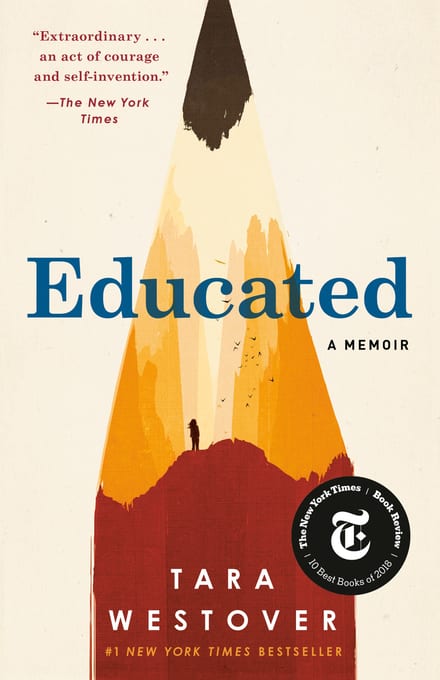
Educated: A Memoir
The full book runs ~388 pages — roughly 7 hours of reading. You get the key ideas here in 4 minutes.
The key ideas
- Raised off-grid, off-record, teaching herself amid junkyard danger
- Distrust of medicine and schooling nearly killed the family
- Abuse stays nameless without outside perspective and vocabulary
- Self-study earned her a path to Cambridge and a PhD
- Recognized her father's untreated bipolar illness shaped everything
- Chose her own mind over a family demanding denial
The summary
Education gave Tara Westover far more than facts and a diploma. It handed her the words to name what had been done to her — and once she had them, she couldn’t keep both the education and the family that required her not to know.
She grew up in the Idaho mountains with no school, no doctors, and for years no birth certificate. Her father Gene was a fervent Mormon and government-fearing survivalist who kept his children off every official record; her mother Faye worked as an unlicensed midwife and herbalist. “Homeschooling” meant being left alone with whatever books were around. Tara’s real education was bottling peaches, playing in the fields, and eventually hauling scrap in her father’s junkyard, a place casually laced with danger. Gene believed the Days of Abomination were near and dug a bunker stocked with food and weapons; when the world didn’t end on January 1, 2000, life simply went on.
A house that refused help
The family’s distrust of the outside world was nearly fatal. After a car accident coming home from Arizona, they turned down the hospital and reached for herbs and prayer instead — not the first time, and not the last. Gene survived a gas-tank explosion that left him badly burned, again without medical care. Against that backdrop, Shawn, one of Tara’s brothers, was violent: he attacked her for wearing makeup, dragged her by the hair, and her parents waved it away. With no schooling and no outside perspective, Tara had no vocabulary for any of it. She told herself she was invulnerable, that she only ever cried from physical pain. You can’t name abuse you have no word for.
Her brother Tyler was the crack of light. He had left for college, and his example lodged the idea in her that she might leave too. Gene opposed it as worldly corruption; he allowed her voice lessons and a part at the local Worm Creek Opera House but forbade dancing as immodest. Still, the thought wouldn’t leave. Tyler pushed her toward the ACT. She studied alone, scored a 28 on her second try, and got into Brigham Young University. Her father said the Lord was displeased. Her mother drove her to campus anyway, and Tara arrived in Provo with a few jars of canned peaches and almost no idea how ordinary life worked.
The classroom rewires everything
College was disorienting before it was liberating. Her roommates seemed shockingly immodest, the city was loud, and a Western civilization course confronted her with terms and events she had never encountered. She nearly foundered, then pulled near-straight A’s. The harder lesson was learning to accept help: financial aid from the local church, a dental operation she couldn’t pay for, ibuprofen a friend named Charles pressed on her for an earache, which taught her that medicine actually works. At nineteen she qualified for a student loan and, for the first time, lived without money fear.
The knowledge cut in a more personal direction too. Reading about bipolar disorder, she recognized her father with a jolt — the paranoia, the grandiosity, the certainty. Much of what had governed her childhood, she realized, was untreated illness, and it made her angry that it had gone unnamed for so long. She had come to study music, but history and politics were her real pull. A professor sent her to a study-abroad program at Cambridge, where the historian Jonathan Steinberg was impressed enough to promise help with graduate school. She won a Gates Cambridge Scholarship and, briefly, became a local celebrity back in Idaho.
Choosing her own mind
At Cambridge she began to loosen. She made friends, questioned old rules, read feminist theory, and studied Mormonism as a subject rather than a duty, then earned a place for PhD work. But Idaho kept intruding. Her sister Audrey confided that Shawn had attacked her as well. Tara promised to stand with her and confronted their parents — who demanded proof, dismissed the accusations, and sided with their son. Shawn sent death threats. Her father insisted she accept a priesthood blessing and forget everything that had happened. She refused, and the rupture triggered panic attacks and a breakdown that nearly cost her the doctorate. She cut contact with her parents, steadied herself, and finished the thesis.
Years later she went back for her grandmother’s funeral and found most of her siblings still lined up behind Gene and Shawn. She kept a thread to Tyler and a few others and accepted the rest: she could not return to the mountains and remain herself.
The bottom line
Education, for Westover, wasn’t the accumulation of facts but the acquisition of a self — the concepts and language to understand her own history and the strength to leave a family that asked her to deny it. Read it if you want to feel, up close, what it can cost to claim your own mind, and why she still counts the price as worth paying.
Frequently asked questions
What is Educated about?
Educated is Tara Westover's memoir of growing up in a survivalist Mormon family in the Idaho mountains, with no school, no doctors, and for years no birth certificate. Its heart is how education gave her the words to name what had been done to her, and how, once she had them, she couldn't keep both the education and a family that required her not to know.
What are the key takeaways from Educated?
The book shows how isolation leaves you without the vocabulary to recognize abuse, and how learning can rewire your understanding of your own life, from a Western civilization course to reading about bipolar disorder and recognizing her father, to feminist theory at Cambridge. It traces the cost of learning to accept help, choosing your own mind, and the painful rupture that follows when a family sides against you.
Who should read Educated?
Read it if you want to feel, up close, what it can cost to claim your own mind, and why she still counts the price as worth paying.
Is Educated worth reading?
It's a gripping, emotionally precise account of a truly unusual upbringing and a hard-won transformation, memorable for how it dramatizes education as the making of a self rather than the collecting of facts. It's a personal memoir, not a how-to, so read it for the experience and understanding rather than any step-by-step lessons.