Book summary
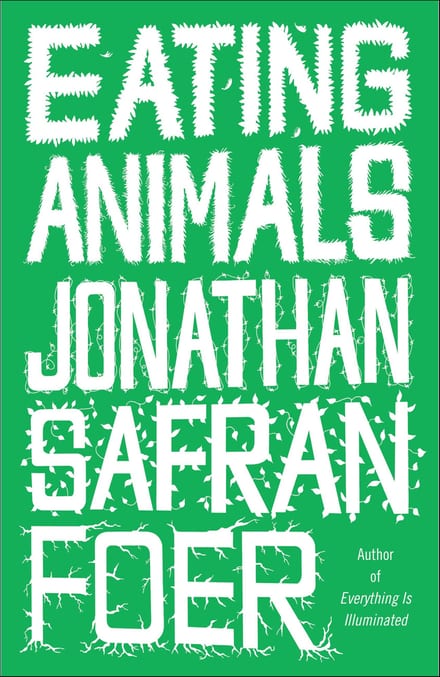
Eating Animals
The full book runs ~365 pages — roughly 7 hours of reading. You get the key ideas here in 4 minutes.
The key ideas
- Factory farms externalize costs onto animals, workers, health, and climate
- Fewer than 1% of American meat comes from family farms
- Systematic cruelty: conscious scalding, gestation crates, thumped runts, sea-lice death crowns
- Crowded uniform animals breed pandemics and antibiotic-resistant bacteria
- Livestock drives 18% of greenhouse emissions, outpacing all transportation
- Industry survives on secrecy and consumers pretending to be asleep
The summary
Cheap meat is a magic trick, and the trick is keeping you from looking. Jonathan Safran Foer set out to see exactly how the animals we eat are raised and killed, and what he found is a system engineered around consumer ignorance. The low price on a package of chicken isn’t real. It exists only because the true costs — to the animals, to slaughterhouse workers, to rivers and air, to the climate — are paid out of sight. Look directly at the process and cheapness stops working as a defense.
The price tag is a lie
Foer frames the whole question through his grandmother, who survived wartime starvation yet refused a piece of non-kosher pork a farmer offered her. “If nothing matters,” she explained, “there’s nothing to save.” Food is never just fuel; it carries our values. And the values built into industrial meat are stark. Less than 1% of the animals killed for meat in America come from family farms. The rest come from operations run on a single calculation, as Foer puts it: factory farmers “calculate how close to death they can keep the animals without killing them. That’s the business model. How quickly can they be made to grow, how tightly can they be packed… how sick can they get without dying.” When he visited a turkey farm at night, he found tens of thousands of chicks crammed under heat lamps in a windowless shed, the dead and deformed scattered among the living, beaks and toes blackened.
Cruelty is the design, not the exception
The scale is hard to hold in your head, so the details do the work. On automated slaughter lines, birds that miss the throat-slitter go into the scalding tank alive and conscious — around 180 million chickens a year in the United States. Pigs endure their own version. Breeding sows spend their pregnancies in gestation crates too small to turn around in; piglets are castrated and tail-docked without anesthesia, then packed into deliberately overcrowded pens because, as an industry magazine notes, “overcrowding pigs pays” — cramped animals burn fewer calories and fatten on less feed. The runts that grow too slowly are “thumped,” killed by slamming their heads into the ground.
Fish farming copies the logic. Salmon crowded into sea cages breed sea lice at thirty thousand times the natural rate; the lice eat into the fish’s face down to the bone, an injury so routine the industry calls it the “death crown.” Scientists cited in the book predict the collapse of every fished species within fifty years even as the hunt intensifies. And the cruelty isn’t only structural. Workers trapped in low-paid, dehumanizing slaughter jobs commit deliberate sadism — clubbing baby turkeys, stomping chickens “to watch them pop,” beating lame pigs with pipes. When Temple Grandin first surveyed U.S. plants, she recorded deliberate acts of cruelty happening regularly at 32% of them, and these were announced visits.
The costs that reach your own body
The damage doesn’t stay on the farm. Packing genetically uniform, stressed animals into filthy, crowded barns is close to a laboratory for new diseases: it hands viruses ideal conditions to mutate and jump to humans, which is how threats like bird flu and swine flu emerge. To keep animals alive in those conditions, the industry doses them constantly with antibiotics — not to treat illness but to force growth — which breeds the drug-resistant bacteria that make human infections harder to cure.
Then there’s the climate. The UN attributes 18% of greenhouse gas emissions to livestock, roughly 40% more than all transportation combined. Animal agriculture drives a huge share of the most potent gases — methane, which traps far more heat than carbon dioxide, and nitrous oxide, worse still — and an omnivorous diet produces about seven times the emissions of a vegan one. Giants like Smithfield generate lagoons of toxic waste that sicken nearby communities, while the meat, dairy, and egg lobby shapes government nutrition guidelines and fends off regulation.
The comfort of pretending to sleep
None of this survives scrutiny, which is why the industry works so hard to prevent it: locked doors, ignored letters, blocked research. It runs on our willingness not to know. “It’s always possible to wake someone from sleep,” Foer writes, “but no amount of noise will wake someone who is pretending to be asleep.” Farmers defend the system by pointing to consumer demand for cheap food, but that’s circular — demand stays high precisely because the real costs stay hidden. Foer refuses to leave the whole burden on shoppers decoding what’s humane at the meat counter; cruel and destructive food products, he argues, should simply be illegal. His sharpest challenge is a question: “Just how destructive does a culinary preference have to be before we decide to eat something else?”
The bottom line
Meat is cheap only because its true costs — animal suffering, worker abuse, pandemics, antibiotic resistance, a warming planet — are pushed onto everyone but the buyer. The book’s real subject isn’t diet so much as honesty: whether we’ll look at what we’re paying for. Read it if you eat animals and want to know what that choice actually sets in motion.
Fact check
Popular books repeat findings that later research has complicated. Where Eating Animals makes a testable claim, here's what the evidence actually shows.
Livestock produce 18 percent of greenhouse gas emissions, roughly 40 percent more than all transportation combined.
Foer reported the FAO accurately for its time: the 2006 assessment Livestock's Long Shadow states that the livestock sector is "responsible for 18 percent of greenhouse gas emissions measured in CO2 equivalent" and that "this is a higher share than transport." The FAO's own 2013 reassessment revised the figure down to 14.5 percent — 7.1 gigatonnes of CO2-equivalent a year against a 2005 baseline — using a fuller supply-chain model. Livestock is still a major emitter, but the 18 percent number and the stated margin over transport no longer stand.
- Food and Agriculture Organization of the United Nations. Livestock's Long Shadow: Environmental Issues and Options. Rome: FAO; 2006. Source
- Gerber PJ, Steinfeld H, Henderson B, et al. Tackling Climate Change Through Livestock: A Global Assessment of Emissions and Mitigation Opportunities. Rome: Food and Agriculture Organization of the United Nations; 2013. Source
Fewer than 1 percent of the animals killed for meat in America come from family farms.
By the USDA's own definition the figure is close to inverted: 97 percent of U.S. farms counted in 2024 were family farms, meaning the operator and their relatives own most of the business. The concentration Foer is pointing at is nonetheless real — large-scale family farms make up about 5 percent of all farms and produce half of U.S. agricultural output by value, and most big livestock operations are family-owned on paper while running at industrial scale under contract to processors. The claim works only if "family farm" is taken to mean small and non-industrial, which is not how the statistics are collected.
- US Department of Agriculture, Economic Research Service. Farming and farm income. Ag and Food Statistics: Charting the Essentials. Accessed July 30, 2026. Source
When Temple Grandin first surveyed U.S. slaughter plants, she recorded deliberate acts of cruelty happening regularly at 32 percent of them.
Grandin's 1996 USDA survey of 24 federally inspected beef, veal, pork and sheep plants does not report that figure. It rated 9 percent of plants a "serious problem" for rough handling — at one, electric prods were used to paralyze cattle before stunning — and 14 percent "not acceptable." The 32 percent in that report is the share of cattle that vocalized under excessive prod use at a single beef plant, not a share of plants. The broader picture Foer draws on holds up: Grandin named several routine practices as cruelty, and her 1998 scoring study found only 4 of 11 beef plants could render 95 percent of cattle insensible with one captive-bolt shot.
- Grandin T. Survey of Stunning and Handling in Federally Inspected Beef, Veal, Pork, and Sheep Slaughter Plants. USDA Agricultural Research Service project 3602-32000-002-08G. Fort Collins, CO; 1997. Source
- Grandin T. Objective scoring of animal handling and stunning practices at slaughter plants. J Am Vet Med Assoc. 1998;212(1):36-9. PubMed
Frequently asked questions
What is Eating Animals about?
The book investigates how the animals we eat are actually raised and killed, and argues that cheap meat only looks cheap because its true costs are hidden from the buyer. Those costs, to the animals, to slaughterhouse workers, to rivers and air, and to the climate, are paid out of sight, so the whole system runs on consumer ignorance.
What are the key takeaways from Eating Animals?
Less than 1% of American meat comes from family farms; the rest runs on a business model of keeping animals as close to death as possible without killing them. Cruelty is the design, not the exception, from chickens scalded alive to sows in gestation crates. The damage reaches your own body through new diseases and antibiotic-resistant bacteria, and livestock drives 18% of greenhouse emissions. The system survives only because people choose not to look.
Who should read Eating Animals?
Read it if you eat animals and want to know what that choice actually sets in motion.
Is Eating Animals worth reading?
Its power is honest, hard-to-unsee reporting woven through a personal story about food and family values, which makes the hidden costs concrete. It's deliberately confronting and one-sided by design, so if you want a balanced defense of animal agriculture you won't find it here; the book's real subject is whether you'll look at all.