Book summary
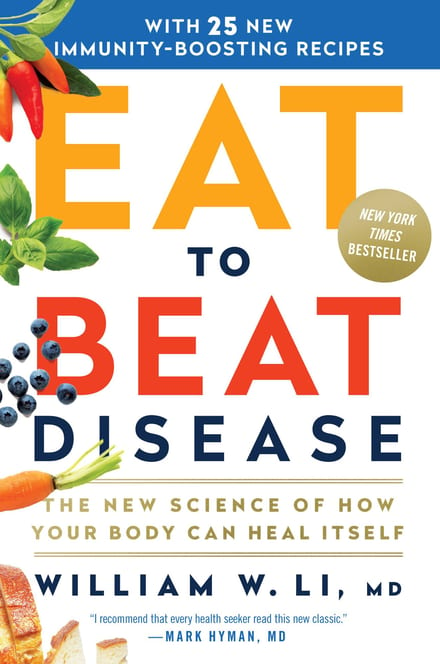
Eat to Beat Disease: The New Science of How Your Body Can Heal Itself
The full book runs ~578 pages — roughly 11 hours of reading. You get the key ideas here in 2 minutes.
The key ideas
- Starve tumors: soy and broccoli suppress blood-vessel-feeding angiogenesis
- Repair faster: cocoa flavanols double circulating stem cells
- Feed your gut: pomegranate, sauerkraut, and parmesan boost the microbiome
- Arm immunity: mushrooms and olive oil raise key immune markers
- Protect DNA: berries and nuts strengthen and lengthen telomeres
- Small additions count: beer, cheese, spice, and seafood cut disease risk
The summary
Cancer isn’t only something that strikes other people from the outside. It’s happening inside you right now. Cells divide incorrectly all the time and form microscopic tumors — not a malfunction, just a fact of biology. What keeps you healthy is not the absence of rogue cells but the presence of systems that stop those cells from ever becoming dangerous. William Li’s argument is that you already own five such defenses — angiogenesis (blood-vessel control), stem-cell regeneration, a protective gut microbiome, your immune response, and the DNA-guarding telomeres — and that ordinary foods measurably strengthen each one. Eating, in this light, is less about restriction than about feeding the machinery that keeps disease from taking hold.
Cut off the tumor’s blood supply
A microscopic tumor is harmless until it can build a blood supply to feed itself. Angiogenesis is the system that governs whether those vessels form, and you can tilt it against cancer with what’s on your plate. Soy is one lever: a daily 10 grams or more of soy protein improves the body’s cancer-fighting function. Broccoli is another, thanks to compounds called brassinin and sulforaphane. Harvard research tied regular broccoli consumption to a 33 percent lower risk of ovarian cancer, a 59 percent lower risk of prostate cancer, and a 28 percent lower risk of melanoma. You’re not stopping the initial mutations. You’re refusing to lay the pipes that would let them grow.
Speed up repair and seed a healthier gut
Stem cells are your regeneration crew — they rebuild tissue and patch up blood vessels after damage like a heart attack. The more of them circulating, the faster you heal, and cocoa helps. The flavanols in it boost circulation so effectively that in one study, people who drank flavanol-rich cocoa twice a day doubled the stem cells in their bloodstream.
Your gut bacteria do quieter but equally real work, shaping mood, diabetes risk, and inflammation. Pomegranate and cranberry lower gut inflammation, strengthen immunity, and fight obesity. Sauerkraut spurs stem-cell growth in the intestines, cooling inflammation there. Even Parmigiano Reggiano carries bacteria linked to protection against cancer, gastroenteritis, and postnatal depression. These aren’t exotic supplements — they’re groceries.
Arm your immune system and protect your DNA
Your immune system doesn’t just fend off colds; it patrols for cancerous cells and clears out debris. Cheap white button mushrooms give it a real lift — adding 100 grams a day for a week raised salivary antibodies by 55 percent in one study. Extra virgin olive oil does something similar: replacing other dietary fat with it for three months lifted key immune markers by 53 percent.
Meanwhile, your DNA frays as you age, and telomeres — the protective caps on the ends of your chromosomes, like the plastic tips on shoelaces — slow that fraying. When they wear down too far, cells stop copying themselves properly and aging accelerates. Berries and nuts have been shown to strengthen and lengthen telomeres, essentially buying your DNA more time.
The small, surprising additions
Not every helpful food is a virtuous one. Beer contains xanthohumol, which has anti-cancer properties and stunts the growth of fat cells. A large study linked daily spicy food to a 14 percent lower risk of dying from any disease, including stroke, heart disease, and cancer. Small amounts of hard cheese — Emmental, Gouda, Edam — carry enough vitamin K2 to lower prostate and lung cancer risk, and modest cheese intake is associated with fewer heart attacks. Daily seafood lowers the odds of breast and bowel cancer. None of these are trendy superfoods. They’re small, cumulative choices backed by population data.
The bottom line
Your body already knows how to defend itself; the point is to feed those defenses — from starving tumors to lengthening telomeres — with foods you can buy at any market. Read this if you’d rather work with your biology than wage war on it with another round of calorie counting.
Fact check
Popular books repeat findings that later research has complicated. Where Eat to Beat Disease makes a testable claim, here's what the evidence actually shows.
Drinking flavanol-rich cocoa twice a day doubles the stem cells circulating in your bloodstream.
The doubling is accurate as far as it goes: CD34+/KDR+ circulating angiogenic cells rose 2.2-fold after 30 days of twice-daily high-flavanol cocoa. But the trial ran in 16 coronary artery disease patients averaging 64 years old, and the cells' actual capacity to survive, differentiate, proliferate and migrate did not differ from the low-flavanol period — the count went up, the function did not. Circulating angiogenic cells are also a marker of vascular repair capacity rather than stem cells in the general sense.
- Heiss C, Jahn S, Taylor M, et al. Improvement of endothelial function with dietary flavanols is associated with mobilization of circulating angiogenic cells in patients with coronary artery disease. J Am Coll Cardiol. 2010;56(3):218-24. PubMed
Eating 100 grams of white button mushrooms a day for a week raises salivary antibodies by about 55 percent.
The number is faithfully reported — salivary IgA secretion rose 53 percent at week 1 and 56 percent at week 2 in volunteers eating 100 g of blanched white button mushrooms daily. The trial was small and loosely controlled: 24 healthy adults, 12 of them eating mushrooms, with the control group simply eating its normal diet rather than a matched placebo food. The effect also vanished by week 3 once the mushrooms stopped, and salivary IgA is a single mucosal marker; the study did not track infections or illness.
- Jeong SC, Koyyalamudi SR, Pang G. Dietary intake of Agaricus bisporus white button mushroom accelerates salivary immunoglobulin A secretion in healthy volunteers. Nutrition. 2012;28(5):527-31. PubMed
Harvard research tied regular broccoli consumption to a 33 percent lower risk of ovarian cancer, a 59 percent lower risk of prostate cancer and a 28 percent lower risk of melanoma.
The prostate figure looks like an odds ratio read as a percentage. The likeliest source, a Seattle case-control study of 628 men with prostate cancer and 602 controls, reported an odds ratio of 0.59 for three or more servings of cruciferous vegetables a week — a 41 percent lower risk, not 59 percent — and it came out of the Fred Hutchinson Cancer Research Center, not Harvard. Pooling 13 studies puts the effect far lower: a relative risk of 0.90 overall, and no significant association at all across the seven cohort studies (RR 0.95, 95% CI 0.88-1.02). Cruciferous vegetables look mildly protective; the individual percentages are single-study associations, not settled effect sizes.
Eating spicy food every day is linked to a 14 percent lower risk of dying from any cause.
The 14 percent is exactly what the study found: among 487,375 Chinese adults followed for a median of 7.2 years, those eating spicy food 6 or 7 days a week had an adjusted hazard ratio for death of 0.86 against those eating it less than weekly. The raw numbers are flatter than that implies — crude mortality was 6.1 deaths per 1,000 person-years in the rarely-spicy group and 5.8 in the daily group, with the lowest rates in the middle categories — so the benefit appears only after adjusting for other risk factors. Spice intake was self-reported once at enrolment, and no trial has tested whether adding chili to a diet changes mortality.
- Lv J, Qi L, Yu C, et al. Consumption of spicy foods and total and cause specific mortality: population based cohort study. BMJ. 2015;351:h3942. PubMed
Frequently asked questions
What is Eat to Beat Disease about?
The book argues that your body already owns five defense systems, angiogenesis, stem-cell regeneration, the gut microbiome, immunity, and DNA-protecting telomeres, that keep everyday rogue cells from ever becoming dangerous. Its point is that ordinary foods measurably strengthen each defense, so eating is about feeding the machinery that keeps disease from taking hold rather than restricting yourself.
What are the key takeaways from Eat to Beat Disease?
Specific foods support specific defenses: soy and broccoli tilt angiogenesis against tumors; cocoa and sauerkraut boost stem cells; pomegranate, cranberry, and Parmigiano Reggiano feed a healthier gut; white button mushrooms and extra virgin olive oil lift immunity; and berries and nuts protect telomeres. Even beer, spicy food, hard cheese, and seafood carry documented benefits. These are groceries, not exotic supplements, and the gains come from small, cumulative choices.
Who should read Eat to Beat Disease?
Read it if you'd rather work with your biology than wage war on it with another round of calorie counting.
Is Eat to Beat Disease worth reading?
It's worth it for an optimistic, food-first frame backed by concrete studies and specific foods you can actually buy. The many single-study percentages read as more certain than nutrition science usually allows, so take the exact numbers as encouraging pointers rather than guarantees.