Book summary
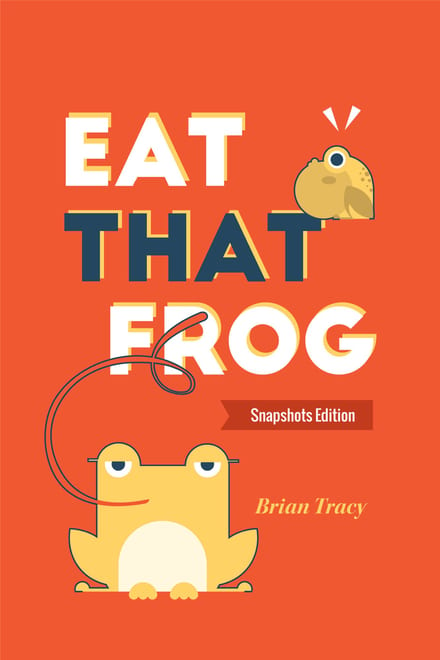
Eat That Frog!
21 Great Ways to Stop Procrastinating and Get More Done in Less Time
The full book runs ~128 pages — roughly 2 hours of reading. You get the key ideas here in 5 minutes.
The key ideas
- Eat the ugliest frog first: tackle your hardest task before anything else
- Write clear goals and plan every day on paper
- Focus on the vital 20% that drives 80% of results
- Rank tasks A-B-C-D-E and start on A-1 immediately
- Procrastinate deliberately on low-value work; say no often
- Single-handle each task to completion without diversion
The summary
If the first thing you do each morning is eat a live frog, you can go through the whole day knowing that’s probably the worst thing that will happen to you. Your frog is your biggest, most important task — the one you’re most likely to procrastinate on if you don’t do something about it, and also the one that can have the greatest positive impact on your life right now. Eat it first thing. And if you have two frogs to eat, eat the ugliest one first: start with the biggest, hardest, most important task before you touch anything else. One more rule — if you have to eat a live frog, it doesn’t pay to sit and look at it for very long. Start.
That is the whole idea, and everything below is how to make it a habit. The people who get paid more and promoted faster launch straight into their major task and work single-mindedly until it’s done, while the talented talker holds meetings, makes wonderful plans, and finishes nothing.
Decide what you want, then plan it on paper
Clarity is the most important concept in personal productivity. The number-one reason some people get more work done faster is that they are absolutely clear about their goals and don’t deviate from them. Vagueness, confusion, and fuzzy-mindedness about what you’re supposed to do feed procrastination directly. The fix is to think on paper. Only about 3% of adults have clear, written goals, and they accomplish five and ten times as much as people of equal ability who never took the time to write theirs down. A goal that isn’t in writing is merely a wish.
Then plan every day in advance. It takes ten or twelve minutes to lay out your day, and that small investment saves you at least two hours of wasted, diffused effort. Always work from a list, and when something new comes up, add it before you do it. This is the 10/90 Rule: the first 10% of time you spend planning and organizing before you begin saves you as much as 90% of the time in getting the job done. Make the list the night before, and your subconscious works on it while you sleep.
The vital few, and the price of everything else
The 80/20 Rule says 20% of your activities account for 80% of your results. On a list of ten things, one or two items will be worth more than the other eight put together — and each may take the same amount of time to finish. The sad fact is that most people procrastinate on that valuable top 20% and busy themselves with the trivial many that contribute almost nothing. Resist the temptation to clear up small things first.
How do you know which task is the frog? Look at consequences. Something important has large long-term consequences; something unimportant has few or none. Before you start anything, ask: what are the consequences of doing or not doing this task? Edward Banfield’s research at Harvard found that “long-time perspective” was the single most accurate predictor of upward mobility — more than family, education, or intelligence. Long-term thinking sharpens short-term decisions.
This ties into the Law of Forced Efficiency: there is never enough time to do everything, but there is always enough time to do the most important thing. You will never be caught up, so get that idea out of your head. To stay pointed at the right task, keep asking three questions: What are my highest-value activities? What can I, and only I, do that if done well will make a real difference? And what is the most valuable use of my time right now?
Sort your list with ABCDE
Start with a list of everything you have to do, then put a letter in front of each item before you begin:
- A — must do, with serious consequences if you do it or fail to. These are your frogs. If you have several, label them A-1, A-2, A-3; your A-1 is the ugliest frog of all.
- B — should do, but only mild consequences. A tadpole. Never do a B task while an A is still undone.
- C — nice to do, no consequences either way, like coffee with a coworker.
- D — delegate to anyone else who can do it, freeing your time for the A tasks only you can do.
- E — eliminate; it no longer matters and won’t make any real difference.
Then discipline yourself to start on A-1 and stay there until it’s complete.
Put off the right things, then single-handle the frog
Here’s the twist most people miss: you can’t do everything, so you have to procrastinate on something. The difference between high and low performers is what they choose to procrastinate on. Practice creative procrastination — deliberately put off the low-value tasks so you have more time for the few that count. Set posteriorities (things you do less of, and later, if ever) as deliberately as you set priorities. And learn to say no, early and often, to anything that isn’t a high-value use of your time.
That clears the deck for the real discipline: single-handling. Once you begin your most important task, work on it without diversion or distraction until it is 100% complete. Concentrating single-mindedly can cut the time a task needs by 50% or more, while starting and stopping — picking it up, putting it down, coming back — can stretch it by as much as 500%. Whenever you feel yourself drifting, pull yourself back with “Back to work!”
The bottom line
Determine the single most valuable thing you could do right now, start on it immediately, and refuse to stop until it’s 100% finished — then do that first thing every morning until it’s automatic. Read this if you’re drowning in a to-do list and keep ending your days busy but behind on the things that actually matter.
Fact check
Popular books repeat findings that later research has complicated. Where Eat That Frog! makes a testable claim, here's what the evidence actually shows.
Only about 3 percent of adults have clear written goals, and they accomplish five to ten times as much as people of equal ability who never write theirs down.
The study behind that number was never conducted. The figure is normally traced to a 1953 survey of a Yale or Harvard graduating class; psychologist Gail Matthews and Harvard social psychologist Steven Kraus each searched the research literature and found no such study existed. Writing goals down does help, but by a modest margin: in Matthews' own experiment, of 149 participants who completed it, the written-goal group averaged 6.08 on a goal-achievement scale against 4.28 for the group that only thought about their goals, and the largest gain came from adding weekly progress reports to a friend (7.6) rather than from writing alone. Goal-setting research itself is solid - Locke and Latham's 35-year review finds specific, difficult goals reliably outperform 'do your best' - but none of it supports a fivefold to tenfold gap.
Edward Banfield's research at Harvard found long-time perspective to be the single most accurate predictor of upward mobility, ahead of family background, education or intelligence.
Banfield's argument comes from The Unheavenly City (1970), a work of social theory about urban poverty, not a longitudinal study that ranked predictors against one another. Where time horizon has been measured directly, it predicts less than the book implies: in a conceptual replication of the marshmallow test, each extra minute a four-year-old waited predicted about a tenth of a standard deviation more achievement at age 15, and that association shrank by roughly two-thirds once family background, early cognitive ability and home environment were controlled. The largest measured correlates of upward mobility in US data are structural - tracking 40 million children, Chetty and colleagues found the odds of moving from the bottom income quintile to the top ranged from 4.4 percent in Charlotte to 12.9 percent in San Jose, varying with residential segregation, school quality, social capital and family stability. Long-term thinking is a reasonable habit to cultivate; it is not the dominant predictor of who moves up.
- Watts TW, Duncan GJ, Quan H. Revisiting the marshmallow test: a conceptual replication investigating links between early delay of gratification and later outcomes. Psychol Sci. 2018;29(7):1159-1177. PubMed
- Chetty R, Hendren N, Kline P, Saez E. Where is the land of opportunity? The geography of intergenerational mobility in the United States. Q J Econ. 2014;129(4):1553-1623. Source
- Banfield EC. The Unheavenly City: The Nature and Future of Our Urban Crisis. Boston: Little, Brown; 1970. Source
Working on a task single-mindedly cuts the time it needs by 50 percent or more, while starting and stopping can stretch the same task by as much as 500 percent.
Task switching carries a real, repeatedly measured cost, but it is counted in fractions of a second per switch rather than in multiples of a task's length. Rubinstein, Meyer and Evans found switching-time costs that grew with rule complexity and fell when the switch was cued; the APA's summary of that work puts the cumulative toll at up to about 40 percent of productive time for people who switch constantly, well short of 500 percent. Interruption on its own does not reliably lengthen work either - Mark, Gudith and Klocke found people completed interrupted tasks in less time with no difference in quality, compensating by working faster and paying for it in stress, frustration, time pressure and effort. The honest case for single-handling is about strain and quality of attention, not a fivefold time penalty.
- Rubinstein JS, Meyer DE, Evans JE. Executive control of cognitive processes in task switching. J Exp Psychol Hum Percept Perform. 2001;27(4):763-97. PubMed
- Mark G, Gudith D, Klocke U. The cost of interrupted work: more speed and stress. In: Proceedings of the SIGCHI Conference on Human Factors in Computing Systems (CHI '08). New York: ACM; 2008:107-110. Source
- American Psychological Association. Multitasking: switching costs. Washington, DC: American Psychological Association; 2006. Source
Frequently asked questions
What is Eat That Frog! about?
The book is about beating procrastination by tackling your most important task, your "frog," first thing each morning before you touch anything else. Everything else flows from that single image: identify the one task that can have the greatest positive impact, start on it immediately, and stay with it until it's done.
What are the key takeaways from Eat That Frog!?
Get clear on your goals and write them down, then plan every day in advance, since the 10/90 Rule says planning up front saves far more time later. Use the 80/20 Rule to find the vital few tasks and judge importance by long-term consequences. Sort your list with the ABCDE method, practice creative procrastination by deliberately putting off low-value tasks, and single-handle your frog, working without diversion until it's 100% complete.
Who should read Eat That Frog!?
Read it if you're drowning in a to-do list and keep ending your days busy but behind on the things that actually matter.
Is Eat That Frog! worth reading?
It's short, memorable, and full of concrete rules like ABCDE and single-handling that you can apply the same day. The ideas underneath, clarity, prioritization, and focus, aren't new or deep, so if you've read other productivity books much will feel familiar, but few state it as crisply.