Book summary
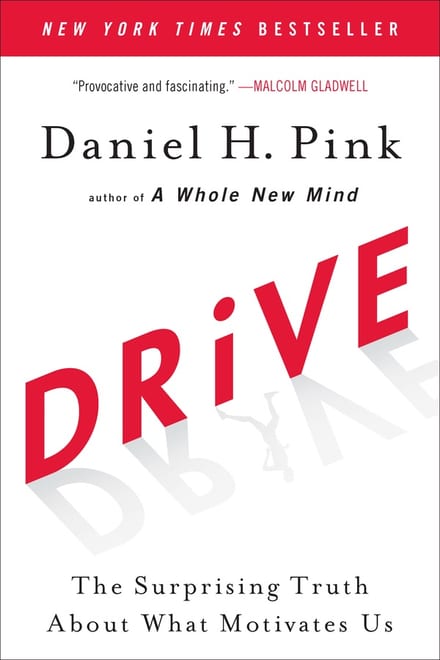
Drive: The Surprising Truth About What Motivates Us
The full book runs ~249 pages — roughly 5 hours of reading. You get the key ideas here in 3 minutes.
The key ideas
- Rewards backfire: cash incentives slow creative problem-solving and narrow thinking.
- Recognize the third drive: intrinsic motivation beyond survival and external incentives.
- Grant autonomy: let people control how, when, and what they work on.
- Enable mastery: challenge people so they enter flow and keep improving.
- Supply purpose: meaningful, socially useful work raises engagement and satisfaction.
- Remember Wikipedia beat Encarta—unpaid volunteers outperformed a funded corporate giant.
The summary
For most of the last century we ran on a simple theory of motivation: reward the behavior you want, punish the behavior you don’t, and people fall into line. It works well enough for dull, routine tasks. But the moment work demands creativity or judgment — anything past mechanical repetition — the theory breaks. Bigger bonuses and sharper penalties don’t just stop helping. They start doing real damage, narrowing focus and dulling the exact thinking the work requires. What actually sustains high performance is letting people steer their own work, get visibly better at it, and see who it serves.
The first crack showed up quietly. In 1949 the psychologist Harry Harlow watched monkeys solve mechanical puzzles for hours with no reward at all — they did it because the puzzles were interesting. That pointed to a third drive, sitting beyond the biological push to survive and the external pull of rewards and punishments: intrinsic motivation, the urge to do something because it’s absorbing in itself. We spent decades ignoring it, building workplaces around bonuses and threats, and paid for it with disengagement, shortcut-driven scandals, and a chronic shortage of the creative work we most needed.
Rewards backfire on creative work
Offer people money to work faster on a creative task, and they slow down. In one well-known experiment, participants had to fix a candle to a wall so the wax wouldn’t drip on the table below. The group promised cash for speed took, on average, nearly three and a half minutes longer than the unpaid group. The reward clamped their attention down at the very moment they needed it wide open.
The pattern repeats. Offer a small payment to potential blood donors and the number who show up drops by almost half. Make an external reward the only thing that matters, and some people will take the fastest route to it, ethics optional — which is where a lot of modern misbehavior comes from. Rewards don’t corrode motivation on boring tasks, because there’s no intrinsic motivation there to corrode. But once a job asks for even a little creativity or care, carrots and sticks eat away at it. People paid only to hit a target do the minimum to hit it. They stop asking questions. They wait to be told what’s next.
The drive we’re born with
Children are the real experts in intrinsic motivation. They explore and learn because curiosity drags them forward, not because anyone’s grading them. Then we grow up, and the world trains it out of us — we learn to work for praise, grades, and paychecks until the external scaffolding replaces the internal engine. By adulthood most people have half-forgotten what it feels like to do something purely because it grips them.
Yet that drive still powers some of the most remarkable work anywhere. Back in 1995, betting on Wikipedia over Microsoft’s Encarta would have sounded absurd: Encarta was professionally written, richly funded, and backed by one of the most powerful companies on earth, while Wikipedia was a heap of articles written by unpaid volunteers for the sheer enjoyment of it. Encarta is discontinued. Wikipedia holds millions of articles. Intrinsic motivation, running at scale, beat the extrinsic model outright. The science lands in the same place: on creative work, the real secret to high performance is our deep desire to direct our own lives, stretch our abilities, and contribute to something.
Autonomy, mastery, and purpose
Pink distills the fix into three conditions. The first is autonomy — letting people decide how, when, and what they work on. The software company Meddius scrapped fixed office hours; employees simply had to get the work done, and they ended up more committed and less likely to leave. Google’s 20% time, a fifth of the week for self-chosen projects, produced Gmail, Google Translate, and more. Management, in this view, isn’t checking whether people are at their desks. It’s creating the conditions in which they can do their best work. Innovation is cheap in the long run; mediocrity is what’s truly expensive, and autonomy is the antidote.
The second is mastery — the freedom to keep getting better. Given a task that’s challenging in the right proportion, people slip into flow, that state of complete absorption. Whether they chase those challenges depends on mindset: someone with a growth mindset treats each hard moment as a chance to improve, while a fixed mindset reads the same moment as a test of worth. With more than half of employees disengaged and nearly a fifth actively so, this is largely a mastery problem.
The third is purpose — work that means something. People who pursue goals like growth and helping others report more life satisfaction than those chasing money or fame, and letting employees see how their work benefits others lifts both welfare and engagement. Or, as Julius Erving put it, being a professional is doing the things you love on the days you don’t feel like doing them.
The bottom line
On anything beyond routine, external rewards narrow attention and drain creativity; durable performance grows from autonomy, the pursuit of mastery, and a sense of purpose. Read this if you manage people, design incentives, or just want to understand why a well-paid job can still leave you flat.
Fact check
Popular books repeat findings that later research has complicated. Where Drive makes a testable claim, here's what the evidence actually shows.
Paying people for speed on a creative task slows them down — in the candle problem the cash group took nearly three and a half minutes longer than the unpaid group.
The candle-problem figure traces to one small 1962 experiment by Sam Glucksberg, not to a replicated body of work, and the wider evidence does not support a blanket rule that rewards damage creative performance. A meta-analysis of 60 studies found that rewards tied to creativity itself raised creative output, especially alongside positive feedback, task-focused guidance and autonomy, while rewards contingent only on completing or performing the task carried a small negative effect. What the reward is attached to matters more than whether money is on the table.
Offering potential blood donors a small payment cuts the number who turn up by almost half.
The near-halving showed up among women only. In the Swedish field experiment behind the claim, a payment of SEK 50 (about $7) cut women's donation rate by almost half, made no significant difference to men, and the drop vanished completely when donors could pass the payment on to charity. Field experiments elsewhere run the other way: in Argentina, higher-value financial incentives increased donations in proportion to the size of the reward, with no loss of blood safety.
- Mellström C, Johannesson M. Crowding out in blood donation: was Titmuss right? J Eur Econ Assoc. 2008;6(4):845-863. Source
- Iajya V, Lacetera N, Macis M, Slonim R. The effects of information, social and financial incentives on voluntary undirected blood donations: evidence from a field experiment in Argentina. Soc Sci Med. 2013;98:214-23. PubMed
Extrinsic rewards reliably erode the intrinsic motivation to do work for its own sake.
The undermining effect is real but modest and conditional. Across 128 experiments, engagement-contingent, completion-contingent and performance-contingent rewards all reduced free-choice intrinsic motivation (d = -0.40, -0.36 and -0.28 respectively), while verbal positive feedback raised it (d = 0.33), and tangible rewards did more damage to children than to college students. A 40-year meta-analysis of 183 studies (N = 212,468) found intrinsic motivation predicted performance whether or not incentives were present (ρ = .21-.45), carrying most weight for quality of work while incentives carried most weight for quantity; its authors concluded the two are best treated as complementary rather than antagonistic.
- Deci EL, Koestner R, Ryan RM. A meta-analytic review of experiments examining the effects of extrinsic rewards on intrinsic motivation. Psychol Bull. 1999;125(6):627-68. PubMed
- Cerasoli CP, Nicklin JM, Ford MT. Intrinsic motivation and extrinsic incentives jointly predict performance: a 40-year meta-analysis. Psychol Bull. 2014;140(4):980-1008. PubMed
Frequently asked questions
What is Drive about?
Drive takes apart the old carrot-and-stick theory of motivation, showing that rewards and punishments work well enough for dull, routine tasks but actively damage performance on anything creative. What sustains high performance instead is a third drive, intrinsic motivation, fed by autonomy, mastery, and purpose.
What are the key takeaways from Drive?
External rewards narrow focus and backfire on creative work, as the candle problem and the drop in paid blood donors show, and once a job needs care or creativity, carrots and sticks eat away at it. The intrinsic drive we're born with still powers remarkable work, seen in Wikipedia's win over Encarta. The fix rests on three conditions: autonomy over how and when you work, mastery through challenges that produce flow and are met with a growth mindset, and purpose that ties your work to something beyond yourself.
Who should read Drive?
Read it if you manage people, design incentives, or just want to understand why a well-paid job can still leave you flat.
Is Drive worth reading?
It makes a persuasive, well-evidenced case that changes how you think about motivating people, anchored by memorable studies and real examples like Google's 20% time and Meddius. The core idea is simple enough that the book can feel stretched, so if you only want the takeaway, autonomy, mastery, and purpose is most of it, but the examples make it stick.