Book summary
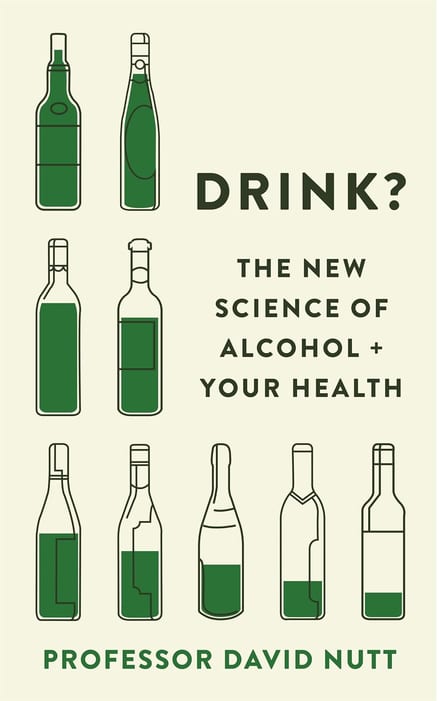
Drink?: The New Science of Alcohol and Your Health
The key ideas
- Alcohol hijacks three brain systems: GABA, glutamate, and pleasure chemicals.
- Hangovers are withdrawal — 47 symptoms of neurotransmitter chaos.
- Debunked: moderate drinking never protected your heart.
- Directly causes seven cancers plus liver, brain, and heart damage.
- Any alcohol impairs driving and fuels violence and mental illness.
- Identify why you drink — coping drinkers risk addiction most.
The summary
No amount of alcohol is good for you. That’s where neuroscientist David Nutt lands after decades studying how ethanol reshapes the brain, and it overturns everything you’ve heard about protective red wine and the French Paradox. Better data killed those stories. What’s left is a drug whose risks — cancer, liver failure, dementia, wrecked sleep, early death — climb in step with how much you drink, with benefits that rarely cover the cost.
How alcohol works on the brain
Alcohol hits three neurotransmitter systems at once. It boosts GABA, the brain’s off switch, producing the relaxation and lowered anxiety people are chasing. It blocks glutamate, the on switch, which explains the stumbling and the memory gaps. And it releases serotonin, dopamine, and endorphins, the chemicals that make you social, cheerful, and disinhibited. Drink enough and the frontal cortex goes quiet, so judgment and self-control collapse. Keep going, and the combination of GABA stimulation and glutamate blocking can slide into blackout, anesthesia, or death.
The same two drinks land differently depending on setting and expectation — preloading before a club is nothing like a glass of sherry at Christmas. Timing matters too; alcohol makes you sleepy when you’re already tired. Tolerance builds fast, which is dangerous: you drink more to feel the same effect, then lose that tolerance after a break and risk poisoning yourself if you return to old amounts. Your sex, genes, and last meal all shape the hit. Women absorb more from the same drink, food slows uptake, and about 70 percent of East Asians carry an ALDH gene variant that slows the breakdown of acetaldehyde — the poison and carcinogen your body makes from ethanol — causing flushing, racing heartbeat, and nausea.
Hangovers are withdrawal
A hangover is a small episode of alcohol withdrawal, driven by neurotransmitter imbalance, inflammation, and mitochondrial dysfunction. It can produce more than 47 distinct symptoms — disturbed sleep, dehydration, nausea, emotional distress. Congeners, the flavor compounds concentrated in aged and darker drinks, make it worse. Nutt notes that the misery may serve a purpose, acting as a natural brake against heavier drinking. Prevention is unglamorous but reliable: drink less, pace yourself, hydrate, and pick clearer spirits with fewer congeners. To treat one, try ibuprofen, food heavy in carbs, and caffeine.
The damage scales with the dose
The idea that moderate drinking guards the heart has fallen apart. The French Paradox — low heart disease despite plenty of fat and wine — is now better explained by the Mediterranean diet, more sun and vitamin D, and relaxed eating habits than by anything in the glass. The harms, by contrast, are well documented and dose-dependent. Alcohol is a risk factor for several cancers, including breast, colorectal, esophageal, pharyngeal, laryngeal, lip, and oral. It damages the liver in a progression from fatty liver to hepatitis to cirrhosis to cancer, often with no warning until it’s advanced. It weakens the heart, raises dementia risk, and can trigger memory-destroying conditions like Korsakoff’s syndrome and Wernicke’s encephalopathy. It inflames the pancreas, feeds insulin-dependent diabetes, and irritates the gut. As a rough measure, Nutt estimates that each seven units — roughly three glasses of wine — costs a 30-year-old man about 30 minutes of life.
The wider toll spreads past the drinker. Any alcohol impairs driving; at the UK limit of 80mg% you’re at least three times as likely to crash, and even one pint compromises you. When Scotland cut its limit to 50mg%, accidents fell. Alcohol also fuels violence — a 2016 report linked 90,000 deaths a year to alcohol-related violence — and worsens anxiety, depression, PTSD, and other mental health conditions. It raises cortisol, disrupts sex hormones, reduces fertility, harms pregnancies, and quietly degrades sleep, skin, and fitness.
Start with the need behind the drink
Cutting back, Nutt argues, begins with honesty about why you drink. He sorts drinkers into four types — social, conformity, enhancement, and coping — and warns that coping drinkers, who use alcohol to numb stress or anxiety, face the highest risk of addiction. A rough red flag is regularly downing more than six units in a sitting. A drink diary helps you see the pattern. So does a month off: Dry January works, but any month will do, and people report better sleep, more energy, weight loss, saved money, and the discovery that fun doesn’t require alcohol. For anyone with a family history of alcoholism or existing health problems, stopping entirely may be the only safe choice.
The bottom line
Alcohol is a powerful, addictive drug that harms nearly every organ, and no dose is actually protective — the risk simply rises with the amount. If you drink, work out which need it’s meeting and whether something else could meet it better. Read this if you drink regularly and want the clear-eyed science before you decide what to do about it.
Fact check
Popular books repeat findings that later research has complicated. Where Drink? makes a testable claim, here's what the evidence actually shows.
The J-shaped curve suggesting moderate drinkers outlive abstainers is a study-design artefact, so no level of drinking protects the heart.
Once cohorts that lump ex-drinkers in with lifelong abstainers are corrected for, the survival advantage disappears. A meta-analysis of 107 cohort studies covering 4.8 million people and 425,564 deaths found no significant mortality reduction for low-volume drinkers (RR 0.93; P = .07) or occasional drinkers (RR 0.96; P = .41). Genetic evidence points the same way: in 500,000 Chinese adults, genotype-predicted alcohol intake raised stroke risk log-linearly and showed no association with myocardial infarction (RR 0.96; P = 0.69), so the apparent protection is largely non-causal. The Global Burden of Disease analysis of 195 countries put the consumption level that minimises total health loss at zero standard drinks per week.
- Zhao J, Stockwell T, Naimi T, Churchill S, Clay J, Sherk A. Association Between Daily Alcohol Intake and Risk of All-Cause Mortality: A Systematic Review and Meta-analyses. JAMA Netw Open. 2023;6(3):e236185. PubMed
- Millwood IY, Walters RG, Mei XW, et al. Conventional and genetic evidence on alcohol and vascular disease aetiology: a prospective study of 500 000 men and women in China. Lancet. 2019;393(10183):1831-1842. PubMed
- GBD 2016 Alcohol Collaborators. Alcohol use and burden for 195 countries and territories, 1990-2016: a systematic analysis for the Global Burden of Disease Study 2016. Lancet. 2018;392(10152):1015-1035. PubMed
When Scotland cut its drink-drive limit from 80mg% to 50mg%, road accidents fell.
Accidents did not fall. A comparative interrupted time-series covering 2013-2016 found no significant change in weekly road traffic accident rates within Scotland after the December 2014 change, and a 7% increase relative to England and Wales, where the limit was left alone. Drinking barely shifted either: on-trade consumption fell 0.7% and off-trade sales were essentially unchanged. The authors' reading is that lowering the legal limit on its own, without stepping up enforcement, does not improve accident outcomes — a point about how the policy was implemented rather than about whether alcohol impairs driving.
- Haghpanahan H, Lewsey J, Mackay DF, et al. An evaluation of the effects of lowering blood alcohol concentration limits for drivers on the rates of road traffic accidents and alcohol consumption: a natural experiment. Lancet. 2019;393(10169):321-329. PubMed
About 70 percent of East Asians carry an ALDH gene variant that slows the breakdown of acetaldehyde and causes flushing.
The published carrier share is roughly 35-45 percent, not 70. ALDH2 deficiency — the inactivating rs671 variant behind the flushing reaction — is carried by about 35-45 percent of East Asians and around 8 percent of the world's population. The underlying point holds: for carriers who drink, the acetaldehyde that accumulates is a recognised carcinogen. It is the prevalence figure that is roughly double what the genetics literature reports.
- Montel RA, Munoz-Zuluaga C, Stiles KM, Crystal RG. Can gene therapy be used to prevent cancer? Gene therapy for aldehyde dehydrogenase 2 deficiency. Cancer Gene Ther. 2022;29(7):889-896. PubMed
Every seven units of alcohol — about three glasses of wine — costs a 30-year-old man roughly 30 minutes of life.
The trade-off is real, but it does not work as a fixed number of minutes per drink. Pooled individual-participant data on 599,912 current drinkers across 83 prospective studies put the threshold for lowest all-cause mortality at about 100g of alcohol a week; drinking 100-200g a week was associated with roughly six months less life expectancy at age 40, and more than 350g a week with four to five years less. Because the curve steepens as volume rises, one flat minutes-per-unit conversion overstates the cost near the threshold and understates it badly for heavy drinkers. It is a rough population average, not a personal forecast.
- Wood AM, Kaptoge S, Butterworth AS, et al. Risk thresholds for alcohol consumption: combined analysis of individual-participant data for 599 912 current drinkers in 83 prospective studies. Lancet. 2018;391(10129):1513-1523. PubMed
Frequently asked questions
What is Drink? about?
Drink? is a neuroscientist's clear-eyed look at what alcohol actually does to your body, landing on the conclusion that no amount of it is good for you. It takes apart the comforting stories about protective red wine and the French Paradox and shows that alcohol's risks, from cancer and liver failure to dementia and early death, climb in step with how much you drink.
What are the key takeaways from Drink??
Alcohol hits three neurotransmitter systems at once, boosting GABA, blocking glutamate, and releasing serotonin, dopamine, and endorphins, and the same drinks land differently depending on setting, timing, sex, genes, and your last meal. A hangover is a small episode of withdrawal, made worse by congeners. The harms are dose-dependent, spanning several cancers, liver disease, and violence beyond the drinker. Cutting back starts with honesty about which of four needs, social, conformity, enhancement, or coping, your drinking meets, with coping drinkers most at risk of addiction.
Who should read Drink??
Read it if you drink regularly and want the clear-eyed science before you decide what to do about it.
Is Drink? worth reading?
Its strength is authoritative, myth-busting science delivered plainly, plus practical steps like a drink diary and a month off that people say brings better sleep, more energy, and saved money. The message is uncompromising, that no dose is truly protective, so if you're looking for permission to keep drinking moderately this won't give it; if you want the honest picture, it's exactly that.