Book summary
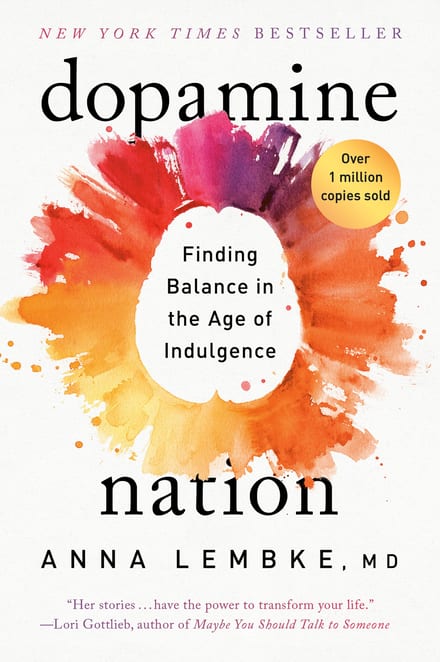
Dopamine Nation
Finding Balance in the Age of Indulgence
The full book runs ~304 pages — roughly 6 hours of reading. You get the key ideas here in 5 minutes.
The key ideas
- Balance pleasure and pain on the same brain scale
- Overconsume and repeated tilting resets your baseline to pain
- Fast from your drug four weeks to reset dopamine
- Self-bind: place barriers between craving and action
- Embrace deliberate pain to swing the balance back toward pleasure
- Practice radical honesty to build awareness and accountability
The summary
Your brain processes pleasure and pain in the same place, and it treats them like opposite ends of a balance. Feel pleasure, and dopamine floods the reward pathway, tipping the scale one way. But the balance hates staying tipped. It wants to sit level, so every swing toward pleasure triggers an automatic correction that pulls it back and, thanks to momentum, pushes it an equal distance into pain. Lembke pictures the correction as little gremlins hopping onto the pain side to cancel out the weight of pleasure. That after-reaction is why the second chocolate satisfies less than the first, and why the moment you crave one more is really the balance already dropping toward pain.
The pleasure-pain balance
This is Solomon and Corbit’s opponent-process theory: any prolonged departure from neutrality has a cost. The trouble comes when you keep pressing on the pleasure side. With repeated exposure the tilt toward pleasure gets weaker and briefer while the drop into pain grows stronger and longer. Scientists call it neuroadaptation; the gremlins get bigger, faster, and more numerous, camping out on the pain side with inflatable mattresses in tow. You need more just to feel normal. That is tolerance, and it is the engine of addiction.
Here is why it matters now. We’ve gone from a world of scarcity to one of overwhelming abundance, and dopamine is the currency scientists use to measure how addictive anything is. Drugs, food, gambling, shopping, gaming, endless feeds, all of it is more plentiful and more potent than ever. The smartphone, Lembke writes, is the modern hypodermic needle, delivering digital dopamine around the clock. Chase pleasure hard enough and you reset your baseline to the side of pain. Lembke saw it starkly in chronic-pain patients on long-term opioids whose pain kept worsening, a reversal known as opioid-induced hyperalgesia, and a gentler version in herself, rereading the Twilight saga four times and enjoying it less each pass while wanting it more.
Dopamine fasting
If overconsumption tips the balance into pain, the first move is to stop feeding it. Lembke calls this a dopamine fast, and puts the minimum at about four weeks. Two weeks isn’t enough; patients are still in withdrawal, still in a dopamine deficit. At four weeks the reward pathway often resets, letting the gremlins climb off and the balance settle back to level. When her patient Delilah quit heavy cannabis use for a month, her anxiety eased on its own, revealing that the drug had been the cause rather than the cure. A study of heavily drinking depressed men found 80 percent no longer met the criteria for clinical depression after a single month off alcohol. One firm caveat: never fast cold turkey from substances with dangerous withdrawal, like alcohol, benzodiazepines, or opioids, which need medically supervised tapering.
To examine your own consumption, she offers a framework she remembers by the word DOPAMINE:
- Data: the plain facts of what you use, how much, how often.
- Objectives: the reasons you use, even seemingly trivial ones.
- Problems: the harms that always follow, to health, relationships, and character.
- Abstinence: the reset that restores homeostasis.
- Mindfulness: observing the discomfort instead of fleeing it.
- Insight: the clarity that only comes on the far side of abstaining.
- Next steps: what you want your relationship with the substance to be.
- Experiment: going back into the world to test what you’ve learned.
Self-binding
Willpower isn’t the answer, because in the grip of craving there is no deciding. So Lembke leans on self-binding: deliberately placing barriers between yourself and your drug of choice while you still have the capacity to choose, pressing the pause button between desire and action. The model is Odysseus, who had his crew stop their ears with beeswax and lash him to the mast so the Sirens’ song couldn’t pull him overboard. Her patient Jacob did the same when he threw his compulsive-use device into a distant dumpster he couldn’t retrieve it from; her patient Oscar had his wife lock all the alcohol in a file cabinet and keep the only key, staying sober for years. Barriers come in three flavors: physical (space), chronological (time), and categorical (meaning). None is foolproof, since the barrier itself can become a puzzle to solve, but it’s the right place to start where high-dopamine goods are practically infinite.
Pressing on the pain side
The balance runs both ways. Do something painful on purpose, and the gremlins hop onto the pleasure side instead, leaving you higher afterward than before. This is hormesis, the science of how small doses of stress make an organism stronger. Lembke’s example is a patient, Michael, who stumbled onto cold-water immersion and found the plunge left him feeling good for hours. Because this dopamine comes indirectly, through your body’s own regulation, it lasts longer than the kind you buy. With intermittent pain your set point drifts back toward pleasure and you grow less vulnerable to it. The warning: pain, too, can become a compulsion, so don’t get addicted to it.
Radical honesty
The last tool is telling the truth, especially the inconvenient truth that exposes your own foibles. Radical honesty, Lembke argues, does three things at once. It makes you aware of your actions, it builds genuine intimacy, and it writes a truthful autobiography that holds you accountable to your future self, not just your present one. Truth-telling is also contagious, and it may head off addiction before it starts. It pairs with prosocial shame, the kind that, handled well, reminds you that you still belong to the human tribe rather than casting you out of it.
The bottom line
The single lesson underneath all of it: chasing pleasure relentlessly, and running from pain just as hard, is what delivers you into pain, and the way out is to stop overconsuming long enough to reset the balance, then lean into discomfort on purpose. Read it if you suspect your phone, your snacks, or your substance of choice has quietly stopped feeling good and started running the show.
Fact check
Popular books repeat findings that later research has complicated. Where Dopamine Nation makes a testable claim, here's what the evidence actually shows.
About four weeks of abstinence resets the reward pathway, and two weeks is not enough.
The four-week figure has a real anchor for one drug. Brain imaging of chronic daily cannabis smokers showed cortical CB1 receptor density downregulated in proportion to years of use, and after roughly four weeks of continuously monitored abstinence on a research unit it had returned to normal. It does not generalize across substances. In methamphetamine users, striatal dopamine transporters recovered only after 12 to 17 months of abstinence (caudate +19%, putamen +16%), and cognitive performance did not fully recover even then. Four weeks is a defensible clinical rule of thumb, not a fixed property of the reward system.
- Hirvonen J, Goodwin RS, Li CT, Terry GE, Zoghbi SS, Morse C, Pike VW, Volkow ND, Huestis MA, Innis RB. Reversible and regionally selective downregulation of brain cannabinoid CB1 receptors in chronic daily cannabis smokers. Mol Psychiatry. 2012;17(6):642-9. PubMed
- Volkow ND, Chang L, Wang GJ, Fowler JS, Franceschi D, Sedler M, Gatley SJ, Miller E, Hitzemann R, Ding YS, Logan J. Loss of dopamine transporters in methamphetamine abusers recovers with protracted abstinence. J Neurosci. 2001;21(23):9414-8. PubMed
In a study of heavily drinking depressed men, 80 percent no longer met the criteria for clinical depression after a single month off alcohol.
Among 191 male alcoholics with no independent psychiatric diagnosis, 42% scored in the clinically depressed range on the Hamilton scale within 48 hours of admission; by week four of abstinence only 6% did. That is a drop of roughly 86%, so the book's 80% figure is if anything conservative, and the sharpest improvement came during week two. The boundary is who it applies to: in a later study of 54 unmedicated men, those whose affective disorder was primary rather than alcohol-driven did not clear on the same schedule, and at least three weeks of abstinence were needed before the two groups could be told apart.
Long-term opioid treatment makes chronic pain worse rather than better, through opioid-induced hyperalgesia.
The direction holds, but the human evidence is thinner than the animal work behind it. A meta-analysis of 26 studies and 2,706 participants found reduced pain tolerance after chronic opioid exposure for thermal stimuli but not electrical, and the effect was clearer in people with opioid use disorder than in pain patients. The clinical upshot Lembke draws survives regardless: in a 12-month randomized trial of 240 patients with chronic back or hip and knee osteoarthritis pain, opioids were no better than non-opioid drugs for pain-related function, and pain intensity was significantly worse in the opioid group (4.0 vs 3.5).
- Higgins C, Smith BH, Matthews K. Evidence of opioid-induced hyperalgesia in clinical populations after chronic opioid exposure: a systematic review and meta-analysis. Br J Anaesth. 2019;122(6):e114-e126. PubMed
- Krebs EE, Gravely A, Nugent S, Jensen AC, DeRonne B, Goldsmith ES, Kroenke K, Bair MJ, Noorbaloochi S. Effect of Opioid vs Nonopioid Medications on Pain-Related Function in Patients With Chronic Back Pain or Hip or Knee Osteoarthritis Pain: The SPACE Randomized Clinical Trial. JAMA. 2018;319(9):872-882. PubMed
Deliberate pain such as cold-water immersion raises dopamine indirectly, and that lift lasts longer than dopamine sourced from pleasure.
The number behind this is real but narrower than the claim built on it. Young men immersed to the neck for an hour at 14°C showed plasma dopamine up 250% and noradrenaline up 530% — circulating catecholamines measured during the immersion, not dopamine in the brain's reward pathway, and the study tracked no mood outcome and no duration. A 2025 meta-analysis of 11 randomized trials and 3,177 participants found cold-water immersion cut stress at 12 hours after exposure (SMD -1.00) but had no significant effect immediately, at 1 hour, 24 hours or 48 hours, and no significant effect on mood at any point. Something durable may be happening; that it is dopamine outlasting pleasure-driven dopamine has not been shown.
- Srámek P, Simecková M, Janský L, Savlíková J, Vybíral S. Human physiological responses to immersion into water of different temperatures. Eur J Appl Physiol. 2000;81(5):436-42. PubMed
- Cain T, Brinsley J, Bennett H, Nelson M, Maher C, Singh B. Effects of cold-water immersion on health and wellbeing: A systematic review and meta-analysis. PLoS One. 2025;20(1):e0317615. PubMed
Frequently asked questions
What is Dopamine Nation about?
The book explains that the brain processes pleasure and pain in the same place and works to keep them balanced, so every swing toward pleasure triggers a correction that pushes you an equal distance into pain. In a world of abundant, potent stimulation, from drugs to the smartphone as the modern hypodermic needle, chasing pleasure hard enough resets your baseline toward pain, which is the engine of addiction.
What are the key takeaways from Dopamine Nation?
The pleasure-pain balance and neuroadaptation explain tolerance: repeated indulgence weakens the high and deepens the crash. A dopamine fast of about four weeks lets the balance reset, though never cold turkey from substances with dangerous withdrawal. Use self-binding, placing physical, chronological, and categorical barriers between you and your temptation instead of relying on willpower; press on the pain side on purpose through hormesis like cold plunges; and practice radical honesty. The DOPAMINE framework helps you examine your own use.
Who should read Dopamine Nation?
Read it if you suspect your phone, your snacks, or your substance of choice has quietly stopped feeling good and started running the show.
Is Dopamine Nation worth reading?
It's worth it for a clear, science-grounded model of why overconsumption backfires, brought to life with vivid patient stories and usable tools like self-binding and the DOPAMINE framework. It's aimed at anyone leaning on a compulsion, so if you have no such struggle you may find the neuroscience interesting but the prescriptions less relevant.