Book summary
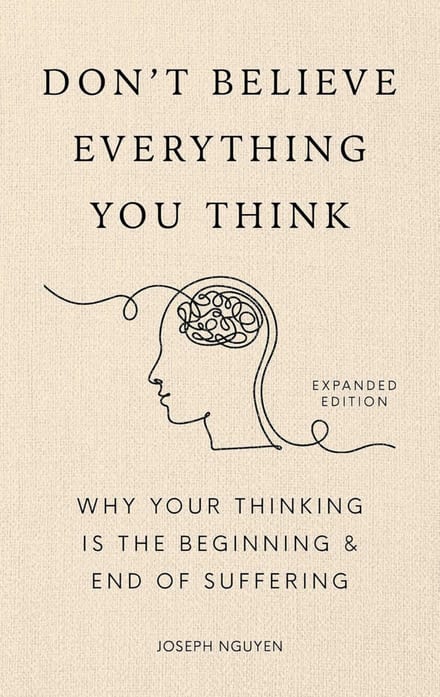
Don't Believe Everything You Think
Why Your Thinking Is The Beginning & End Of Suffering
The full book runs ~87 pages — roughly 2 hours of reading. You get the key ideas here in 3 minutes.
The key ideas
- Recognize events are neutral until your mind assigns meaning
- Distinguish neutral thoughts from the thinking that layers on suffering
- Stop overthinking instead of forcing positive thoughts or reframing
- Notice you're thinking, then let the mind settle naturally
- Chase inspiration-driven goals, not desperation born from fear
- Trust intuition and flow; get out of your own way
The summary
Nothing that happens to you actually causes your suffering. A layoff, a breakup, an election result — the event lands, but the pain that lingers afterward is manufactured by the commentary you wrap around it. Joseph Nguyen builds his whole argument on the old Buddhist image of two arrows. The first arrow is the event, often unavoidable and genuinely painful. The second arrow is your reaction to it — the replaying, the catastrophizing, the rehearsal of futures that haven’t happened. “In life, we can’t always control the first arrow. However, the second arrow is our reaction to the first. The second arrow is optional.”
The reason is that you never touch reality directly. You experience your thinking about reality, and the meaning you assign is what generates the feeling. A hundred people can look at the same job, the same president, the same cup of coffee and come away with a hundred different verdicts. The coffee doesn’t change. Since every feeling grows out of a thought, the true source of psychological suffering is always your own mind.
Thoughts are not the same as thinking
Nguyen draws a line that does most of the work in the book. A thought is a neutral, effortless idea that simply appears — “I have a meeting tomorrow.” Thinking is what you do to that thought: judging it, analyzing it, layering your fears onto it — “the meeting will go badly, I always mess these up, my boss thinks I’m useless.” Thinking is where suffering starts, and the intensity of your distress tracks the intensity of your thinking. This isn’t a quirk of temperament; it’s the mind doing its evolved job. The brain was built for survival, not happiness, and its default setting is to scan for threats by dredging up the past and simulating disaster in the future. Run that stone-age reflex full time in a modern life and chronic negative emotion is the guaranteed output.
Which means positive emotion isn’t something you have to manufacture. Joy and love are the natural state you return to when thinking goes quiet — babies feel wonder without any coaching. “We do not have to try to ’think positive’… The only times we don’t naturally feel these emotions is when we begin to think about the thoughts we’re having.” The goal isn’t better thoughts. It’s less thinking.
Let the water settle
So the fix is not to fight your thoughts or force them to stop, because fighting is just more thinking. The move is smaller: notice that you’re thinking. That awareness creates a little distance, and the mind settles on its own — the way murky water clears when you stop stirring it. Distress turns out to be temporary thought passing through consciousness, and once you see it as that, it loses its grip.
You can watch the same principle in performance. Your best work happens in flow, where conscious thought thins out and action comes straight from training and intuition; overthinking a free throw or a presentation only injects hesitation and ego. Most of the time you already know what to do — fear and self-doubt just convince you that you don’t. If you want to lose weight, Nguyen points out, the formula isn’t rocket science. You know it. What stops you is the thinking that says you can’t.
Goals from inspiration, not desperation
Quieting the mind doesn’t mean surrendering ambition. It means learning to tell two kinds of goals apart. Goals from desperation are driven by fear and scarcity — I need this or I’m nothing — and they produce stress and leave you hollow even when you win. Goals from inspiration arise naturally, feel lighter, and lead to joy. The same split shows up in fulfillment itself, which Nguyen locates in unconditional love, affection with no reasons or reciprocity attached, and unconditional creation, making things for the sheer joy of making rather than as a means to an end.
Getting there means emptying the cup before it can be filled. Einstein and Edison both leaned on stretches of deliberate non-thinking to let new ideas arrive; a mind stuffed with old narratives has no room for insight. Know what you want, then stop trying to control how it shows up, and trust the intuition that already holds the answer. Expect resistance — sustained calm feels so unfamiliar that the mind flags it as something being wrong and tries to drag you back to the suffering it knows. When doubt and anxiety return, remember that your thinking is their only cause, and that events, decisions, and opinions are neutral until you label them. If something is “true” for one person but not another, it was never truth to begin with — only thinking.
The bottom line
Your suffering is self-made, spun out of the stories you tell about neutral events, which means the exit isn’t positive thinking or a rearranged life but noticing when you’re thinking and letting the mind go still. Read this if you’re worn out from trying to think your way out of anxiety and want a plainer route to peace.
Fact check
Popular books repeat findings that later research has complicated. Where Don't Believe Everything You Think makes a testable claim, here's what the evidence actually shows.
Psychological suffering is produced by your thinking about an event, not by the event itself.
The rumination half of this is well supported: dwelling on distress predicts the onset of depression, sharpens negative thinking, impairs problem solving and erodes social support, and it tracks anxiety, binge eating, binge drinking and self-harm too. But events carry weight of their own. In a twin study controlling for genetic confounding, the odds of a major depressive episode were 5.64 times higher in the month of a stressful life event, and still 3.58 times higher when compared within identical twin pairs.
Reframing your thoughts or trying to think positively doesn't work; the only exit from suffering is to think less.
Reappraisal is the best-performing family of emotion-regulation strategies tested. A meta-analysis of 306 experimental comparisons found cognitive change had a small-to-medium effect on emotional outcomes (d+ = 0.36) — the largest of the strategy families, with reappraising the situation itself at 0.36 and perspective taking at 0.45. Nguyen is right about one part: trying to suppress an emotion or a thought did nothing at all (d+ = -0.04 and -0.12), so fighting your thinking really is a dead end. Therapies built on reworking thoughts also beat care-as-usual across 331 randomized trials and 34,285 patients.
- Webb TL, Miles E, Sheeran P. Dealing with feeling: a meta-analysis of the effectiveness of strategies derived from the process model of emotion regulation. Psychol Bull. 2012;138(4):775-808. PubMed
- Cuijpers P, Quero S, Noma H, Ciharova M, Miguel C, Karyotaki E, Cipriani A, Cristea IA, Furukawa TA. Psychotherapies for depression: a network meta-analysis covering efficacy, acceptability and long-term outcomes of all main treatment types. World Psychiatry. 2021;20(2):283-293. PubMed
Overthinking degrades skilled performance — your best work happens when conscious thought thins out and action comes from training.
This holds for skills that have become automatic. Expert golfers choked under pressure when attention turned to the step-by-step mechanics of their putting stroke, while a comparable task that still required deliberate step-by-step processing showed no such decline — and training players to tolerate self-consciousness eliminated the choke entirely. A meta-analysis of 73 studies with 1,824 participants found that directing attention outward, to the intended effect of a movement rather than the body making it, improved performance (Hedges' g = 0.264), with larger gains for retention (0.583) and transfer (0.584).
- Beilock SL, Carr TH. On the fragility of skilled performance: what governs choking under pressure? J Exp Psychol Gen. 2001;130(4):701-25. PubMed
- Chua LK, Jimenez-Diaz J, Lewthwaite R, Kim T, Wulf G. Superiority of external attentional focus for motor performance and learning: Systematic reviews and meta-analyses. Psychol Bull. 2021;147(6):618-645. PubMed
Frequently asked questions
What is Don't Believe Everything You Think about?
The book's central claim is that events don't actually cause your suffering; the thinking you wrap around them does. Using the Buddhist image of two arrows, it holds that the first arrow, the event, is often unavoidable, but the second arrow, your reaction, is optional, which means the real source of psychological pain is always your own mind.
What are the key takeaways from Don't Believe Everything You Think?
A key distinction is between a thought, a neutral idea that simply appears, and thinking, the judging and fear-layering you do to it, which is where suffering starts. Positive emotion is your natural state when thinking goes quiet, so the fix isn't better thoughts but less thinking: notice that you're thinking and let the mind settle like murky water clearing. Pursue goals from inspiration rather than desperation, and find fulfillment in unconditional love and unconditional creation.
Who should read Don't Believe Everything You Think?
Read it if you're worn out from trying to think your way out of anxiety and want a plainer route to peace.
Is Don't Believe Everything You Think worth reading?
It's short and clarifying, distilling one powerful move, noticing when you're thinking, into something you can actually practice. The flip side is that it's a single idea stretched across a book, so if you already know mindfulness or want nuance and caveats, it may feel repetitive or too absolute.