Book summary
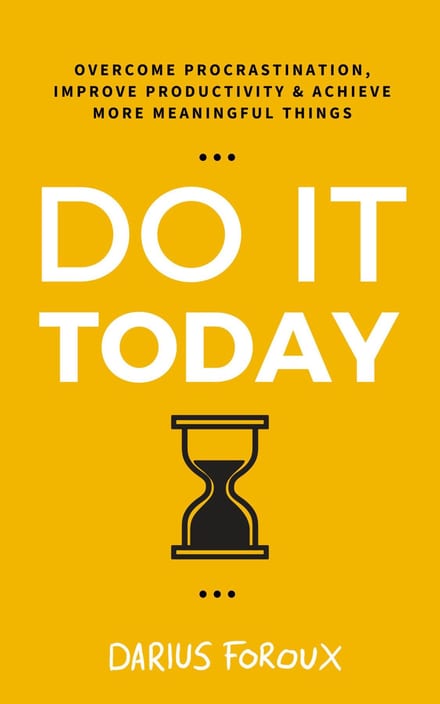
Do It Today: Overcome Procrastination, Improve Productivity and Achieve More Meaningful Things
Overcome Procrastination, Improve Productivity and Achieve More Meaningful Things
The full book runs ~155 pages — roughly 3 hours of reading. You get the key ideas here in 5 minutes.
The key ideas
- Treat chronic procrastination as a diagnosis: ask whether the work is worth doing.
- Manage your attention, not your time — time refuses to be managed.
- Eliminate distractions instead of resisting them; willpower is the weakest tool you have.
- Log your hours for two weeks, then cut whatever nobody would miss.
- Schedule tomorrow tonight — working and making progress are not the same thing.
- Improve 0.1% a day; compounding punishes bad days as reliably as it rewards good ones.
The summary
You already know what you should be doing. That’s what makes procrastination so strange. Darius Foroux’s version started early: at sixteen, in an inside sales job, he wrote needlessly long summaries after every call so the software wouldn’t dial the next client. Then came college semesters that ended in a week of panic and a pile of Red Bull cans, and freelance years where he took a job rather than do the uncomfortable work of chasing clients. None of that is a scheduling problem. Steven Pressfield named the enemy in The War of Art, and Foroux keeps the line close: “Resistance is always lying and always full of shit.”
Which is why apps and hacks bounce off. They can’t win an argument you’re having with yourself.
Procrastination is usually a signal
The research is blunt about the cost. Foroux leans on Dianne Tice and Roy Baumeister’s much-cited study, which ties procrastination to depression, low self-esteem, anxiety and stress — some researchers put it alongside alcohol and drug abuse. Their key finding is the useful part: procrastinators enjoy themselves rather than working until an imminent deadline forces them to start. You’ve outsourced your motivation to a deadline.
His own turnaround came from none of the systems he’d tried. It came from finally doing work he loved — writing, which he now does seven days a week. So he reads chronic procrastination as a diagnosis rather than a character flaw: if you keep putting something off, ask whether it’s worth doing at all. He points Ryan Holiday’s line about speed reading — if you want to rush through a book, maybe ask whether it’s any good — at your career instead. Life is too short to do work you don’t enjoy.
Perfectionism gets no exemption. “If you’re a perfectionist, you’re just a procrastinator with a mask.” One kind never starts, because doubt arrives before the first move. The other starts but sets the bar so high they fail themselves permanently. Both are still waiting for the right moment. The way out isn’t the slacker’s shrug at the other extreme — it’s fixing the problem instead of judging yourself for having one. Not “this is the worst thing ever,” not “I don’t care.” Just: I’ve got this.
Manage your attention, not your time
Here’s the line the whole book turns on. You cannot manage time. You can only manage attention. And distraction isn’t a modern invention — Socrates warned about the barrenness of a busy life 2,400 years ago; Seneca noted there is never a time when a new distraction will not show up.
The numbers still sting. In a study by the universities of Würzburg and Nottingham Trent, 37.4% of participants rated their phone as equally or more important than their close friends — and in a concentration test, scores climbed with every layer of distance between person and phone, finishing 26% higher once the phone left the room. Gloria Mark’s research at UC Irvine found it takes 25 minutes on average to return to the original task after an interruption, and you’re interrupted more than once.
So stop negotiating. Willpower is overrated: if something distracts you, eliminate it rather than resist it. Foroux told a friend with a news habit to junk the TV, delete the apps and block the sites; two weeks later the friend was starting a business. He went from “always connected” to always disconnected — data off by default, a site-blocker running while he works, every notification off except calls and messages.
Willpower doesn’t work. Systems do.
Most people resist rules because they want freedom. Foroux’s counter is that freedom is the enemy here, and rules are how anything gets finished. Stack enough tactics and you have a system: self-imposed deadlines, accountability to a friend or coach, working in intervals, exercise, distractions removed — held together by knowing why you’re doing the work.
Start by measuring. Borrowed from Peter Drucker’s The Effective Executive: keep an hour-by-hour activity log for two weeks, then walk down the recurring items and ask what would happen if you stopped each one. “All hell breaks loose” means keep it. “Nothing would happen” means you’ve found a time-waster, and you cut it.
Then put the important work on the calendar rather than in your head, because working is not the same as making progress. Cal Newport spends ten to twenty minutes every evening building the next day’s schedule; Foroux closes his own day with thirty — ten to journal what he did and learned, ten to review tomorrow, five to picture how it goes. Jim Rohn’s framing is the point: play back the tape of your performance, and let the results either applaud you or prod you.
Small things add up, in both directions
The ambition here is deliberately unglamorous: improve by 0.1% a day. Inconsistency, not a shortage of breakthroughs, kills results. Gary Keller and Jay Papasan’s line carries it — success is sequential, not simultaneous. Warren Buffett acquired 99% of his net worth after turning 50.
Compounding runs the other way too. Complain daily, eat junk, skip the gym, and that adds up just as reliably. Almost nobody’s life is destroyed in a single moment; it leaks away. As Pressfield puts it: the amateur works when inspiration strikes, the pro sits down every day.
The bottom line
Procrastination is rarely a time problem and never yields to willpower. It yields to work that means something to you, an attention you actually defend, and a system that keeps producing on the days you feel nothing. Read this if you’ve tried every productivity app and still end most days having avoided the one task that mattered.
Fact check
Popular books repeat findings that later research has complicated. Where Do It Today makes a testable claim, here's what the evidence actually shows.
Procrastination is an emotional problem — you are avoiding how a task makes you feel — rather than laziness or poor time management.
Current models treat procrastination as short-term mood repair: delaying a task is a low-effort way to escape the aversive feelings it triggers, which is why stressful periods that drain coping resources make it worse rather than better. The strongest evidence is causal. In a randomized controlled trial of 148 university students, nine weeks of general emotion-regulation training significantly reduced later procrastination compared with a wait-list group, and the improvement in those skills mediated the effect — pointing at the emotional mechanism rather than the scheduling one.
- Sirois FM. Procrastination and Stress: A Conceptual Review of Why Context Matters. Int J Environ Res Public Health. 2023;20(6):5031. PubMed
- Schuenemann L, Scherenberg V, von Salisch M, Eckert M. "I'll Worry About It Tomorrow" - Fostering Emotion Regulation Skills to Overcome Procrastination. Front Psychol. 2022;13:780675. PubMed
Procrastination costs more than missed deadlines — it tracks with depression, anxiety, stress and low self-esteem, seriously enough to sit alongside problems like alcohol and drug abuse.
The association is real and it holds prospectively, not just in cross-sections. A three-level meta-analysis of 66 studies covering 32,131 participants found a moderate correlation between procrastination and adverse health outcomes (r = 0.29), and a Swedish cohort that followed 3,525 university students for nine months found each standard deviation of procrastination predicted higher later depression (β 0.13), anxiety (β 0.08) and stress (β 0.11), plus poorer sleep quality and more physical inactivity, after controlling for a wide set of confounders. Those are small-to-moderate effects — enough to take procrastination seriously as a health issue, not enough to rank it with substance abuse.
- Yang T, Guo S, Zhang Q, Chen Z, Lu D. Barriers or helpers to health: A systematic review and three-level meta-analytic evidence to the associations between procrastination and health. J Health Psychol. 2026;31(4):1309-1323. PubMed
- Johansson F, Rozental A, Edlund K, Côté P, Sundberg T, Onell C, Rudman A, Skillgate E. Associations Between Procrastination and Subsequent Health Outcomes Among University Students in Sweden. JAMA Netw Open. 2023;6(1):e2249346. PubMed
After an interruption it takes about 25 minutes on average to get back to the original task, and you deal with more than one other thing before you do.
Both halves match the source, which is unusual for a statistic this widely repeated. Gloria Mark's team at UC Irvine shadowed 24 information workers for over 700 hours of formal observation and found that when interrupted work was resumed the same day, it took an average of 25 minutes 26 seconds, with 2.26 other working spheres visited in between. Two caveats the popular version drops: that is elapsed time during which people did other real work, not 25 minutes of pure recovery, and the spread was enormous — a standard deviation of nearly 55 minutes around a 25-minute mean.
- Mark G, Gonzalez VM, Harris J. No task left behind? Examining the nature of fragmented work. Proceedings of the SIGCHI Conference on Human Factors in Computing Systems (CHI '05). 2005:321-330. Source
Frequently asked questions
What is Do It Today about?
Procrastination is almost never a scheduling problem. Darius Foroux reads it as a signal — usually that you're avoiding work you don't actually care about, or that you're waiting for a perfect moment that never arrives. The answer isn't another app: do work that means something to you, defend your attention, and build a system that keeps producing on the days you feel nothing.
What are the key takeaways from Do It Today?
Treat chronic procrastination as a diagnosis: if you keep putting something off, ask whether it's worth doing at all. You can't manage time, only attention — so eliminate distractions instead of resisting them, because willpower loses that fight. Measure before you optimize with Peter Drucker's two-week hour-by-hour activity log, then cut every recurring item that nothing depends on. Put the important work on the calendar rather than in your head, close each day by reviewing it, and aim to improve 0.1% a day instead of waiting for a breakthrough.
Who should read Do It Today?
Anyone who has tried every productivity app and still ends most days having avoided the one task that mattered. It lands hardest if you suspect the real problem is the work itself rather than your calendar.
Is Do It Today worth reading?
It's short, blunt, and honest about the thing most productivity books dodge — that procrastination is an argument you're having with yourself, which is why hacks bounce off it. The framing of perfectionism as procrastination with a mask is worth the price on its own. Most of the tactics are borrowed rather than original — Drucker's activity log, Cal Newport's evening planning, Pressfield's Resistance — so if you've read widely in this genre you'll recognize a lot.