Book summary
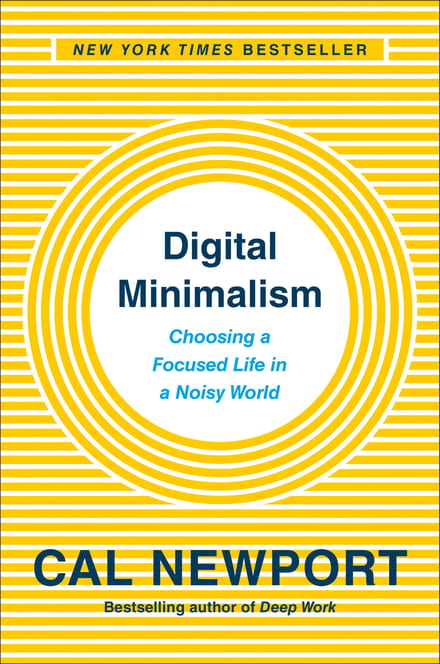
Digital Minimalism: Choosing a Focused Life in a Noisy World
The full book runs ~295 pages — roughly 5 hours of reading. You get the key ideas here in 3 minutes.
The key ideas
- Recognize apps are engineered to addict, like cigarettes
- Reset with a thirty-day declutter of optional technologies
- Reclaim solitude as a requirement for a stable mind
- Prioritize real conversation over shallow digital connection
- Fill time with demanding, skill-based, real-world leisure
- Reintroduce tools only when they serve deep values
The summary
No one ever sat down and decided to spend their life this way. You picked up each app for a small, reasonable convenience—keeping up with friends, glancing at the news, filling a dead minute in line—and only later noticed that these tools had taken over your time and reshaped your behavior. Newport’s first move is to get you off the hook and onto the real culprit. This isn’t a failure of willpower. Tech companies deliberately built their products around the psychological levers that make behavior addictive: intermittent positive reinforcement and the craving for social approval. He quotes a blunt verdict on the industry—that its leaders should stop pretending to be “friendly nerd gods building a better world” and admit they’re “just tobacco farmers in T-shirts selling an addictive product to children,” because checking your likes is the new smoking.
His answer is digital minimalism, “a philosophy of technology use in which you focus your online time on a small number of carefully selected and optimized activities that strongly support things you value, and then happily miss out on everything else.” Set that against the way most of us actually operate, which he calls maximalism: if a tool offers any potential benefit at all, we let it in. Minimalism reverses the burden of proof. It rests on three ideas—that clutter is costly, that optimization matters, and that intentionality is deeply satisfying. The aim is never to reject technology. It’s to treat each tool as a means to something you care about rather than a source of value in itself.
The thirty-day declutter
You don’t ease into this gradually; Newport wants a clean break. For thirty days, step away from every optional technology in your life—anything you could set down without wrecking your job or damaging an essential relationship. Social media, news feeds, games, streaming binges all go. Keep the genuinely necessary tools, but strip out the rest. Before you start, write a list of the offline activities you’ve let wither: hiking, reading, time with friends and family, things that use your hands. Then actually do them during the month. The declutter isn’t a detox you white-knuckle before crawling back to normal. It’s a reset. When the thirty days end, you rebuild your digital life from a blank slate, readmitting a tool only if it directly serves something you deeply value and is the best available way to serve it. The point is a permanent change in how you decide, not a temporary break.
Solitude is not optional
Newport is emphatic that solitude—time alone with your own thoughts, free from any input from other minds—is something humans need in order to flourish, and it has become genuinely rare. “Humans are not wired to be constantly wired,” he writes. When there’s never a gap in the stream of other people’s words and images, you lose the room to process emotions, work through problems, and think for yourself. He calls the result solitude deprivation, and it shows up as damaged mental health, shakier emotional regulation, and weaker problem-solving. Studies find that people badly underestimate how much they use their phones, and the damage is sharpest among the younger generation raised on them, whose anxiety has climbed in step with smartphone adoption. The fixes are simple and analog: leave your phone at home sometimes, take long walks alone, even write letters to yourself. Each one buys back a stretch of uninterrupted time inside your own head.
Real conversation and better leisure
Face-to-face conversation is what we evolved to crave, and Newport insists that texts and likes are poor substitutes for it—shallow digital contact can leave you feeling more isolated, not less. So be intentional: let digital tools support real relationships instead of replacing them, and batch your messaging into set times rather than letting it interrupt everything. The other half of reclaiming your attention is filling your free time with something better than passive scrolling. High-quality leisure, in his framing, is demanding rather than passive, produces something real in the physical world, and often involves structured, in-person social interaction. A few of his practical prompts:
- Fix or build something every week.
- Schedule your low-quality leisure—decide in advance when and how long you’ll check feeds or watch TV, instead of drifting into them.
- Join a group or organization that meets in person.
- Make seasonal and weekly leisure plans so your time off is deliberate.
Behind all of it is a pointed observation: “You can’t build a billion-dollar empire like Facebook if you’re wasting hours every day using a service like Facebook.” The people who built these platforms guard their own attention. If plain rules aren’t enough, Newport is fine with harder measures—deleting social apps from your phone, running blocking software, even downgrading to a simpler device.
The bottom line
Your attention is your most valuable currency, and it’s being harvested by tools engineered to hold it. Digital minimalism is the deliberate way to take it back: clear the optional technology out for thirty days, rebuild real solitude and offline habits, then let back only the few tools that demonstrably serve what you value. Read this if you suspect your phone is using you more than you’re using it, and you want a concrete plan rather than another round of guilt.
Fact check
Popular books repeat findings that later research has complicated. Where Digital Minimalism makes a testable claim, here's what the evidence actually shows.
Anxiety among the younger generation has climbed in step with smartphone adoption, and the phones are doing the damage.
The size of the association depends heavily on how it is measured. Across three large datasets covering 355,358 adolescents, Orben and Przybylski found digital technology use explained at most 0.4% of the variation in well-being, and their analysis of three time-use-diary studies (17,247 more respondents) found little evidence of a substantial negative link. Heavy or compulsive use looks different: a 2025 systematic review and meta-analysis tied digital addiction in youth to anxiety (odds ratio 2.14), depression (1.76) and sleep disturbance (roughly 1.5). Newport's correlation is defensible for problematic use, but ordinary screen time tracks teen well-being weakly, and none of this evidence establishes that smartphones caused the generational rise.
- Orben A, Przybylski AK. The association between adolescent well-being and digital technology use. Nat Hum Behav. 2019;3(2):173-182. PubMed
- Orben A, Przybylski AK. Screens, Teens, and Psychological Well-Being: Evidence From Three Time-Use-Diary Studies. Psychol Sci. 2019;30(5):682-696. PubMed
- Shiferaw BD, Tang J, Wang Y, et al. Impact of digital addiction on youth health: A systematic review and meta-analysis. J Behav Addict. 2025;14(3):1129-1158. PubMed
People badly underestimate how much they use their phones.
It holds for how often you pick the phone up, much less for total hours. Andrews and colleagues logged 23 people's smartphones for two weeks: they averaged 84.7 uses a day but estimated 37.2, while their estimates of daily duration (4.1 hours estimated against 5.1 logged) were not significantly different and did correlate with the logs. A meta-analysis of 106 effect sizes found self-reported media use correlates only moderately with logged measurements and is rarely an accurate reflection of it, with problematic-use measures tracking the logs even more weakly.
- Andrews S, Ellis DA, Shaw H, Piwek L. Beyond Self-Report: Tools to Compare Estimated and Real-World Smartphone Use. PLoS One. 2015;10(10):e0139004. PubMed
- Parry DA, Davidson BI, Sewall CJR, Fisher JT, Mieczkowski H, Quintana DS. A systematic review and meta-analysis of discrepancies between logged and self-reported digital media use. Nat Hum Behav. 2021;5(11):1535-1547. PubMed
Solitude is a psychological requirement, and going without it damages mental health, emotional regulation and problem-solving.
Solitude has measurable effects, but they run in both directions and depend on whether it is chosen. In a 21-day diary study of 178 people, more hours alone on a given day brought lower stress and greater feelings of autonomy alongside more loneliness and lower satisfaction, with the downside muted when the solitude was self-chosen. Nguyen, Ryan and Deci found being alone deactivates affect, damping high-arousal positive and negative feelings alike, and across 11 studies Wilson and colleagues found most people did not enjoy 6 to 15 minutes alone with their thoughts — some chose a self-administered electric shock over sitting through it. Reclaiming solitude is reasonable advice; the stronger claim that lacking it degrades mental health and problem-solving runs ahead of the evidence.
- Weinstein N, Vuorre M, Adams M, Nguyen TV. Balance between solitude and socializing: everyday solitude time both benefits and harms well-being. Sci Rep. 2023;13(1):21160. PubMed
- Nguyen TT, Ryan RM, Deci EL. Solitude as an Approach to Affective Self-Regulation. Pers Soc Psychol Bull. 2018;44(1):92-106. PubMed
- Wilson TD, Reinhard DA, Westgate EC, et al. Social psychology. Just think: the challenges of the disengaged mind. Science. 2014;345(6192):75-77. PubMed
Frequently asked questions
What is Digital Minimalism about?
The book is about taking back your attention from apps deliberately engineered to hold it, reframing compulsive phone use as a designed product rather than a personal failure of willpower. Its answer is digital minimalism: focusing your online time on a small number of carefully chosen tools that support what you value, and happily missing out on everything else.
What are the key takeaways from Digital Minimalism?
Run a thirty-day declutter, stepping away from every optional technology and refilling the time with offline activities you've let wither, then readmit only the tools that directly serve something you deeply value. Rebuild solitude, the time alone with your own thoughts that humans need and now rarely get. And upgrade your leisure toward demanding, in-person, hands-on activities instead of passive scrolling, while batching messaging into set times.
Who should read Digital Minimalism?
Read it if you suspect your phone is using you more than you're using it, and you want a concrete plan rather than another round of guilt.
Is Digital Minimalism worth reading?
It delivers what it promises: a clear philosophy plus a step-by-step declutter, grounded in the point that these tools are built to be addictive. If you already keep tight boundaries with technology, the thirty-day reset may feel like more structure than you need, but for anyone drifting through feeds it's a practical way to start over.