Book summary
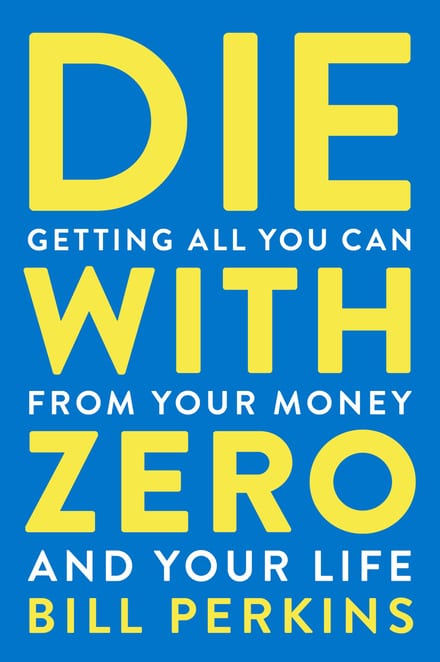
Die with Zero
Getting All You Can from Your Money and Your Life
The full book runs ~240 pages — roughly 4 hours of reading. You get the key ideas here in 4 minutes.
The key ideas
- Reframe money as stored life energy, not wealth to hoard
- Invest in experiences early — they pay lifelong memory dividends
- Track your declining ability to enjoy money as you age
- Peak your net worth by 45–60, then spend down
- Give inheritances and gifts now, when they matter most
- Take bold risks young, when downside is small
The summary
Money is not wealth. It’s life energy in another form—the hours you traded away to earn it. So when you die with a big balance in the bank, you’ve done something quietly tragic: you worked stretches of your one life for nothing, banking hours you will never spend. Bill Perkins’s argument is uncomfortable and simple. Treating your life as if it were infinite isn’t prudent; it’s “terribly shortsighted.” The goal is to convert your money back into living while you still can, and to reach the end with the tank as close to empty as you can manage.
Most people do the reverse. Federal Reserve data shows American households keep getting richer in retirement—median net worth climbs from $187,300 for 55-to-64-year-olds to $224,100 for those 65 to 74—and even in their mid-seventies, the wealthier half barely touch their savings. They’re hoarding life energy they will never turn back into experience.
Experiences pay a memory dividend
Perkins sees a life as the sum of its experiences, and experiences keep paying out long after they end. He calls it the “memory dividend”: every time you recall or retell a great trip, a friendship, an adventure, you collect a little more fulfillment from it. When you’re too old for the experience itself, you get to retire on the memories. His friend Jason borrowed from a loan shark to backpack across Europe in his twenties and never regretted it—“Whatever I paid, I feel it was a bargain… I would never have them erased for any amount of money.” That’s why the timing of experiences matters as much as the money. Invest in them early, and the dividends compound for decades.
Your ability to spend has an expiration date
A flat rule like “save 15 percent forever” ignores the plain fact that your body changes. The trek you can do at thirty may be impossible at seventy. Health declines compound, and as you age your “personal interest rate” rises: the cost of postponing an experience gets steeper because you have fewer years left to reschedule it. A twenty-year-old can safely wait a year for a trip; an eighty-year-old who waits may never take it. Perkins’s fix is to sort the experiences you want into “time buckets,” five- or ten-year slices of your life, placing each one in the window when you’ll actually be able to enjoy it. He reminds you that you die many small deaths along the way—the version of you that’s a new parent, the single unattached you—each one ending and never returning. Facing that pushes you to stop postponing what matters.
Peak your net worth, then spend it down
This leads to a specific and slightly frightening idea: pick an age, usually between 45 and 60, when your wealth should hit its maximum, and after that, deliberately spend it down. Working past your peak just to grow the pile costs you irreplaceable health and time. Before you set that peak, though, calculate a survival threshold so you don’t run out—roughly 0.7 times your annual cost of living, times the years you have left. Clear that floor and you can start cracking the nest egg. To guard against living longer than expected, Perkins favors buying an income annuity—handing an insurer a lump sum for a guaranteed monthly payout for life—rather than the inefficient habit of over-saving to self-insure against every worst case.
Give money away while it still matters
If you plan to leave money to your kids or to causes you care about, do it now, not in your will. Waiting until you die leaves the timing to chance and nearly guarantees the money lands too late to matter most. Give to medical research today and it fights disease today; the suffering is happening now. And the most valuable thing you can hand your children isn’t cash at all—it’s the time and attention you spend on them while they’re growing up, the very thing you sacrifice every time you work late to leave them a bigger inheritance they’ll collect at fifty.
The bottom line
Aim to die with zero and your whole autopilot shifts—from earning, saving, and maximizing wealth toward simply living the best life you can. Spend boldly while you’re young, when the downside of a risk is small and you have decades to recover, and spend deliberately as you age, before your health spends you. Read this if you’ve been telling yourself you’ll enjoy the money “later” and you’re starting to suspect later may not come.
Fact check
Popular books repeat findings that later research has complicated. Where Die with Zero makes a testable claim, here's what the evidence actually shows.
Americans keep getting richer in retirement instead of spending down — median net worth climbs from $187,300 at ages 55-64 to $224,100 at 65-74, and even well-off retirees in their seventies barely touch their savings.
Both figures are exactly right: they are the 2016 Survey of Consumer Finances medians, and the shape has held since — in the 2022 survey median net worth rises from $364,500 at ages 55-64 to $409,900 at 65-74 before easing to $335,600 at 75 or older. Panel evidence backs the behavior, not just the cross-section. Tracking the same households through the Health and Retirement Study, Poterba, Venti and Wise found retirees treat housing equity and non-annuitized financial assets as precautionary savings, drawing them down mainly after a shock such as a spouse's death or a large medical expense. The caveat is that comparing age brackets inside one survey compares different households, so part of the upward slope reflects cohort differences and the longer lifespans of wealthier families.
- Bricker J, Dettling LJ, Henriques A, et al. Changes in U.S. family finances from 2013 to 2016: evidence from the Survey of Consumer Finances. Fed Reserve Bull. 2017;103(3). Source
- Aladangady A, Bricker J, Chang AC, et al. Changes in U.S. Family Finances from 2019 to 2022: Evidence from the Survey of Consumer Finances. Washington, DC: Board of Governors of the Federal Reserve System; 2023. Source
- Poterba JM, Venti SF, Wise DA. The composition and draw-down of wealth in retirement. NBER Working Paper 17536. Cambridge, MA: National Bureau of Economic Research; 2011. Source
Money spent on experiences pays a lasting memory dividend — experiences keep generating happiness through recollection in a way possessions do not.
The experiential advantage is real and shows up most strongly in hindsight, which is where Perkins puts it: Van Boven and Gilovich found people reported experiential purchases had made them happier than material ones, partly because experiences stay open to positive reinterpretation and feed into identity and relationships. It is not universal, though. Lee, Hall and Wood found the effect held for higher-social-class participants while lower-class participants were made happier by material purchases, which suggests the memory dividend assumes a degree of financial slack.
Buying an income annuity is a more efficient way to insure against outliving your money than over-saving to self-insure.
Economists broadly agree with Perkins on this one. Davidoff, Brown and Diamond showed full annuitization is optimal when markets are complete, and that substantial annuitization stays attractive even with incomplete markets and consumption needs that do not match a level payout — they conclude limited real-world annuity buying is plausibly down to psychological or behavioral biases. Mitchell, Poterba and Warshawsky's money's-worth analysis reached the same practical verdict: individual annuities are priced so that a retiree without a bequest motive should find them of substantial value. What the book skates over is that full annuitization stops being optimal once uninsured medical costs and a wish to leave something behind enter the picture.
Frequently asked questions
What is Die with Zero about?
The book argues that money is really life energy, the hours you traded away to earn it, so dying with a big bank balance means you worked stretches of your one life for nothing. Its goal is to convert your money back into living experiences while you still can, and to reach the end with the tank as close to empty as you can manage.
What are the key takeaways from Die with Zero?
Experiences pay a compounding "memory dividend," so invest in them early. Your ability to enjoy money has an expiration date as your health declines, so sort the experiences you want into "time buckets" tied to the years you can actually enjoy them. Pick an age, usually between 45 and 60, to peak your net worth and then deliberately spend it down; guard against outliving your money with an income annuity; and give to your kids and causes now, not in your will.
Who should read Die with Zero?
Read it if you've been telling yourself you'll enjoy the money "later" and you're starting to suspect later may not come.
Is Die with Zero worth reading?
It's a genuinely reframing read for chronic savers, with practical tools like time buckets and a survival-threshold calculation that make spending feel safe rather than reckless. The premise assumes you have savings to draw down and a fairly predictable life, so if you're struggling to make ends meet or crave the security of a cushion, parts of the argument will land differently.