Book summary
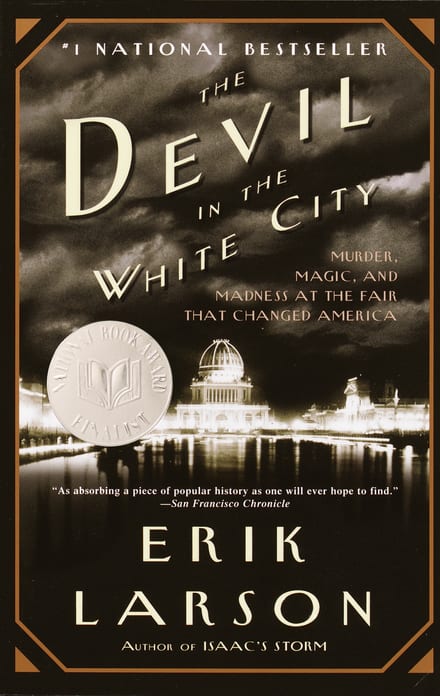
The Devil in the White City: Murder, Magic, and Madness at the Fair That Changed America
Murder, Magic, and Madness at the Fair That Changed America
The full book runs ~496 pages — roughly 9 hours of reading. You get the key ideas here in 5 minutes.
The key ideas
- Chicago won the fair in 1890 and had twenty-six months to out-Eiffel Eiffel.
- John Root died of pneumonia five days after the architects first saw Jackson Park.
- Uniform white paint and a sixty-foot cornice line turned separate palaces into one city.
- Ferris answered Burnham's insult to engineers with a wheel lifting 2,160 people.
- Holmes designed his own hotel with an airtight vault, greased chute, and kiln.
- Detective Frank Geyer found the Pitezel children by canvassing hotels in five cities.
The summary
On a gray January morning in 1891, America’s most celebrated architects stepped from their carriages onto a square mile of sand and half-dead oaks on Chicago’s South Side. This was Jackson Park, where the World’s Columbian Exposition was to open in twenty-seven months, and they “gazed,” Daniel Burnham wrote, “with a feeling almost of despair.” Robert Peabody said flatly, “It can’t be done.” Burnham looked at him: “That point is settled.”
It got built. And while it went up, a young doctor calling himself H. H. Holmes finished a building of his own a few streetcar stops west — block-long, with a soundproof vault, gas jets he opened from his closet, a greased chute to the basement, and a kiln that ran at three thousand degrees.
The fair was built on will, not genius
Burnham had flunked the entrance exams at Harvard and Yale. His gift was organization; his partner John Root supplied the art. Five days after that tour of Jackson Park, Root died of pneumonia at forty-one, and the papers assumed the fair had died with him. Burnham paced below the deathbed shouting “damn!” and was back at his desk Monday writing twelve letters. What followed was logistics enforced by temper, starting with the one-word sign over that desk: RUSH.
The beauty came from a few shared rules: neoclassical buildings clad in “staff” — plaster and jute over wood frames, not a brick on the grounds — with every cornice on the Court of Honor at exactly sixty feet. At a meeting the fair’s director of color happened to miss, the thought came: make it all perfectly white. The painter Frank Millet invented spray paint to finish in time. Visitors walked in and wept.
The last hole was the Eiffel Tower. Burnham told a dinner of engineers that the architects had covered themselves in glory while they had contributed nothing. A thirty-three-year-old steel inspector from Pittsburgh sat there feeling “cut to the quick,” and left with a machine already whole in his head: thirty-six cars the size of Pullman coaches on two 250-foot bicycle wheels, 2,160 people lifted three hundred feet at once. George Ferris’s wheel opened fifty-one days late and never faltered.
Holmes built the same city’s negative
Herman Mudgett of Gilmanton, New Hampshire, had already schemed to defraud insurers with cadavers before he reached Chicago in 1886, took a new name from the newest detective in fiction, and talked a dying druggist’s wife out of her store. She had gone to see relatives in California, he explained, and decided to stay.
He designed the block across the street himself and fired crews fast enough that no worker saw the whole plan. The second floor held thirty-five rooms, six corridors and fifty-one doors, some windowless and airtight. A bricklayer built the basement kiln, told it was for bending plate glass; the furnace man who boosted its heat later conceded it resembled “a crematory for dead bodies.” He never used force. He stood too close, stared too hard, touched too much, and women adored him for it.
He chloroformed his bookkeeper Julia Conner and her daughter Pearl on Christmas Eve 1891, paid a man named Chappell thirty-six dollars to strip the flesh from her bones, and sold the skeleton to a medical college. He did the same a year later with his secretary Emeline Cigrand; when police finally opened the vault, a woman’s bare footprint was etched into the enamel inside the door. On July 5, 1893, the morning after taking two Texas sisters to the fair’s fireworks, he asked Anna Williams to fetch a document from that vault, then sat listening at the gas pipe.
His hotel opened with the fair and filled with young women; male travelers were told, regretfully, that there were no vacancies.
The real subject is the city
Larson claims less than the subtitle suggests. Everything in quotation marks comes from a document, and he keeps reaching for an explanation plainer than devilry. A thousand trains a day brought single women into Chicago — never before, Jane Addams wrote, had so many young girls been “suddenly released from the protection of the home.” The city logged nearly eight hundred violent deaths in the first half of 1892, and its few detectives, mostly ward-boss appointees, joked about a “mysterious disappearances department.”
People did notice him. A tenant watched two men haul a heavy new trunk out of his locked office and concluded he had murdered Emeline. She neither moved out nor went to the police, because nobody expected the police to care. Two families hired private detectives; Holmes shook their hands and told them to stop by anytime.
Both stories end in fire
Two days before the closing ceremony a delusional Irishman named Prendergast, convinced the mayor owed him a job, shot Carter Harrison at his front door. The celebration became a memorial. The next summer arsonists burned the seven great palaces during the Pullman strike, and Chicago watched the glow from its rooftops without regret.
The other ending took a Philadelphia detective, Frank Geyer, who had just lost his own wife and daughter in a house fire and spent the summer of 1895 canvassing hotel registers in five cities for three missing Pitezel children. He dug two girls out of a Toronto cellar and found the boy’s teeth and organs in an Indianapolis chimney flue. Holmes hanged in 1896 after confessing to twenty-seven murders, most of them lies. Nine are certain.
The bottom line
Larson’s argument is not that evil shadows greatness but that both fed on the same thing: a raw, anonymous city where nobody was watching. The fair drew 27.5 million visits and left America the Ferris wheel, alternating current and the City Beautiful movement; it also handed Holmes a supply of strangers. Read it for history that moves like a thriller without inventing a word — though be warned: the murders pull harder than the architecture, and the architecture is the better story.
Fact check
Popular books repeat findings that later research has complicated. Where The Devil in the White City makes a testable claim, here's what the evidence actually shows.
The 1893 World's Columbian Exposition drew 27.5 million visits.
The fair's own accounting matches the figure almost exactly. The president's report to the board of directors tallies 21,480,141 cash admissions and 6,059,380 free admissions between 1 May and 30 October 1893, for 27,539,521 in all. Those are turnstile entries rather than individual people — Chicagoans returned again and again — which is why the summary's word choice, visits rather than visitors, matters.
- Higinbotham HN. Report of the President to the Board of Directors of the World's Columbian Exposition, Chicago, 1892-1893. Chicago, IL: Rand, McNally & Co; 1898:408. Source
H. H. Holmes confessed to twenty-seven murders, most of them lies, and nine of the killings are certain.
Larson's numbers are far more cautious than the legend, and rightly so — the widely repeated figure of 200 or more victims has no evidentiary basis, and Holmes was formally accused of only one killing at the Englewood building itself. Adam Selzer's 2017 reconstruction, the fullest modern pass through the primary documents, concludes that most of what circulates about Holmes was assembled from conjecture and gossip after his arrest rather than from evidence. That leaves nine as a careful estimate rather than a documented total. The summary presents it about as the record allows, but a reader should not treat the figure as settled.
George Ferris's wheel lifted 2,160 people three hundred feet into the air at once.
The capacity is exact by the fair's own accounting: the president's report records thirty-six passenger cars hung on the wheel, each seating forty to sixty people, which puts a full load at 2,160. The height is rounded up. The same report measures the wheel at 250 feet in diameter, so the high point of the ride was nearer 260 feet than 300.
- Higinbotham HN. Report of the President to the Board of Directors of the World's Columbian Exposition, Chicago, 1892-1893. Chicago, IL: Rand, McNally & Co; 1898:88. Source
Frequently asked questions
What is The Devil in the White City about?
Two true stories set in the same city at the same moment. Daniel Burnham had twenty-seven months to build the 1893 World's Columbian Exposition on a square mile of sand in Chicago, and did it; a few streetcar stops away, a young doctor calling himself H. H. Holmes opened a hotel he had designed with an airtight vault, a greased chute to the basement, and a kiln. Erik Larson's point is that the same raw, anonymous, fast-growing city made both men possible.
What are the key takeaways from The Devil in the White City?
That an impossible project gets finished on shared rules and stubbornness rather than genius: neoclassical buildings, one cornice height, all painted white, and a sign over Burnham's desk reading RUSH. That ambition and predation can run on the same fuel — Holmes charmed creditors, police and grieving parents with exactly the warmth that made Burnham effective with clients. And that anonymity is what let the murders continue: a thousand trains a day brought young women into Chicago, nobody kept track of them, and the few detectives the city had were ward-boss appointees who joked about a 'mysterious disappearances department.'
Who should read The Devil in the White City?
Anyone who wants American history told with the pace of a thriller, and anyone drawn to how huge, chaotic projects actually get built. It suits readers of true crime and readers of architecture and urban history equally, which is unusual.
Is The Devil in the White City worth reading?
Yes, with one caveat. The reporting is meticulous — everything in quotation marks comes from a letter, memoir or document — and the fair sections are genuinely thrilling, from Root's sudden death to Ferris building a wheel that lifted 2,160 people three hundred feet. The caveat is that the two threads are unequal: the Holmes chapters pull harder, but the Burnham chapters are the better story, and readers who came only for the murderer may find the architecture slow.