Book summary
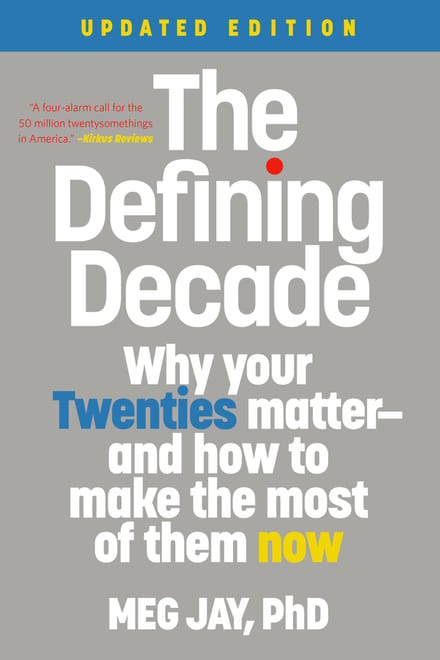
The Defining Decade: Why Your Twenties Matter—And How to Make the Most of Them Now
Why Your Twenties Matter—And How to Make the Most of Them Now
The full book runs ~336 pages — roughly 6 hours of reading. You get the key ideas here in 5 minutes.
The key ideas
- Reject "thirty is the new twenty" — it removes urgency without adding freedom.
- Collect identity capital; exploration that doesn't count narrows your options.
- Ask people you barely know — weak ties reach networks yours can't.
- Choose a partner deliberately instead of sliding into a shared lease.
- Expect personality to keep moving through your twenties and thirties.
- Know the timing: pay compounds early, and fertility declines from the thirties.
The summary
Alex was twenty-six, dating a man she had no intention of marrying, and Meg Jay — then a clinical psychology doctoral student at Berkeley — was happy to let her keep telling funny stories about him. Thirty is the new twenty, Alex kept saying. Then Jay’s supervisor made the point that reorganizes the whole book: she might not marry this one, but she might marry the next one, and the best time to work on a marriage is before you have one. The twenties are not a developmental holding pattern. They are the window when the big decisions are cheapest to make and most expensive to skip.
Thirty is not the new twenty
The number Jay leads with — that 80 percent of life’s most defining moments happen by about thirty-five — is the one everybody repeats, and it rests on thinner ground than it sounds. It traces to a 1991 analysis of autobiographies by forty-nine eminent psychologists, whose life-shaping experiences clustered in their college and early adult years — a real pattern in a very unusual sample, not a population statistic. What’s solid is narrower and still uncomfortable: in decades of Social Security earnings records, a median male earner’s pay climbs roughly 38 percent between twenty-five and fifty-five, and the line is flat after thirty-five. Start late and you don’t start behind. You start flat.
Her real target isn’t lateness anyway, it’s the message. Telling a twenty-three-year-old they have ten spare years doesn’t hand them freedom, it removes the urgency that makes anyone do anything. Jay borrows a line she credits to Leonard Bernstein, though it traces back to Elbert Hubbard in 1911: to achieve great things you need a plan and not quite enough time. Postpone everything to thirty and you get a decade where the career, the city, the partner and the kids all have to arrive at once.
Identity capital, not an identity crisis
Emma came in announcing an identity crisis. She thought she might like to work in art or entertainment, hadn’t decided, and had spent years waiting tables while she didn’t decide. She lived with a boyfriend she wasn’t attached to, because rent split two ways was cheaper.
Jay told her to stop having the crisis and start collecting identity capital: do something that adds value to who you are. This is not an argument against exploring. It’s an argument against exploration that isn’t supposed to count. The years of underemployment that feel like keeping your options open mostly narrow them, because none of it adds up to something a stranger can read.
Comparison makes it worse. Facebook, Jay says, is less about looking up friends than looking at friends — and the twentysomething version of that is a life graded against everyone else’s edited one. You can spend the whole decade displaying identity capital instead of acquiring any.
New things come from outside your circle
Emma’s job came from an old roommate’s cousin who worked at a museum in another state: a name in an address book, not a friend. That’s the second instruction: your close circle already knows what you know. In 1973 the sociologist Mark Granovetter surveyed 282 American men about how they found their jobs and reported that casual acquaintances outperformed close friends — weak ties reach networks yours doesn’t. LinkedIn experiments covering 20 million people over five years, published in Science, confirmed it causally and then complicated it: the payoff rises as ties get weaker but peaks at moderately weak ones, and in less digital industries strong ties did more.
The practical version is unglamorous: ask someone you barely know for something specific, and make it easy to say yes.
Pick your family instead of sliding into it
Emma’s refrain was that you can’t pick your family, but you can pick your friends. Jay’s reply: the time to start picking your family is now, and be as deliberate about love as you are about work.
Her sharpest and most contested claim sits here. Couples tend to move in together by drift — sleeping over, then more, then one lease. Researchers call it sliding rather than deciding, and the trouble is inertia: shared furniture and a shared address make leaving harder, so people stay in relationships they’d otherwise have ended, and some marry. The evidence has moved around. Several studies in the 2010s concluded the cohabitation effect had faded; Rosenfeld and Roesler, working with the National Survey of Family Growth, found it hadn’t — living together first lowered divorce odds in year one and raised them every year after. Others argue the real risk is moving in young. Jay’s advice survives the dispute intact: know what you are agreeing to, and say it out loud.
The clock nobody argues with
The book’s last third is about timing. The brain is still rewiring through the twenties — prefrontal remodeling runs well into the third decade, building the machinery that tolerates ambiguity and weighs a future against a feeling — which makes this the cheapest decade in which to change. Jay says personality shifts more now than at any other point; the strongest evidence, a meta-analysis of 92 longitudinal samples, puts the biggest gains in conscientiousness and emotional stability across ages twenty to forty rather than the twenties alone. On fertility she is close but runs a little early: joint ACOG and ASRM guidance has fecundity declining gradually from around thirty-two and sharply after thirty-seven.
Worth naming plainly: the reader Jay pictures is educated, career-track and American, and much of the advice assumes an internship you can afford and a career with a ladder in it. Her answer is that weak ties work at any level, which the LinkedIn data only partly bears out — the payoff depends on the industry — and which isn’t a full answer either.
The bottom line
Nothing about your twenties is automatic, and that is the good news: this is the decade where each choice buys the most, so make them on purpose. Pick work that compounds, ask people you barely know for help, and choose a partner the way you’d choose a job. Read it if you’re in your twenties and everyone keeps telling you there’s no rush.
Fact check
Popular books repeat findings that later research has complicated. Where The Defining Decade makes a testable claim, here's what the evidence actually shows.
Eighty percent of life's most defining moments happen by about age thirty-five.
The figure traces to a 1991 content analysis of the published autobiographies of 49 eminent psychologists, which found that the experiences they named as life-shaping clustered in their college and early adult years. That is a reminiscence effect in a small, unrepresentative sample, not a population statistic, and the paper reports no eighty-percent threshold at thirty-five. A separate life-span study in which 99 adults ranked personal and historical events found the same tilt — more events were recalled from young adulthood, and those were rated most important. The clustering is real; the specific number is an extrapolation.
- Mackavey WR, Malley JE, Stewart AJ. Remembering autobiographically consequential experiences: content analysis of psychologists' accounts of their lives. Psychol Aging. 1991;6(1):50-9. PubMed
- Martin P, Smyer MA. The experience of micro- and macroevents. A life span analysis. Res Aging. 1990;12(3):294-310. PubMed
Living together before marriage raises the odds of divorce, because couples slide into cohabitation instead of deciding on it.
The literature genuinely disagrees, and the disagreement is about timing. A harmonized analysis of the National Survey of Family Growth covering 216,455 couple-years found couples who had lived together first were less likely to break up during the first year of marriage but substantially more likely to divorce in every year after that. Other work on the same survey found no association at all between premarital cohabitation and marital instability among couples married since 1996. A third line of research argues the real predictor is how young a couple was when they first moved in together, not whether they married first.
- Rosenfeld MJ, Roesler K. Cohabitation experience and cohabitation's association with marital dissolution. J Marriage Fam. 2019;81(1):42-58. Source
- Manning WD, Cohen JA. Premarital Cohabitation and Marital Dissolution: An Examination of Recent Marriages. J Marriage Fam. 2012;74(2):377-387. PubMed
- Kuperberg A. Age at Coresidence, Premarital Cohabitation, and Marriage Dissolution: 1985-2009. J Marriage Fam. 2014;76(2):352-369. Source
Casual acquaintances - weak ties - are more useful than close friends for finding work.
Granovetter's 1973 study of a sample of 282 men in a Boston suburb found the pattern: of those who got a job through a personal contact, only 16.7% saw that contact often, while 55.6% saw them occasionally and 27.8% rarely. Randomized experiments on LinkedIn's recommendation algorithm, covering more than 20 million people and 600,000 new jobs over five years, gave the idea its first causal test and found the relationship is not linear. Weaker ties raised job transmission only up to a point, after which returns diminished; measured by shared connections, moderately weak ties produced the most job mobility, and in less digital industries strong ties beat weak ones.
Female fertility peaks around twenty-eight and gets difficult after thirty-five, so the twenties are the window to plan around.
Right direction, ages roughly four years early on both counts. Joint guidance from the American College of Obstetricians and Gynecologists and the American Society for Reproductive Medicine puts the decline in fecundity as gradual but significant from approximately age thirty-two, with the steeper drop after thirty-seven. The same guidance does back the practical advice: women over thirty-five should get a fertility evaluation after six months of trying rather than the usual twelve, and women over forty sooner still.
- American College of Obstetricians and Gynecologists Committee on Gynecologic Practice; Practice Committee of the American Society for Reproductive Medicine. Female age-related fertility decline. Committee Opinion No. 589. Fertil Steril. 2014;101(3):633-4. PubMed
Frequently asked questions
What is The Defining Decade about?
Clinical psychologist Meg Jay's argument is that your twenties are not a developmental holding pattern but the window when the big decisions are cheapest to make and most expensive to skip. Telling a twenty-three-year-old that thirty is the new twenty doesn't hand them freedom, it removes the urgency that makes anyone do anything — and postponing everything leaves the career, the city, the partner and the kids all arriving at once.
What are the key takeaways from The Defining Decade?
On work, collect identity capital — do things that add value to who you are — rather than staging an identity crisis, because years of underemployment that feel like keeping your options open mostly narrow them. New opportunities come from weak ties, not your close circle: Mark Granovetter's 1973 survey of 282 men found casual acquaintances outperformed close friends, and LinkedIn experiments covering 20 million people over five years, published in Science, found the weakest ties were the most useful for career mobility. On love, be as deliberate as you are about work — couples slide into living together rather than deciding, and shared furniture and a shared address make leaving harder. And the timing is real: most of a career's income growth arrives in its first ten years, with a median earner's pay climbing roughly 38 percent between twenty-five and fifty-five, while the brain finishes its second growth spurt in this decade.
Who should read The Defining Decade?
It's for twentysomethings who keep being told there's no rush. Worth knowing that the reader Jay pictures is educated, career-track and American, and much of the advice assumes an internship you can afford and a career with a ladder in it.
Is The Defining Decade worth reading?
It's persuasive where it matters — the case for identity capital and weak ties is both practical and well supported, and the reframe from drifting to deciding is the kind of thing that changes a year. Treat the numbers carefully, though: the headline claim that 80 percent of life's defining moments happen by about thirty-five has never been publicly sourced, the cohabitation research is genuinely contested, and the fertility timeline runs a little early against current ACOG and ASRM guidance. Read it for the questions it forces rather than as settled science.