Book summary
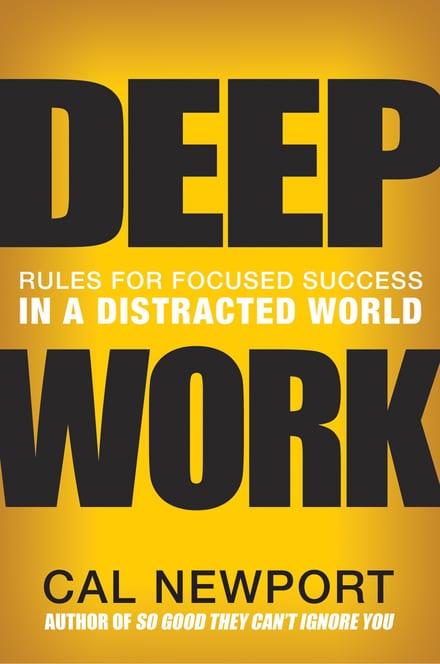
Deep Work: Rules for Focused Success in a Distracted World
The full book runs ~303 pages — roughly 6 hours of reading. You get the key ideas here in 2 minutes.
The key ideas
- Deep work builds skill by strengthening neural circuits through intense focus
- Choose a scheduling style: monastic, bimodal, rhythmic, or journalistic
- Multitasking leaves cognitive residue and degrades performance on every task
- Remove distraction triggers instead of relying on willpower
- Ruthlessly cut shallow busywork that feels productive but adds little value
- Schedule every hour in blocks to spend time intentionally
The summary
The rarest skill in the modern economy is also one of the most valuable: the ability to concentrate, without distraction, on something cognitively demanding. Newport calls this deep work, and his central point is that you can’t wait around for it to happen. It’s the opposite of stumbling “into the zone” by luck. Deep work is intentional. You schedule it in advance, you defend the time, and you deliberately let small tasks and notifications go unanswered while you do it. Try to squeeze focus into the gaps between interruptions and you’ll never get it. The distraction has to be designed out of the way first.
Deep work is a skill, not a mood
The payoff runs deeper than getting more done. Intense focus on a single skill physically changes your brain, wrapping the relevant neurons in myelin so their circuits fire faster and cleaner. That’s the mechanism behind expertise, and it’s why deep work makes you better at your craft rather than just busier. There’s a second reward that shallow busywork can never deliver. Clearing a pile of tiny tasks feels productive, but the satisfaction is hollow; it’s the hard, focused stretches that produce work worth being proud of.
Pick a rhythm that fits your life
There’s no single correct way to structure focus, so Newport lays out four. The monastic approach removes distraction entirely by secluding yourself. The bimodal approach carves your life into defined stretches of deep work and defined stretches of availability. The rhythmic approach turns focus into a daily habit, working in blocks of a set length such as 90 minutes. The journalistic approach is the hardest to pull off: you drop into deep work in whatever unexpected pocket of free time appears.
Whichever you choose, give it a place and a fence. J.K. Rowling checked into a hotel to finish a book because a designated space told her brain this is where serious work happens. Set clear windows when you simply won’t answer messages. And don’t neglect the body underneath it all, since a decent diet and regular exercise supply the energy that sustained concentration burns through.
Distraction costs more than you feel
Multitasking is a comforting lie. The research is consistent: switching between tasks drains your focus and worsens your performance on both. A 2009 University of Minnesota study found that jumping between tasks leaves a residue of attention stuck on the one you just left. Meanwhile a McKinsey study found the average worker spends most of the day on email, messaging, and browsing, with only a sliver left for work that matters. Even a notification you never act on chips away at your concentration, because your brain evolved to snap toward movement and novelty, wiring that once meant food or danger and now just means another ping. Willpower won’t beat that. Removing the triggers will, so turn the alerts off and batch your email into scheduled windows.
You can also train the muscle directly. Newport calls it productive meditation: when you’re stuck in an unproductive moment, waiting in line or walking between meetings, pick one specific problem and think about it hard. Repeated often enough, it teaches your mind to hold focus even when the environment is begging it to wander. Learning to sit with boredom, to focus on nothing, turns out to be part of the same skill and gives your mind the room to recharge and generate ideas.
Drain the shallows and schedule everything
Most of what fills a workday is shallow work, low-value tasks that demand no real focus. Cut or hand off as much of it as you can. The trap is that shallow work feels productive precisely because it keeps you busy, and every hour lost to it is an hour stolen from work that could actually move things forward. Be especially skeptical of technology and social media, which we reach for on reflex. Newport’s test is a 30-day experiment: quit a platform completely, then judge whether your life was genuinely worse without it. Usually it wasn’t. Fill the recovered time with things that don’t glow, like reading, exercise, or people you love.
Finally, put the whole day on a schedule, dividing work and personal time alike into blocks of at least 30 minutes. The goal isn’t rigid obedience to the plan, and you should rearrange blocks freely as the day shifts. The goal is intention. Scheduling your hours forces you to see exactly how you’re spending them and whether those choices match what you actually care about.
The bottom line
Deep work is built, not found: protect the time, strip out the distractions, and train your brain to resist the pull of interruption. In a world where shallow busywork is the default setting, the capacity to concentrate hard is both scarce and enormously valuable. Read this if you’re always busy yet never seem to finish the things that matter most.
Fact check
Popular books repeat findings that later research has complicated. Where Deep Work makes a testable claim, here's what the evidence actually shows.
Switching between tasks leaves "attention residue" — part of your attention stays stuck on the task you just left and drags down performance on the new one.
The 2009 study exists and says roughly what the summary says it says: Sophie Leroy found that people who switched away from an unfinished task kept thinking about it and did worse on the next one, and that finishing under time pressure made the transition cleaner. The broader result underneath it — that switching tasks costs you speed and accuracy compared with staying on one — is among the most replicated effects in cognitive psychology and is reviewed at length in Psychological Bulletin. Residue as a named effect, though, rests on a far thinner base than the general switch cost, with no large direct replication of the original experiments.
- Leroy S. Why is it so hard to do my work? The challenge of attention residue when switching between work tasks. Organ Behav Hum Decis Process. 2009;109(2):168-181. Source
- Kiesel A, Steinhauser M, Wendt M, Falkenstein M, Jost K, Philipp AM, Koch I. Control and interference in task switching--a review. Psychol Bull. 2010;136(5):849-874. PubMed
A notification you never act on still costs you concentration.
This one holds up. In a 2015 experiment, simply receiving a call or text alert during a demanding attention task disrupted performance even though participants never touched the phone, and the cost was comparable to actually using the device. A 2022 study with EEG found the same behavioral pattern: people responded more slowly on trials paired with a smartphone notification sound than with a matched control sound. The cost is a brief attentional hit rather than a lasting drop in ability, which is why Newport's fix — remove the alert — matches the finding.
- Stothart C, Mitchum A, Yehnert C. The attentional cost of receiving a cell phone notification. J Exp Psychol Hum Percept Perform. 2015;41(4):893-897. PubMed
- Upshaw JD, Stevens CE Jr, Ganis G, Zabelina DL. The hidden cost of a smartphone: the effects of smartphone notifications on cognitive control from a behavioral and electrophysiological perspective. PLoS One. 2022;17(11):e0277220. PubMed
Intense focus on one skill physically rewires the brain by wrapping the relevant circuits in myelin, and that is the mechanism behind expertise.
The biology is directionally real but the causal story is tidier than the evidence supports. Diffusion imaging of pianists found that practice hours correlate with white-matter structure, most extensively for practice during childhood, and mouse work shows that blocking the production of new myelin-forming cells stops animals from mastering a complex motor skill. The gap is in the middle: diffusion MRI cannot separate myelin from axon diameter, fiber packing or crossing fibers, a limitation the imaging literature has flagged repeatedly, and none of this work shows that the intensity of focus is what drives myelination or that myelin accounts for expertise in cognitive work.
- Bengtsson SL, Nagy Z, Skare S, Forsman L, Forssberg H, Ullén F. Extensive piano practicing has regionally specific effects on white matter development. Nat Neurosci. 2005;8(9):1148-1150. PubMed
- McKenzie IA, Ohayon D, Li H, Paes de Faria J, Emery B, Tohyama K, Richardson WD. Motor skill learning requires active central myelination. Science. 2014;346(6207):318-322. PubMed
- Jones DK, Knösche TR, Turner R. White matter integrity, fiber count, and other fallacies: the do's and don'ts of diffusion MRI. Neuroimage. 2013;73:239-254. PubMed
Quit a social platform completely for 30 days and you will usually find your life was not worse without it.
The "you won't miss it" half checks out; the implied payoff is smaller than the pitch suggests. A randomized trial that recruited 2,743 Facebook users and paid a subset to deactivate for four weeks freed up about 60 minutes a day, raised an index of subjective well-being by 0.09 standard deviations, and left people using Facebook less once the experiment ended. But a 2025 meta-analysis pooling 10 abstinence trials with 4,674 participants found no significant effect on positive affect (g = 0.03), negative affect (g = -0.01) or life satisfaction (g = 0.03). Taking a month off is a cheap way to see what a platform actually costs you in time; expecting to feel noticeably happier is the part the evidence doesn't back.
- Allcott H, Braghieri L, Eichmeyer S, Gentzkow M. The welfare effects of social media. Am Econ Rev. 2020;110(3):629-676. Source
- Lemahieu L, Vander Zwalmen Y, Mennes M, Koster EHW, Vanden Abeele MMP, Poels K. The effects of social media abstinence on affective well-being and life satisfaction: a systematic review and meta-analysis. Sci Rep. 2025;15(1):7581. PubMed
Frequently asked questions
What is Deep Work about?
Deep Work is about the ability to concentrate without distraction on something cognitively demanding, a skill Newport says is both rare and enormously valuable in the modern economy. Its core point is that focus won't happen by luck: you have to schedule it in advance, defend the time, and design distraction out of the way rather than squeezing focus into the gaps between interruptions.
What are the key takeaways from Deep Work?
Pick a focus rhythm that fits your life, whether monastic, bimodal, rhythmic, or journalistic, and give it a fixed place and time. Multitasking drains performance, and even a notification you never act on chips away at concentration, so turn alerts off and batch email into scheduled windows. Train focus directly with productive meditation, drain the shallow work by cutting or delegating it, and put your whole day on a schedule of blocks at least 30 minutes long.
Who should read Deep Work?
Read it if you're always busy yet never seem to finish the things that matter most, and you want the capacity to concentrate hard rather than staying stuck in shallow busywork.
Is Deep Work worth reading?
Yes, if you want a concrete system for protecting focus, backed by research like the University of Minnesota study on attention residue and a clear menu of scheduling strategies. The advice leans toward knowledge workers with real control over their calendars, so if your job is mostly reactive or you already guard your time well, some of it may feel out of reach.