Book summary
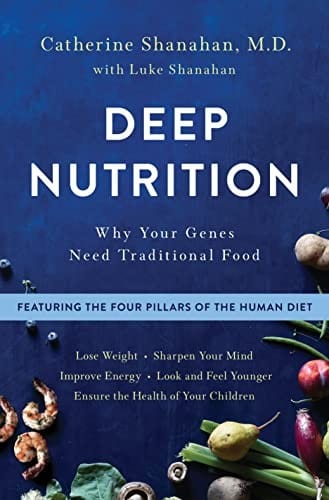
Deep Nutrition
Why Your Genes Need Traditional Food
The full book runs ~500 pages — roughly 9 hours of reading. You get the key ideas here in 3 minutes.
The key ideas
- Diet switches genes on and off through epigenetics.
- Facial symmetry and straight teeth signal nutritional health.
- Seed oils and sugar act as slow-acting poisons.
- Bone meat, organs, ferments, and raw foods rebuild bodies.
- Natural fats protect arteries; cholesterol theory was flawed science.
- One generation can reverse generations of dietary damage.
The summary
Your face is a record of what your mother ate. Crowded teeth, a narrow jaw, a flat profile — the Shanahans argue these aren’t bad luck or faulty genes but the visible result of nutrients missing while you formed in the womb. And if you eat the same industrial diet, your own children will fare worse. The claim rests on epigenetics: diet switches genes on and off without altering the DNA sequence itself, which means the food on your plate is programming the next generation, not just feeding you.
Your genes are a script, not a blueprint
Epigenetic tags are chemical markers that decide which genes are active. A 2005 Spanish study of identical twins showed how much they move: at age three, twins carried nearly identical tags; by fifty, decades of different diets and lives had driven them far apart. Genes aren’t a fixed blueprint — they’re a script that nutrition rewrites over time.
The sharpest proof is the agouti mouse. Researchers took a genetically obese, sickly mouse and, before pregnancy, fed her a diet super-fortified with vitamin B12, folic acid, choline, and betaine. She gave birth to normal, healthy offspring. One diet change, one generation, a full reversal. The “junk DNA” once dismissed as evolutionary debris turns out to be an intelligent regulatory system that uses nutrients to dictate gene expression — and can repair earlier damage when you feed it properly.
A face is a health report card
Dr. Weston Price studied indigenous peoples around the world and found that those still eating their native diets were consistently free of cavities and dental-arch deformities, and took in at least ten times the fat-soluble vitamins of modernized Americans. Symmetry, in this telling, isn’t vanity — it’s biology reporting on itself. Human beauty tracks the golden ratio because that’s what healthy DNA builds when it has the right materials, and a lack of symmetry signals suboptimal growth and worse health.
The stakes go well past looks. An underdeveloped jaw doesn’t hold teeth well, which makes chewing harder and cavities likelier. Poor facial geometry narrows the airway and can cause sleep apnea, starving the developing brain of the oxygen it needs to build normal intelligence. A mother’s deficiency — especially from closely spaced pregnancies on a modern diet — leaves her children with reduced symmetry and poorer health, and standard prenatal vitamins don’t rescue the situation, because sugar and vegetable oil block the hormonal signaling that guides development in the womb.
The two modern poisons
Industrial seed oils — canola, soy, corn, sunflower, cottonseed — are the first. The Shanahans call them neurotoxins: heated, they generate byproducts like 4-HNE that mutate DNA and wreck cellular machinery, accelerating degenerative brain disease. By disrupting the lining of blood vessels they choke blood flow to the brain’s busiest regions, producing mental fatigue, migraines, even mini-strokes. Yet they fill nearly every packaged food because they’re cheap and shelf-stable.
Sugar and starch are the second. Once digested, a seven-ounce serving of cooked spaghetti delivers the sugar of four twelve-ounce cans of Pepsi — complex carbohydrates are structurally identical to sugar by the time your body is done with them. That glucose drives glycation, forming advanced glycation end products, or AGEs, that stiffen cells, block hormone receptors, and speed aging, feeding insulin resistance and the diabetes epidemic. Meanwhile the cholesterol theory of heart disease was built on flawed science: natural fats — butter, olive oil, coconut oil, lard, tallow — protect against inflammation, while it’s the processed vegetable oils that build up in the arteries.
The four pillars
Every traditional cuisine that produced healthy people leaned on the same four strategies. Meat on the bone, because cooking bones releases glycosaminoglycans that build strong joints, ligaments, and cartilage. Organ meats like liver and heart, which pack nutrients muscle meat can’t. Fermented and sprouted foods — sauerkraut, kimchi, sugar-free yogurt — where microbes neutralize plant toxins, turn simple sugars into complex nutrients, and add vitamins and protective probiotics. And fresh, raw foods. Reducing all of this to grams of protein, carbs, and fat, the authors note, makes about as much sense as describing the Taj Mahal as so many tons of rock.
Weight follows from these chemical signals, not a simple tally of calories. Eat sugar, starch, and trans fat without moving and your body spins out fat cells like a termite queen laying eggs; pair exercise with an anti-inflammatory diet and, through transdifferentiation, it can convert fat back into lean tissue. The same foods rebuild collagen and elastin — the connective tissue of youth that sugar and vegetable oil destroy — with bone broth and natural saturated fats supplying the repair materials. The people who succeed long term do three things: cut down on carbs, swap toxic fats for healthy ones, and add the missing nutrients back through daily meal planning.
The bottom line
What your parents ate shaped your face, brain, and health more than any gene they passed down, and your diet is programming your children right now — but epigenetics cuts both ways, so a single generation can reverse the damage. Cut seed oils and sugar, and build meals around bone-in meat, organ meats, ferments, and fresh food. Read this if you’re planning to have children, wrestling with unexplained health problems, or curious why modern people look and feel worse than their great-grandparents.
Fact check
Popular books repeat findings that later research has complicated. Where Deep Nutrition makes a testable claim, here's what the evidence actually shows.
A 2005 Spanish study of identical twins showed that decades of different diets and lives drive their epigenetic tags apart — near-identical at three, far apart by fifty.
The study is real and the age pattern is roughly as the book describes it: across 80 monozygotic twins aged 3 to 74, young pairs were epigenetically almost indistinguishable while older pairs differed markedly in DNA methylation and histone acetylation, with all three markers significantly different in 35% of pairs (14 of 40). What the study did not do is test diet. The authors named smoking, physical activity and diet as plausible influences without measuring any of them, so the paper supports epigenetic drift with age and environment, not the specific claim that food is what moves the marks.
- Fraga MF, Ballestar E, Paz MF, et al. Epigenetic differences arise during the lifetime of monozygotic twins. Proc Natl Acad Sci U S A. 2005;102(30):10604-10609. PubMed
Industrial seed oils are neurotoxins: heated, they generate byproducts such as 4-HNE that mutate DNA and accelerate degenerative brain disease.
The chemistry is not invented. 4-hydroxynonenal is a genuine product of polyunsaturated-fat peroxidation, it forms adducts with cellular proteins that alter their function, and it is elevated in Alzheimer's, Parkinson's and ALS tissue. The leap is from that mechanism to seed oils on the plate, and there the human data run the other way: a pooled analysis of 30 prospective cohorts covering 68,659 people and 15,198 cardiovascular events found higher circulating linoleic acid — the dominant fat in these oils — associated with lower total cardiovascular disease (HR 0.93; 95% CI 0.88-0.99) and substantially lower cardiovascular mortality (HR 0.78; 0.70-0.85). No trial has shown that eating seed oils causes neurodegeneration.
- Allowitz K, Taylor J, Harames K, Yoo J, Baloch O, Ramana KV. Oxidative stress-mediated lipid peroxidation-derived lipid aldehydes in the pathophysiology of neurodegenerative diseases. Curr Neuropharmacol. 2025;23(6):671-685. PubMed
- Marklund M, Wu JHY, Imamura F, et al. Biomarkers of dietary omega-6 fatty acids and incident cardiovascular disease and mortality. Circulation. 2019;139(21):2422-2436. PubMed
The cholesterol theory of heart disease was built on flawed science; natural saturated fats protect the arteries and it is processed vegetable oils that build up in them.
LDL's causal role is among the better-established findings in medicine — the European Atherosclerosis Society's 2017 consensus found genetic, epidemiological and trial evidence converging on a dose-dependent effect, with inherited lifelong low LDL cutting coronary risk far more than short drug trials suggest. Cochrane's 2020 review of 15 randomised trials in 56,675 people found that reducing saturated fat cut combined cardiovascular events by 17% (RR 0.83; 95% CI 0.70-0.98), with larger reductions producing larger benefits and no evidence of harm. The book is on firmer ground about a narrower question: recovered data from the Minnesota Coronary Experiment showed that swapping saturated fat for linoleic-acid-rich vegetable oil lowered serum cholesterol without lowering mortality. But that is a dispute about which replacement foods help, not evidence that cholesterol science was flawed or that vegetable oils are what accumulate in arteries.
- Ference BA, Ginsberg HN, Graham I, et al. Low-density lipoproteins cause atherosclerotic cardiovascular disease. 1. Evidence from genetic, epidemiologic, and clinical studies. A consensus statement from the European Atherosclerosis Society Consensus Panel. Eur Heart J. 2017;38(32):2459-2472. PubMed
- Hooper L, Martin N, Jimoh OF, Kirk C, Foster E, Abdelhamid AS. Reduction in saturated fat intake for cardiovascular disease. Cochrane Database Syst Rev. 2020;8(8):CD011737. PubMed
- Ramsden CE, Zamora D, Majchrzak-Hong S, et al. Re-evaluation of the traditional diet-heart hypothesis: analysis of recovered data from Minnesota Coronary Experiment (1968-73). BMJ. 2016;353:i1246. PubMed
Complex carbohydrates are structurally identical to sugar once digested, so a seven-ounce serving of cooked spaghetti delivers the sugar of four twelve-ounce cans of Pepsi.
Pasta does break down to glucose, but not at anything like soda's speed. The 2021 international glycemic index tables, a systematic review covering more than 4,000 foods, place pasta consistently in the low band at or below 55 on the 100-point glucose scale, because its dense protein-starch matrix slows digestion. A meta-analysis of 32 trial comparisons in 2,448 adults found that pasta eaten within low-glycemic-index diets reduced body weight by 0.63 kg and BMI by 0.26 kg/m2 rather than adding weight. The chemistry differs as well: starch is a pure glucose polymer, while the sugar in soft drinks is roughly half fructose, which the liver processes by a different route.
- Atkinson FS, Brand-Miller JC, Foster-Powell K, Buyken AE, Goletzke J. International tables of glycemic index and glycemic load values 2021: a systematic review. Am J Clin Nutr. 2021;114(5):1625-1632. PubMed
- Chiavaroli L, Kendall CWC, Braunstein CR, et al. Effect of pasta in the context of low-glycaemic index dietary patterns on body weight and markers of adiposity: a systematic review and meta-analysis of randomised controlled trials in adults. BMJ Open. 2018;8(3):e019438. PubMed
Frequently asked questions
What is Deep Nutrition about?
The book makes the case that what your parents ate, especially your mother, shaped your face, brain, and health more than the genes they passed down. It works through epigenetics: diet switches genes on and off without changing the DNA itself, so traditional whole-food diets build healthy, symmetrical bodies while modern seed oils and sugar cause damage that carries into the next generation.
What are the key takeaways from Deep Nutrition?
Genes act like a script that nutrition rewrites, not a fixed blueprint, so a single generation can reverse earlier damage, as the agouti mouse study showed. Two modern poisons do most of the harm: industrial seed oils and sugar and starch. And every traditional cuisine that produced healthy people leaned on the same four pillars: meat on the bone, organ meats, fermented and sprouted foods, and fresh raw food.
Who should read Deep Nutrition?
Read it if you're planning to have children, wrestling with unexplained health problems, or curious why modern people look and feel worse than their great-grandparents.
Is Deep Nutrition worth reading?
It's worth it for a memorable frame on how diet programs your body and your children's, built around vivid evidence like the agouti mouse and Weston Price's fieldwork on indigenous peoples. The claims run strong and sweeping, though, treating cooked pasta as sugar and calling seed oils neurotoxins, so skip it if you want cautious, hedged nutrition advice rather than a bold thesis.