Book summary
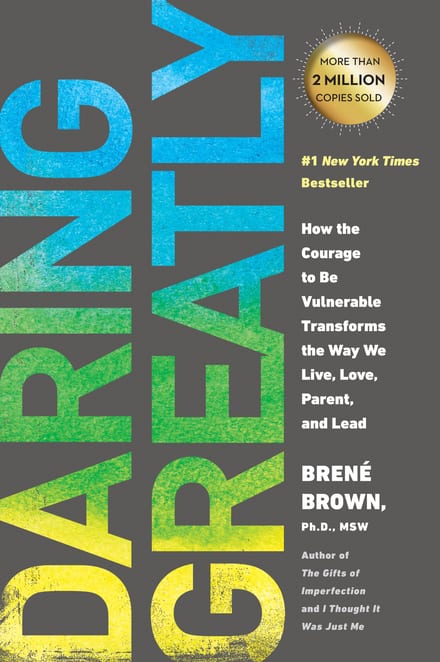
Daring Greatly
How the Courage to Be Vulnerable Transforms the Way We Live, Love, Parent, and Lead
The full book runs ~251 pages — roughly 5 hours of reading. You get the key ideas here in 3 minutes.
The key ideas
- Distinguish shame ('I am bad') from guilt ('I did bad')
- Understand shame survives on secrecy, dies in the open
- Embrace vulnerability as strength that fuels courage and connection
- Reject perfection, numbing, and joy-avoidance as failed defenses
- Build cultures of openness instead of shame at work and home
- Embody worthiness yourself before teaching it to children
The summary
Shame tells you that you are flawed. Guilt only tells you that you acted badly. Confuse the two and you’ll hide instead of grow, because shame gains its whole power from secrecy — and the moment you name it out loud, it drains away. That act of exposure is what frees you to take the risks that produce creativity, connection, and courage. This is the paradox at the center of Brené Brown’s argument: the vulnerability we spend our lives avoiding is the very thing that makes a full life possible.
Shame and guilt are not the same emotion
We’re social creatures, wired to seek each other’s company because belonging has always been essential to survival. Neuroscience shows that social disconnection changes brain chemistry in ways that cause real pain. Shame exploits exactly that wiring. It’s the belief that you are unworthy of the love, connection, and belonging you need to thrive, and it keeps you from engaging with the world, taking risks, or improving. Guilt works differently. Guilt is behavior-focused — “I did something bad” — and it can be productive, pointing you toward growth. Shame is self-focused — “I am bad” — and it only paralyzes.
Our culture has made this worse. On social media, everyone showcases a packaged, best-of version of their lives, which breeds envy and a nagging sense of scarcity. That “never-enough” atmosphere fuels a constant fear of inadequacy, and we end up measuring ourselves against unattainable standards, which deepens the shame and cuts us off from other people. Eventually we stop striving at all, convinced we could never measure up.
Vulnerability is strength, not weakness
Vulnerability is simply the capacity to experience and express emotion — to accept uncertainty, take risks, and expose yourself. Far from a weakness, it’s what lets you push past the fear of failure and actually act. It builds connection, because honest openness is what lets people truly see you. At work it means submitting your ideas to criticism so they can improve. Acknowledging your vulnerability matters, too: in one study, people who believed themselves immune to advertising turned out to be more susceptible to it. Recognizing that you’re exposed is the first step to handling it well.
The trouble is that we keep trying to eliminate vulnerability instead of accepting it. We chase perfection, always want more, refuse to feel joy for fear of losing it, and numb ourselves with addictions. None of it works, because vulnerability can’t be removed, only hidden — and suppressing it correlates strongly with addiction, depression, eating disorders, violence, bullying, and aggression. Shame itself is a defense against vulnerability, which means you have to dismantle the shame to get vulnerability’s rewards.
How to drain shame’s power
Shame is hard to talk about, and that difficulty is exactly what keeps it strong; it survives on secrecy and on the way we internalize it. So the antidote is to say it out loud. When you reach out and name what you’re feeling, other people can understand your fears and respond with empathy, and that empathy replaces shame with connection. Building self-compassion, setting boundaries, and embracing your imperfections all make you more resilient to shame. So does accepting that you’re already enough. Let go of the pursuit of perfection and criticism stops defining your worth; you can even embrace joy instead of bracing for its loss, because you recognize you deserve to be happy. Brown calls this wholehearted living.
Building cultures of vulnerability
Shame doesn’t only operate inside individuals; it poisons whole environments. Workplaces and schools that run on public shaming and blame make people disengage and disconnect emotionally, which kills motivation, creativity, and productivity. Organizations that promote openness, authenticity, and support create room for people to express themselves, collaborate, and contribute fully, and leaders have both the power and the responsibility to build that kind of culture.
The same holds at home, where the stakes are highest. Childhood experiences of shame are traumatic and leave lasting marks, so parents have to create a nurturing, accepting environment and teach shame resilience by staying actively involved while offering unconditional love and a sense of belonging. The catch is that children only adopt traits their parents actually possess. You can’t hand your kids worthiness and vulnerability you don’t model yourself — you have to embody the values you hope they’ll carry into their own relationships.
The bottom line
Shame loses its grip the moment you name it out loud, and that opens the door to the vulnerability that fuels real connection, creativity, and growth. Read this if you’re tired of hiding and ready to engage fully with your life, your work, and the people in it.
Fact check
Popular books repeat findings that later research has complicated. Where Daring Greatly makes a testable claim, here's what the evidence actually shows.
Shame ("I am bad") is corrosive and paralysing, while guilt ("I did something bad") is productive and points toward growth.
The distinction holds at the size Brown gives it. Pooling 242 effect sizes from 108 studies and 22,411 participants, shame correlated with depressive symptoms at r = .43 against r = .28 for guilt, and the gap widened when guilt was measured free of shame. One qualification: guilt only behaves benignly when it stays tied to the act — generalised guilt tracked depression at r = .42, essentially as strongly as shame.
- Kim S, Thibodeau R, Jorgensen RS. Shame, guilt, and depressive symptoms: a meta-analytic review. Psychol Bull. 2011;137(1):68-96. PubMed
Social disconnection changes brain chemistry in ways that produce real, physical pain.
The idea traces to a 2003 fMRI study in which anterior cingulate activity during an exclusion game correlated with self-reported distress, which was read as social and physical pain sharing neural machinery. A larger follow-up separated them: pattern classifiers trained on 60 participants identified painful heat with 92% accuracy and romantic rejection with 80%, and each classifier performed at chance on the other condition. Even inside the classic pain regions the two patterns were uncorrelated, so rejection genuinely hurts but does not appear to run on the physical pain circuitry.
Pushing vulnerable feelings down correlates strongly with addiction, depression, eating disorders, violence and bullying.
A meta-analysis of 241 effect sizes from 114 studies did find suppression associated with psychopathology in the medium-to-large range, across anxiety, depression, eating and substance-related disorders. But suppression was not the standout — it sat alongside avoidance and problem solving, while rumination showed the largest association of the six strategies examined. The evidence is correlational, and violence and bullying were not among the outcomes studied.
- Aldao A, Nolen-Hoeksema S, Schweizer S. Emotion-regulation strategies across psychopathology: A meta-analytic review. Clin Psychol Rev. 2010;30(2):217-37. PubMed
People who believe themselves immune to advertising turn out to be more susceptible to it.
Three experiments found that training people to spot manipulative advertising only produced lasting resistance once participants were shown they had personally been fooled — dispelling the sense of invulnerability was the active ingredient, and without it the training did not take hold. That supports Brown's point that admitting exposure is what lets you handle it. It is a step short of the stronger reading, though: the studies tested an intervention rather than measuring whether people who claim immunity are, on average, persuaded more than everyone else.
- Sagarin BJ, Cialdini RB, Rice WE, Serna SB. Dispelling the illusion of invulnerability: the motivations and mechanisms of resistance to persuasion. J Pers Soc Psychol. 2002;83(3):526-41. PubMed
Frequently asked questions
What is Daring Greatly about?
Shame tells you that you are flawed; guilt only tells you that you acted badly. Brené Brown's book turns on that distinction and on a paradox — the vulnerability we spend our lives avoiding is the very thing that makes creativity, connection, and courage possible. Shame draws its whole power from secrecy, so naming it out loud is what frees you to take real risks.
What are the key takeaways from Daring Greatly?
Shame ('I am bad') is self-focused and paralyzing, while guilt ('I did something bad') is behavior-focused and can be productive. Our culture's 'never-enough' atmosphere, amplified by social media's packaged best-of lives, deepens the shame. Vulnerability is strength, not weakness — the capacity to accept uncertainty and expose yourself, which builds connection and lets you act. You drain shame's power by saying it out loud so empathy can replace it, and by building self-compassion, boundaries, and the belief that you're already enough. The same holds in workplaces, schools, and families, where children only adopt the worthiness their parents actually model.
Who should read Daring Greatly?
Read this if you're tired of hiding and ready to engage fully with your life, your work, and the people in it. It suits anyone weighed down by shame or perfectionism, including leaders and parents who shape the cultures around them.
Is Daring Greatly worth reading?
It's worth it for cleanly separating shame from guilt and reframing vulnerability as courage rather than weakness — a shift that reaches into work, parenting, and relationships. The core move, naming shame out loud to drain its power, is simple and actionable. Readers who prefer step-by-step tactics over reflective, research-informed argument may want more concrete drills, but the emotional insight is what makes it stick.