Book summary
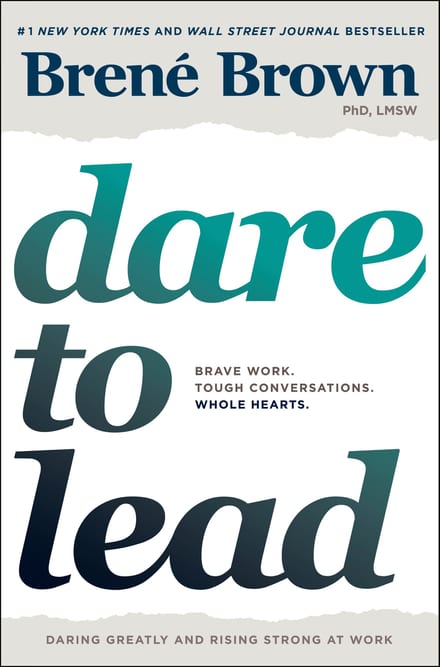
Dare to Lead: Brave Work. Tough Conversations. Whole Hearts.
Brave Work. Tough Conversations. Whole Hearts.
The full book runs ~320 pages — roughly 6 hours of reading. You get the key ideas here in 5 minutes.
The key ideas
- Name the four: rumbling with vulnerability, values, braving trust, learning to rise.
- Say the hard thing — on her formula, clear is kind and unclear is unkind.
- Read a nice problem as a fear problem, on Brown's reading of her interviews.
- Watch for armor rather than fear: knowing, being right, exhaustion as status.
- Break trust into nameable parts with BRAVING, filled out separately, then compared.
- Treat self-awareness as the entry fee — who you are is how you lead.
The summary
Courage, on Brené Brown’s account, is not a temperament. After what she describes as a seven-year study of brave leadership, she states her central claim flatly: daring leadership is a collection of four skill sets that are “100 percent teachable, observable, and measurable.” Rumbling with vulnerability, living into our values, braving trust, learning to rise. The first is load-bearing — she argues our ability to lead daringly will never exceed our capacity for vulnerability — and it takes the first 150 pages of the book, with roughly 50 apiece for the other three.
The one answer every leader gave
Brown’s team opened its interviews with senior leaders on one question: what about the way people lead today needs to change for leaders to succeed in a complex, fast-changing environment full of intractable challenges and insatiable demand for innovation. She says it was the first time in a twenty-year research career that every participant handed back the same answer. We need braver leaders and more courageous cultures.
Then it fell apart. Asked what skills that actually requires, just under half described courage as a personality trait — you have it or you don’t. By her count, 80 to 90 percent, including those who did think of courage as behavior, couldn’t name the specific skills.
So she flipped the question and asked what happens when brave leadership is absent. That, she says, they could not stop talking about. Ten behaviors and cultural problems came out of it, and one ranked above the rest.
Clear is kind, unclear is unkind
The top barrier was avoiding tough conversations, including giving honest, productive feedback. More than half the leaders pointed to a “nice and polite” norm used as an excuse for it. Brown’s reading is blunt: a nice problem is really a fear problem, because fear doesn’t make people kind — it makes them talk about each other instead of to each other.
She lists the costs her data kept surfacing. Trust and engagement drop. Problematic behavior climbs: passive aggression, back-channeling, gossip, the meeting after the meeting, and what she calls the dirty yes, where you agree to someone’s face and undo it behind their back. Performance slides because nobody is clear on the goal.
Hence the six words she first heard in a 12-step meeting two decades earlier and now runs her company on: clear is kind, unclear is unkind. Feeding people half-truths to make them feel better, she argues, is almost always about your own comfort. Staying vague about your expectations because the conversation is hard, then blaming someone for not delivering, is unkind.
The practices underneath it are small. A rumble is her word for a hard conversation entered deliberately — a commitment to lean into vulnerability, stay curious and generous, sit in the messy middle, own your part, circle back when you need a break, and, crediting Harriet Lerner, listen with the same passion with which you want to be heard. The sentence-starter “the story I’m telling myself…” surfaces the fiction your brain wrote to fill in for missing facts. Painting done means explaining what the finished thing is for, not just handing over the task. Her TASC check asks who owns the task, whether they have the authority to be held accountable, whether they’re set up to succeed, and whether there’s a checklist.
Armor, not fear, is what stops you
Brown says her own hypothesis failed here. She expected fear to be the obstacle; the leaders told her that if being afraid disqualified them, none of them belonged on the list. What blocks courage, on her account, is armor — the thoughts, emotions, and behaviors we use to protect ourselves when we aren’t willing and able to rumble with vulnerability.
The workbook she publishes free scores you on sixteen paired behaviors, armored at one end and daring at the other. Being a knower and being right, versus being a learner and getting it right. Using power over, versus using power with, power to, and power within. Rewarding exhaustion as a status symbol, versus modeling rest and recovery. Leading from hurt, versus leading from heart.
That makes self-awareness the entry fee, which is why she insists who we are is how we lead. In her trainings she tells leaders they’re conscious of maybe thirty or forty percent of how they show up. The leader who walks out of a bad meeting asking what just happened to her is doing different work from the one who blames the room.
Trust is seven things you can name
Brown breaks trust into components specific enough to discuss without defensiveness. BRAVING: boundaries — making clear what’s okay and what’s not okay, and why; reliability; accountability; vault, meaning you don’t share information or experiences that aren’t yours to share; integrity, which she defines as choosing courage over comfort and practicing your values rather than professing them; nonjudgment; and generosity, extending the most generous interpretation to other people’s intentions, words, and actions. Two people fill it out separately, then compare where their experiences line up and where they don’t.
The same move runs through her other exercises: cut the lofty thing into observable behavior. Pick two values, then name three behaviors that support each and three slippery ones that don’t. After a setback, write the shitty first draft of the story you’re telling yourself and fact-check it before acting.
The bottom line
Brown’s argument is that the skills everyone dismisses as soft are the ones nobody has been taught, and that they break down into behaviors you can name, score, and rehearse. The finding she calls controversial but plainly supported in her data is also the least complicated: leaders have to care for and be connected to the people they lead. When she brought it to an Air Force general, he told her they already knew — “affection for the people we lead is non-negotiable.” Read it if you manage people and your team has gone polite, stalled, and quietly avoidant.
Fact check
Popular books repeat findings that later research has complicated. Where Dare to Lead makes a testable claim, here's what the evidence actually shows.
The skills of daring leadership are fully teachable, observable, and measurable rather than a personality trait you either have or don't.
Leadership training does change behavior, and by more than the field once assumed: a meta-analysis of 335 independent samples reported corrected effect sizes of .73 for learning, .82 for on-the-job transfer and .72 for organizational results. Those gains tracked design choices closely, though — needs analysis, feedback, spaced sessions, on-site face-to-face delivery and hands-on practice all moved the numbers — so teachable does not mean teachable however you go about it. Brown is also explicit that her four skill sets came out of grounded-theory interviews rather than a measured intervention, and no controlled trial has tested the model or its scoring, which makes "measurable" a design goal here rather than a reported result.
- Lacerenza CN, Reyes DL, Marlow SL, Joseph DL, Salas E. Leadership training design, delivery, and implementation: A meta-analysis. J Appl Psychol. 2017;102(12):1686-1718. PubMed
Direct, honest feedback improves performance, and avoiding the tough conversation is what costs the team.
Feedback helps on average but not dependably. The largest meta-analysis of feedback interventions — 607 effect sizes across 23,663 observations — found an average improvement of d = .41, and yet over a third of the interventions made performance worse, a split the authors could not explain by sampling error or by whether the feedback was positive or negative. A later meta-analysis of randomized trials found face-to-face verbal feedback beat no feedback by a standardized mean difference of 0.7 (95% CI 0.37 to 1.03) among health professionals, but the prediction interval ran from -0.06 to 1.46, meaning a fresh team could see no benefit at all. Brown's case that avoidance carries a cost is a fair reading of her own data; what the research adds is that how the feedback is delivered decides whether the conversation helps or backfires.
- Kluger AN, DeNisi A. The effects of feedback interventions on performance: A historical review, a meta-analysis, and a preliminary feedback intervention theory. Psychol Bull. 1996;119(2):254-284. Source
- Johnson CE, Weerasuria MP, Keating JL. Effect of face-to-face verbal feedback compared with no or alternative feedback on the objective workplace task performance of health professionals: a systematic review and meta-analysis. BMJ Open. 2020;10(3):e030672. PubMed
A leader's capacity for vulnerability is the foundation that trust and team performance rest on.
The closest rigorously measured version of this idea is psychological safety — a team's shared belief that it is safe to take interpersonal risks — and it holds up. A meta-analysis pooling 136 independent samples, more than 22,000 individuals and nearly 5,000 groups, found psychological safety predicted task performance and organizational citizenship behavior over and above related factors such as positive leader relations and work engagement. What got measured is narrower than what Brown claims, though: a group-level climate captured with validated scales, not an individual leader's willingness to be vulnerable, which is where she places the ceiling on daring leadership.
- Frazier ML, Fainshmidt S, Klinger RL, Pezeshkan A, Vracheva V. Psychological safety: a meta-analytic review and extension. Personnel Psychology. 2017;70(1):113-165. Source
Frequently asked questions
What is Dare to Lead about?
Brené Brown's case that the courage leadership actually requires is a set of teachable skills rather than a temperament. It comes out of what she describes as a seven-year study of brave leadership, in which every senior leader she interviewed asked for braver leaders and more courageous cultures, and then could not name the skills that would produce them. Her four skill sets are rumbling with vulnerability, living into our values, braving trust, and learning to rise.
What are the key takeaways from Dare to Lead?
Avoiding tough conversations was the top barrier her leaders named, with a nice-and-polite norm used as the excuse — hence "clear is kind, unclear is unkind." What blocks courage, on her account, is not fear but armor: the behaviours we use to protect ourselves, which she scores against their daring opposites. Trust becomes discussable when you break it into nameable parts, which is what BRAVING is for. And self-awareness is the entry fee, because who you are is how you lead.
Who should read Dare to Lead?
Managers and leaders whose team has gone polite, stalled and quietly avoidant. It is also the most work-specific of Brown's books, so it suits readers who found the earlier ones too personal to apply on a Monday morning.
Is Dare to Lead worth reading?
Yes if you want language and exercises for conversations you keep postponing — the practices are unusually concrete, and the free workbook she publishes does a lot of the work. Know what the evidence is, though: this is qualitative research built from interviews, not measured intervention studies, so treat the skill sets as a well-organised framework rather than a validated instrument. Readers who already own her earlier books will find some overlap.