Book summary
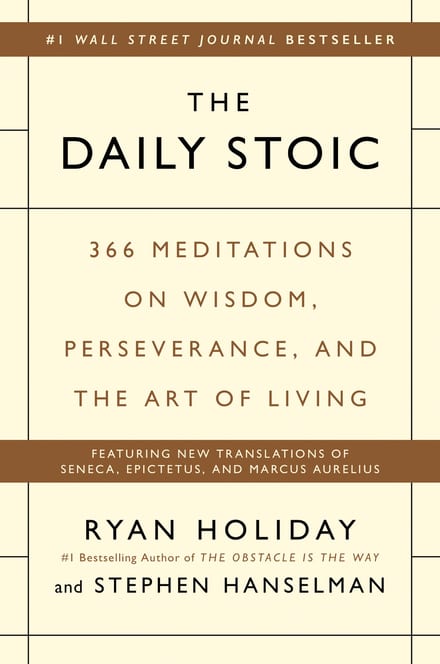
The Daily Stoic: 366 Meditations on Wisdom, Perseverance, and the Art of Living
366 Meditations on Wisdom, Perseverance, and the Art of Living
The full book runs ~368 pages — roughly 7 hours of reading. You get the key ideas here in 5 minutes.
The key ideas
- Train three disciplines in order: perception, then action, then will.
- Shrink your circle of control until it holds one item: your mind.
- Recognize a Stoic by character alone — the philosophy has no uniform.
- Practice hardship like Cato, so no condition can ambush you later.
- Love what happens instead of merely enduring it: amor fati.
- Balance the day's books each night, in writing, as Seneca did.
The summary
Stoicism only counts if you practice it today, and then again tomorrow. That sets the shape of this book: 366 entries, one for every day of the year plus a leap day, each anchored to a new Hanselman translation of Seneca, Epictetus, or Marcus Aurelius and followed by a page of commentary meant to be turned into something you do before nightfall. Alongside the famous three it reaches back to Zeno, Cleanthes, Chrysippus, Hecato, and repeatedly Musonius Rufus. The stated aim: not a word in it that can’t, to paraphrase Seneca, be turned into works.
The year runs on three disciplines, not twelve topics
The calendar isn’t decorative. Epictetus taught that anyone who would be wise and good must train in three areas: desires and aversions, impulses to act and not to act, and freedom from deception in judgment. Holiday and Hanselman turn that into the book’s skeleton. January through April is the Discipline of Perception, May through August Action, September through December Will. Each month narrows further — clarity, passions and emotions, awareness, unbiased thought; then right action, problem solving, duty, pragmatism; then fortitude and resilience, virtue and kindness, acceptance, and finally meditation on mortality.
January 4th compresses the architecture into three lines: control your perceptions, direct your actions properly, willingly accept what’s outside your control.
Your circle of control holds exactly one thing
The first discipline starts with the separation everything else depends on: what you can change against what you can’t. No amount of yelling at an airline representative ends a storm. The book then makes the circle smaller than you’d expect. According to the Stoics, it contains one item: your mind. Not your body, which illness can take at any moment; not your property, reputation, or position. That sounds like a demotion until you notice what it does to your obligations: everyone else hauls a list a mile long of things they aren’t responsible for, and you have a one-item list.
The goal is steadiness, not detachment. Seneca used the Greek word euthymia, which he defined as “believing in yourself and trusting that you are on the right path.” Where the Zen monk sits in quiet hills, the Stoic is the man in the marketplace, the senator in the Forum, the sculptor busy in her studio. Composure came from judgment, not from an absence of noise.
A Stoic has no uniform
The monk has robes, the priest a collar, the banker a suit and a briefcase. A Stoic resembles no stereotype, and the only way to recognize one is by their character — philosophy, as Musonius Rufus put it, “doesn’t consist in outward display.” Epictetus is rougher on people who recite what they’ve learned without living it: bare theories get spewed back up, he says, “as an upset stomach does its food.” Digest first, then let the change show in your choices the way a gymnast’s shoulders display their training.
So the action months keep landing on what character costs. Cato the Younger, rich enough to buy anything in Rome, walked barefoot, ate plain fare, and went bareheaded in rain and heat — training in indifference, so that no condition could ambush him later.
Training for weather you didn’t choose
The last four months deal with what can’t be fixed, only borne. Epictetus walked with a permanent limp, said to be the result of being chained as a slave, and still wrote: “You can bind up my leg, but not even Zeus has the power to break my freedom of choice.” Shot down over Vietnam in 1965, Captain James Stockdale told himself he was “entering the world of Epictetus,” then spent seven and a half years in prison camps making the phrase mean something. Interviewed later by Jim Collins for Good to Great, he named the group that fared worst. “It was the optimists,” he said, “the ones who said, ‘We’re going to be out by Christmas.’ And Christmas would come, and Christmas would go… And they died of a broken heart.”
November’s theme is acceptance, and the book pushes past it to amor fati — Nietzsche’s phrase, borrowed here for loving what happens rather than putting up with it. Marcus supplies the handle: we’ll swallow anything unpleasant on doctor’s orders, so treat what nature prescribes the same way. Eisenhower, on the eve of Normandy, told his wife everything that could be done had been done and “the answer is in the lap of the gods” — having drafted that same night the letter he’d release if the invasion failed.
A page a day, and a notebook
The format is an argument, not a marketing device. Marcus credited his teacher Rusticus — who lent him his personal copy of Epictetus’s lectures — with teaching him “to read carefully and not be satisfied with a rough understanding of the whole.” A page invites that attention; a chapter doesn’t.
The Stoics also wrote things down, morning and night. In a letter to his brother Novatus, Seneca describes an exercise borrowed from another philosopher: at day’s end, ask what bad habit you curbed, how you are better, whether your actions were just, how you could improve. Meditations reads strangely for exactly this reason — it was a private ledger, never meant for us. Balance life’s books each day, Seneca says, and you are never short of time.
The bottom line
Stoicism here is not a doctrine to agree with but a rotation of exercises for one mind, run daily in the ancients’ order: see clearly, act well, accept the rest. The wager is that a year of dated prompts changes behavior in a way one heroic read-through never will.
Read this if you want the Stoics as a practice rather than a text — if Meditations felt like eavesdropping and you’d rather be handed your own notebook.
Fact check
Popular books repeat findings that later research has complicated. Where The Daily Stoic makes a testable claim, here's what the evidence actually shows.
Working through the same material a page a day for a year sticks better than one straight read-through.
Spreading study across days does beat massing it. A 2025 meta-analysis of 31 effect sizes from classroom studies (N > 3,000) found a moderate advantage for distributed over massed practice (d = 0.54, 95% CI 0.31–0.77), with larger effects at longer retention intervals — and an earlier synthesis of 839 assessments across 317 experiments found the optimal gap between sessions grows as the delay before testing grows, which suits a year-long daily schedule. What this research measures is retention of material, not conduct. Nothing here tests whether a year of dated prompts changes how someone behaves, which is the book's actual wager.
- Mawson RD, Kang SHK. The Distributed Practice Effect on Classroom Learning: A Meta-Analytic Review of Applied Research. Behav Sci (Basel). 2025;15(6):771. PubMed
- Cepeda NJ, Pashler H, Vul E, Wixted JT, Rohrer D. Distributed practice in verbal recall tasks: A review and quantitative synthesis. Psychol Bull. 2006;132(3):354-80. PubMed
Frequently asked questions
What is The Daily Stoic about?
A year of dated readings — 366 of them, one for every day plus a leap day — each anchored to a new translation of Seneca, Epictetus, or Marcus Aurelius and followed by a page of commentary. The entries are organized by Epictetus's three disciplines rather than by topic: perception from January to April, action from May to August, will from September to December. The aim is not to agree with Stoicism but to run one exercise a day and turn it into something you actually do before nightfall.
What are the key takeaways from The Daily Stoic?
Start by separating what you control from what you don't — and the Stoic circle is smaller than expected, holding a single item: your mind. Steadiness, what Seneca called euthymia, comes from judgment rather than from quiet surroundings; the Stoic is the person in the marketplace, not the monk in the hills. Character shows in choices rather than recital, which is why Cato trained in discomfort — barefoot, plain food, bareheaded in rain — so no condition could ambush him later. The closing months push past acceptance to amor fati, loving what happens, and back to the notebook: Seneca's nightly audit of what habit you curbed and how you could improve.
Who should read The Daily Stoic?
Anyone who wants the Stoics as a practice rather than a text — especially if Meditations felt like eavesdropping on someone else's private notes and you'd rather be handed your own notebook.
Is The Daily Stoic worth reading?
The daily format is the argument, not packaging: a page invites the careful attention Marcus learned from Rusticus, and a chapter doesn't. It's also a wider door into Stoicism than most, reaching past the famous three to Zeno, Cleanthes, Chrysippus, Hecato, and Musonius Rufus. If you'd rather read the primary sources straight through and skip the commentary, this isn't built for you — it's meant to be picked up 366 times, not finished in a weekend.