Book summary
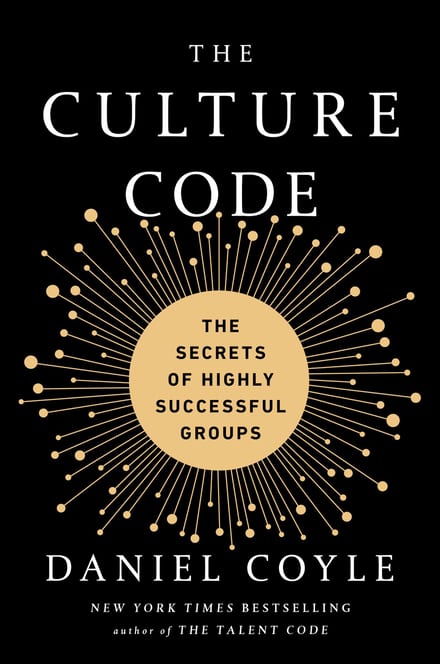
The Culture Code: The Secrets of Highly Successful Groups
The Secrets of Highly Successful Groups
The full book runs ~280 pages — roughly 5 hours of reading. You get the key ideas here in 5 minutes.
The key ideas
- Kindergartners beat MBAs at the marshmallow challenge by building instead of managing status.
- Send belonging cues — a laugh, a question, real listening — in the first seconds.
- Take the first risk yourself; trust follows candour, not the other way round.
- Run After-Action Reviews with rank off: what worked, what didn't, what changes.
- Repeat what the group is for far past the point it feels excessive.
- Watch the energy in the room after something goes wrong — it diagnoses in seconds.
The summary
Culture isn’t something a group has. It’s something a group does, in exchanges so small nobody would call them culture. Daniel Coyle spent four years inside teams whose success usually gets waved away as chemistry — SEAL Team Six, Pixar, IDEO, the San Antonio Spurs, Zappos, the improv troupe Upright Citizens Brigade, and for contrast a crew of jewel thieves. Culture is not a set of traits, he concludes, but a signaling contest: a stream of small messages telling people we are safely connected, we share accurate information, we know which way to move. Three learnable skills produce those signals — build safety, share vulnerability, establish purpose.
Kindergartners beat the MBAs
Peter Skillman’s design challenge, built at IDEO, gives four people twenty sticks of uncooked spaghetti, a yard of tape, a yard of string, one marshmallow and twenty minutes to build the tallest free-standing tower. Tom Wujec, who has run it around seventy times, reports rough averages: about twenty inches for most groups, half that for business students, and kindergartners beating most adults.
The MBAs aren’t less capable. They’re busy with a second problem the children never notice — what Coyle calls status management. Who’s running this? Is it safe to shoot down someone’s idea? They discuss, defer, and settle on a design so late there’s no time left to find out it won’t hold. The kindergartners jam the marshmallow on early, watch the tower sag, and fix it. They win, Coyle says, not because they’re smarter but because they work together in a smarter way.
Safety arrives two seconds at a time
Will Felps planted an actor named Nick inside forty four-person groups, cycling him through three roles: the Jerk, the Slacker, the Downer. By Felps’s account one person dragged the whole group’s output down 30 to 40 percent, and it barely mattered which role he played. The exception was a quiet, curly-haired student Coyle calls Jonathan, who absorbed Nick without the group ever sagging — not by confronting him, but with body language, a laugh, a simple question that drew the others out, and then listening. Coyle’s term for those moves is belonging cues: small, repeated signals saying you’re safe here, you have a voice, we share a future. The brain scans for them constantly, and it doesn’t care what the mission statement says.
Gregg Popovich runs the Spurs on almost nothing else. He touches players on the elbow and the shoulder, speaks their languages, and feeds them — the team eats together roughly as often as it plays. One video session, instead of game film, was a documentary on the Voting Rights Act, then questions about what the players made of it.
It works at sentence scale too. Psychologists from Stanford, Yale and Columbia found nineteen words added to feedback on an essay sharply raised how many seventh-graders revised it: “I’m giving you these comments because I have very high expectations and I know that you can reach them.” No advice, no correction — just membership, a high bar, and belief you can clear it. A call center losing half its staff a year added an hour to orientation in which new hires talked about themselves — their best day, what they’d bring to a desert island. Seven months on, they were about a third less likely to have quit.
Someone has to go first
Common sense says trust comes first and candor follows. Coyle reverses it: someone takes a small risk, someone answers in kind, and trust is the residue. That makes the leader’s job uncomfortable — the signal only counts coming from the person with the most to lose.
SEAL Team Six does it as routine. After a mission or a training run the team circles up for an After-Action Review: What went well? What didn’t go well? What are we going to do differently next time? Rank comes off for the duration. Dave Cooper, who ran those reviews, told Coyle the most important four words a leader can say are “I screwed that up.” He calls the quality underneath it a backbone of humility — not softness, but discipline about staying exposed.
At Pixar the same move showed up as a question. Watching engineers work out a new programming technique, co-founder Ed Catmull asked whether they’d come by his office afterward and teach him. They spent an hour on it; the engineer telling Coyle the story still had goosebumps a decade later. The cheap version is a one-line email: tell me one thing you’d like me to do more of, and one thing less of.
Purpose is a story you repeat past the point of embarrassment
Values painted on a wall accomplish nothing, which is a failure of method, not of the idea. The groups Coyle studied dig out the narratives that explain what they’re for, then repeat them past the point where it feels excessive — in speeches, catchphrases, artifacts, everyday shorthand. Being ten times clearer about priorities than seems necessary is the baseline. Pixar’s crisis over Toy Story 2 became a question the studio still runs on: are we about making A-level work or B-level work?
Danny Meyer, who built Union Square Cafe, Gramercy Tavern and Shake Shack, gave Coyle the book’s fastest diagnostic. When something goes wrong, watch the energy in the room. Either people pull together and end with more of it than they started with, or blame and resentment leak in and it drops. Ten seconds, and it tells you more than a survey.
The bottom line
Culture isn’t chemistry or DNA. It’s a set of behaviors you can practice: signal safety in the first few seconds, take the first risk yourself, and say what the group is for far more often than feels dignified. The uncomfortable part is that the highest-status person has to go first, every time, and the moments that matter are two seconds long. Read it if you lead a team that’s polite and stuck, or if you’ve watched talented people produce less than any of them would alone.
Fact check
Popular books repeat findings that later research has complicated. Where The Culture Code makes a testable claim, here's what the evidence actually shows.
In the spaghetti-and-marshmallow tower challenge, kindergartners reliably build taller towers than business school students, lawyers and CEOs — about twenty-six inches against the MBAs' ten.
The pattern is real but it comes from workshop tallies, not a controlled study. Tom Wujec, who popularized the exercise and ran it about seventy times, is the only public source for the numbers, and in his 2010 TED talk he gives them as approximations: roughly twenty inches for people in general, about half that for business students, lawyers a little better, CEOs slightly above average, kindergartners better than most adults. There was no randomization, no published dataset and no independent replication. The same talk adds a detail the retelling usually drops — architects and engineers build the tallest towers of anyone, with thirty-nine inches the record Wujec had seen — so the exercise shows the cost of planning without a prototype, not the superiority of not planning.
- Wujec T. Build a tower, build a team. TED talk, recorded February 2010, published April 2010 (transcript). Source
A single negative team member — a jerk, a slacker or a pessimist — cuts a four-person group's performance by 30 to 40 percent.
Will Felps did run the confederate experiment the book describes, but its result has never appeared in a peer-reviewed paper. The 30-to-40-percent figure's public source is a December 2008 This American Life segment on his research. The one published paper Felps and colleagues wrote on bad apples — a 2006 review in Research in Organizational Behavior — is a synthesis of existing studies that proposes exactly this confederate design as future research, and no report of the experiment appears in his publication record since. The direction is well supported by that published literature; the precise number rests on data no one outside the study has seen.
- Felps W, Mitchell TR, Byington E. How, when, and why bad apples spoil the barrel: negative group members and dysfunctional groups. Research in Organizational Behavior. 2006;27:175-222. Source
- This American Life, episode 370: Ruining It for the Rest of Us. WBEZ Chicago; originally aired December 19, 2008 (Prologue: Will Felps). Source
Adding one line to critical feedback — that the teacher has high expectations and believes the student can meet them — sharply raises the effort students put in.
The effect is real and was measured behaviorally, but it is narrower than the retelling suggests. In the randomized field experiments, 71 percent of African American seventh graders who received the wise-feedback note revised their essay against 17 percent who got plain criticism; among White students the note moved revision rates from 62 to 87 percent, a difference that was not statistically significant. Each study ran on 44 students at a single middle school, and the benefit concentrated among students who already mistrusted school — among low-trust African American students, 82 percent revised versus none in the control group. The first conceptual replication in another setting, with 94 undergraduates in 2024, found no effect, with trust already high in both conditions.
- Yeager DS, Purdie-Vaughns V, Garcia J, Apfel N, Brzustoski P, Master A, Hessert WT, Williams ME, Cohen GL. Breaking the cycle of mistrust: wise interventions to provide critical feedback across the racial divide. J Exp Psychol Gen. 2014;143(2):804-24. PubMed
- Troy A, Moua H, Van Boekel M. Wise feedback and trust in higher education: a quantitative and qualitative exploration of undergraduate students' experiences with critical feedback. Psychology in the Schools. 2024;61(6):2424-2447. Source
A call center added an hour of self-focused reflection to its orientation and retention rose 270 percent.
The experiment is real and the direction holds, but the number describes something else. At Wipro's Indian call centers, 605 new agents were assigned to a one-hour orientation focused on their own identity, one focused on the company, or the standard skills-training program; about seven months later the personal-identity group had the lowest quit rate. What the paper reports is that being in the company-identity or standard condition raised the odds of leaving by 250 and 157 percent respectively, relative to the personal-identity group — odds of quitting, not a rise in retention. In raw terms the standard group's turnover rate was 47.2 percent higher than the personal-identity group's, which the authors summarize for a general audience as new hires being 'more than 32 percent less likely to quit'.
- Cable DM, Gino F, Staats BR. Breaking them in or eliciting their best? Reframing socialization around newcomers' authentic self-expression. Administrative Science Quarterly. 2013;58(1):1-36. Source
- Cable DM, Gino F, Staats BR. Reinventing employee onboarding. MIT Sloan Management Review. March 19, 2013. Source
Frequently asked questions
What is The Culture Code about?
Culture isn't something a group has, it's something a group does — a stream of small signals telling people they're safely connected, that information is accurate, and that everyone knows which way to move. Daniel Coyle spent four years inside teams whose success usually gets waved away as chemistry, including SEAL Team Six, Pixar, IDEO, Zappos and the San Antonio Spurs, and found three learnable skills behind all of them: build safety, share vulnerability, establish purpose.
What are the key takeaways from The Culture Code?
Safety arrives two seconds at a time, through what Coyle calls belonging cues — the laugh, the question that draws someone out, the listening — and the brain scans for them constantly regardless of what the mission statement says. Their absence is expensive: in Will Felps's study, one planted bad actor dropped a four-person group's output by 30 to 40 percent, while the student who absorbed him kept the group whole with body language alone. Trust doesn't come before candor, it's the residue of it, which is why the signal has to come from whoever has the most to lose — SEAL Team Six drops rank for its After-Action Review, and Dave Cooper's four most important words from a leader are "I screwed that up." Purpose works the same way: dig out the story that explains what the group is for and repeat it past the point of embarrassment, aiming to be ten times clearer about priorities than seems necessary. The details are unglamorous and they compound — nineteen words added to essay feedback sharply raised student effort, and an extra hour of orientation where new hires talked about themselves raised a call center's retention by 270 percent.
Who should read The Culture Code?
Read it if you lead a team that's polite and stuck, or if you've watched a room full of talented people produce less than any of them would working alone.
Is The Culture Code worth reading?
It's strong reporting, and the field research does real work — the marshmallow-tower challenge where kindergartners beat business students, Popovich feeding the Spurs as often as he coaches them, Ed Catmull asking engineers to teach him. What it asks for is uncomfortable rather than complicated: the highest-status person has to go first, every time, and the moments that matter are two seconds long. If you want a policy to install rather than a set of behaviors to practise daily, it will feel thin.