Book summary
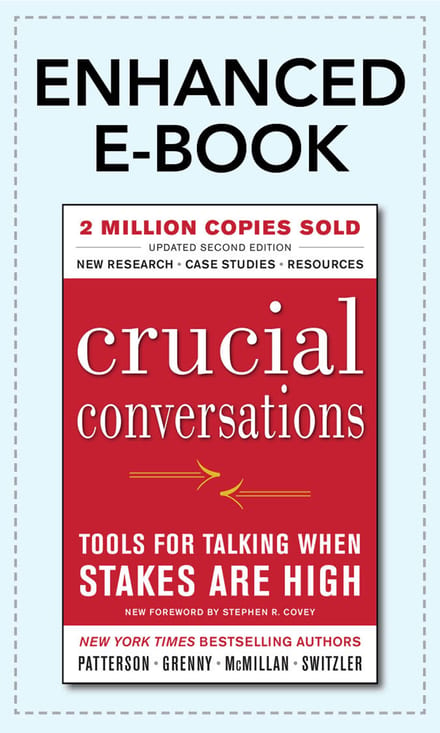
Crucial Conversations: Tools for Talking When Stakes are High
The full book runs ~272 pages — roughly 5 hours of reading. You get the key ideas here in 3 minutes.
The key ideas
- Recognize crucial conversations: high stakes, clashing opinions, strong emotions.
- Manage yourself first; you create your own feelings.
- Guard mutual respect—the instant it vanishes, dialogue collapses.
- Separate observable facts from the stories you invent.
- Reject Victim, Villain, and Helpless narratives that kill dialogue.
- Close with clear decisions: who does what by when.
The summary
The instant someone feels disrespected in a heated conversation, the real subject changes. You think you’re still talking about the budget, the missed deadline, or how to handle a teenager, but the other person has quietly switched topics to defending their dignity. Nothing you say lands until safety is restored. The authors distill twenty years of research on more than 100,000 people into a single finding: the skill that separates strong leaders, teammates, and partners from everyone else is the ability to handle emotionally and politically risky conversations without setting off that defensive shutdown.
They call these crucial conversations, and they share three ingredients—high stakes, clashing opinions, and strong emotions. Those conditions ambush us. The moment we feel threatened, fight-or-flight kicks in and clear thinking goes offline. Studies of couples found three ways people handle the tension: they react emotionally, they fume in silence, or they talk openly and honestly. Only the third group tends to stay together, and, remarkably, they even show stronger immune function. How you handle your hardest conversations quietly shapes the quality of your whole life.
Start with your own heart
Before you can manage a conversation, you have to manage yourself. Pause and get clear on what you actually want—both what you’re trying to achieve and what you want to avoid. Then name the emotion running through you: anger, disappointment, shame. The authors insist on an unpopular truth here—other people don’t make you feel anything; you do. No one makes you angry except you. Once you own the feeling, you can choose your response instead of getting hijacked by it.
From there, look for the path between two bad options: swallowing what you think, or blurting it out and doing damage. The guiding question is, “How can I raise this honestly without causing offense?” Answering it well takes confidence to speak, humility in how you speak, and enough skill to keep the exchange going. When you can, decide your desired outcome in advance so you steer the conversation on purpose rather than react on reflex.
Respect is like air
As long as respect is in the room, nobody notices it. Remove it, and it’s all anyone can think about. That’s why protecting two things—mutual respect and a shared purpose—keeps a hard conversation from collapsing. When either goes missing, people get defensive and the dialogue breaks down. The stakes can be literal: the authors describe a surgeon who amputated the wrong leg because his subordinates were too afraid to challenge him. People stay silent when they fear hurting someone or facing disapproval, and the cost is worse decisions, more mistakes, and weaker buy-in. Sharing freely does the opposite—every perspective surfaces, and people commit to the outcome even when they didn’t get their way.
A few concrete moves protect safety. If you have to criticize, pair it with genuine praise and point to the goal you both share. When you’re wrong, apologize on the spot. And prove you’re listening with the AMPP sequence: Ask for the other person’s view, Mirror what you notice (“You seem hesitant…”), Paraphrase their meaning back in their own words, and Prime when they start to withdraw (“Are you thinking that…”). As Dean Rusk said, one of the best ways to persuade people is with your ears.
Separate the fact from the story
A hotel bill is a fact. “He’s having an affair” is a story built on top of it. A frown is a fact; “she’s angry at me” is an interpretation. Most of our heat comes not from what happened but from the meaning we bolt onto it—Shakespeare’s line, that nothing is good or bad but thinking makes it so, is the whole lesson in miniature. Before you decide how to feel, ask questions to find out what’s actually true. And when you disagree, resist the assumption that the other person is wrong; more likely they’re reading the same facts differently. Open with “I think I see things differently…” instead of an accusation.
Watch, too, for three stories that quietly poison your judgment: the Victim (“it’s not my fault”), the Villain (“it’s all your fault”), and the Helpless (“there’s nothing I can do”). Each one lets you off the hook and hardens you against the other person. Aim to understand rather than win, and you sidestep the defensiveness that wrecks most difficult talks.
Turn talk into action
A good conversation that changes nothing was just a nice conversation. Before you finish, settle how the decision gets made—vote, consensus, or delegated to one person—and then nail down who does what by when. Vague assignments send people off toward different goals, sometimes with disastrous results. Or, as the authors put it, goals without deadlines aren’t goals; they’re merely directions.
The bottom line
Hard conversations live or die on whether people feel safe enough to say what they really think, and that safety rests on respect and a shared purpose. Guard both, separate the facts from the stories you invent about them, and close with clear commitments. Read this if you regularly face charged disagreements at work or home and want them to produce clarity instead of wreckage.
Fact check
Popular books repeat findings that later research has complicated. Where Crucial Conversations makes a testable claim, here's what the evidence actually shows.
Couples who talk conflict through openly, rather than blowing up or going silent, are the ones who stay together, and they show stronger immune function.
The immune half has real support, though it runs the other direction: among 90 newlywed couples, those who behaved most negatively during a 30-minute discussion of marital problems showed declines over the next 24 hours on four immunological assays and higher antibody titres to latent Epstein-Barr virus, with larger changes in women. In that same study, positive problem-solving behaviour showed no significant relationship to immune or blood-pressure outcomes, so hostility depressing immunity is the finding, not open dialogue boosting it. The companion claim that conflict style predicts who divorces comes from a literature whose headline accuracy collapses once the models are tested on couples they were not built on.
- Kiecolt-Glaser JK, Malarkey WB, Chee M, et al. Negative behavior during marital conflict is associated with immunological down-regulation. Psychosom Med. 1993;55(5):395-409. PubMed
- Heyman RE, Smith Slep AM. The Hazards of Predicting Divorce Without Crossvalidation. J Marriage Fam. 2001;63(2):473-479. PubMed
Nobody else makes you feel anything — you generate your own emotions, so in a heated moment you can choose your reaction.
Reframing how you read a situation does change what you feel, but the lever is smaller than "you choose" implies. Across 306 experimental comparisons, cognitive change produced a small-to-medium effect on emotional outcomes (d = 0.36), response modulation a small one (d = 0.16), and shifting attention none at all (d = 0.00). The book's specific advice also splits: suppressing the outward expression of an emotion worked (d = 0.32) while suppressing the experience of it did essentially nothing (d = -0.04).
- Webb TL, Miles E, Sheeran P. Dealing with feeling: a meta-analysis of the effectiveness of strategies derived from the process model of emotion regulation. Psychol Bull. 2012;138(4):775-808. PubMed
Fear of contradicting a senior colleague keeps people silent about obvious errors, as when a surgeon amputated the wrong leg and no one in the room spoke up.
The silence is well documented: a narrative synthesis of 31 studies on challenging authority in the operating room found hierarchy and organisational culture to be the most frequently observed barriers to voicing a concern. The catastrophic outcome, though, is far rarer than the anecdote suggests — a review of about 2.8 million operations over 20 years turned up 25 non-spine wrong-site cases, roughly 1 in 112,994, and most caused minor or temporary injury. Of 13 cases with records available, 8 might have been prevented by a verification checklist rather than by anyone finding the courage to object.
- Pattni N, Arzola C, Malavade A, Varmani S, Krimus L, Friedman Z. Challenging authority and speaking up in the operating room environment: a narrative synthesis. Br J Anaesth. 2019;122(2):233-244. PubMed
- Kwaan MR, Studdert DM, Zinner MJ, Gawande AA. Incidence, patterns, and prevention of wrong-site surgery. Arch Surg. 2006;141(4):353-7; discussion 357-8. PubMed
Frequently asked questions
What is Crucial Conversations about?
The instant someone feels disrespected in a heated conversation, the real subject changes — they quietly switch to defending their dignity, and nothing lands until safety is restored. Drawing on research covering more than 100,000 people, the book argues that handling high-stakes, emotionally charged conversations without triggering that defensive shutdown is the skill that separates strong leaders and partners from everyone else.
What are the key takeaways from Crucial Conversations?
Crucial conversations combine high stakes, clashing opinions, and strong emotions. Start with your own heart: get clear on what you want and own your feelings, since no one makes you angry but you. Protect mutual respect and shared purpose — 'respect is like air,' unnoticed until it's gone. Separate the fact from the story you bolt onto it, and watch for the Victim, Villain, and Helpless stories that let you off the hook. Use the AMPP sequence — Ask, Mirror, Paraphrase, Prime — to keep people talking, and close by settling how the decision gets made and who does what by when.
Who should read Crucial Conversations?
Read this if you regularly face charged disagreements at work or home and want them to produce clarity instead of wreckage. It's built for managers, teammates, couples, and anyone who goes silent or blows up under pressure.
Is Crucial Conversations worth reading?
It's worth it for turning a vague skill into concrete moves — separating facts from stories, the AMPP listening sequence, guarding respect and shared purpose — backed by decades of research. The examples, like the surgeon whose team was too afraid to speak up, show the real stakes. It's practical rather than literary, so readers wanting a quick read may find the framework-heavy approach dense, but the tools reward practice.