Book summary
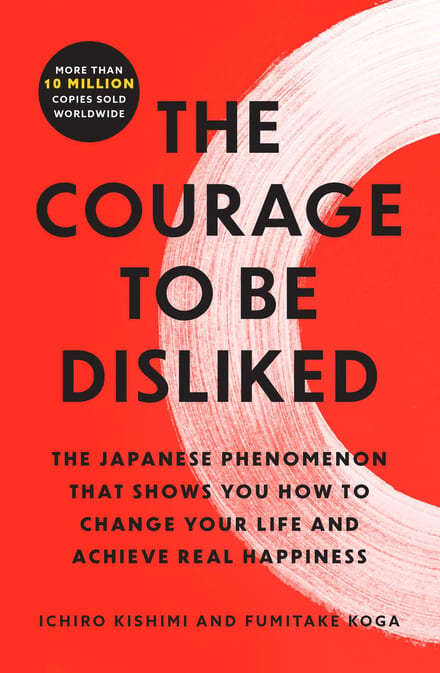
The Courage to Be Disliked
How to Free Yourself, Change your Life and Achieve Real Happiness
The key ideas
- Reject determinism; you assign meaning, so trauma need not rule you
- Deploy emotions as tools you manufacture to reach goals
- Trace all suffering back to interpersonal comparison and relationships
- Separate your tasks from others' to escape needless stress
- Accept being disliked as the necessary price of freedom
- Live each present moment fully instead of deferring fulfillment
The summary
Nothing in your history compels your present. That is the jolt at the center of this book, which lays out Adlerian psychology as a running argument between a stubborn philosopher and a skeptical young man. Most therapy, and Freud above all, works backward: it treats your unhappiness as an effect of past causes — childhood wounds, trauma, formative injuries that supposedly made you who you are. Adler flips the direction. He says we’re driven by purpose, not history, choosing goals in the present and then recruiting the past as evidence for them. If you’re convinced a hard childhood made you anxious, you have the arrow backward: you settled on anxiety, unconsciously, because it serves some goal, and the past is just the alibi.
The philosopher makes it concrete with a fever. If you’re burning up and the doctor only explains why you got sick — you went out yesterday underdressed — you’d be furious, because you need treatment now, not a tidy story about yesterday. Yet that’s exactly what a cause-hunting counselor offers: your suffering came from such-and-such in the past, so it’s not your fault. Adler refuses the consolation. No experience is in itself a cause of our success or failure; we are not determined by our experiences but by the meaning we give them. In that sense, trauma as a force that controls you does not exist. You are self-determining.
Anger is a tool you pick up and put down
Emotions feel like weather that happens to you, but they aren’t. A mother is screaming at her daughter when the phone rings. She answers, and her voice turns instantly polite and warm — it’s the girl’s teacher — and she holds a pleasant five-minute conversation. The second she hangs up, her face hardens and the yelling resumes. If anger were an eruption she couldn’t control, she could not have switched it off for the call and back on afterward. She was using anger as a tool, a way to overpower her daughter with volume and force her point through without argument. Seeing this doesn’t make your feelings fake; it means they’re chosen, usually below awareness, to accomplish something. The useful question becomes: what am I trying to get by feeling this way?
Every problem is a relationship problem
Adler goes further and claims all our troubles are interpersonal. Feelings of inferiority aren’t built into you — they only appear when you measure yourself against someone else. Alone on an island, there’d be nothing to feel inferior about. Even the drive to better yourself is often a disguised bid for superiority, a way of winning the social contest. Your difficulties, in other words, are rarely about a lack of ability; they’re about other people.
This explains something strange: why people who claim to want confidence keep disliking themselves. Self-rejection has a payoff. If you decide you’re unworthy and fixate on your flaws, you build a reason to stay out of relationships, where you might get hurt. Then, when someone snubs you, you can blame your shortcomings instead of facing rejection as your whole self. The point was never to improve. It was to avoid the risk of connection, which is exactly why the self-loathing sticks around — it’s doing a job.
Separate your tasks, then pay the price of freedom
So much of our stress comes from grabbing at things that were never ours to hold. Adler’s remedy is task separation: figure out which parts of a situation are your responsibility and which belong to someone else. You control your own choices and conduct. You do not control how others react, whether they approve, or what they think of you — and trying to manage their feelings is trespassing into their task. If you speak honestly and someone dislikes you for it, your task was to speak honestly; how they take it is theirs. Blur that line and you drown in burdens that aren’t yours, reshaping yourself to please people.
From there, the book’s title makes sense. Living freely means accepting that some people will dislike you; that is simply what freedom costs. Arranging your life so that nobody is ever displeased is not only exhausting and impossible, it’s a form of bondage — you become a performer endlessly adjusting for approval. The courage to be disliked is the willingness to be misunderstood and rejected and to keep walking your own path anyway. It isn’t a license for cruelty; it’s the recognition that other people’s judgments are their task, and that trying to govern those judgments is a way of jailing yourself. Freedom also means dropping the habit of treating life as a march toward some future payoff. Life is less a journey to a destination than a dance, complete in each step; you don’t earn happiness later, you contribute and find meaning in this present moment, one here-and-now after another.
The bottom line
You are not the product of your past, and your emotions are not forces that seize you — you pick goals now and enlist history and feeling to justify them, which means you can pick differently. Draw a clear line between your tasks and everyone else’s, and accept being disliked as the fee for living as yourself. Read this if you’re tired of blaming your circumstances and ready to take back the wheel.
Fact check
Popular books repeat findings that later research has complicated. Where The Courage to Be Disliked makes a testable claim, here's what the evidence actually shows.
Trauma as a force that controls your present behaviour does not exist; you are shaped by the meaning you assign to experience, not by the experience itself.
Childhood adversity shows a clear dose-response relationship with adult outcomes. Across 37 studies covering 253,719 people, those reporting four or more adverse childhood experiences had odds ratios above 7 for problematic drug use and interpersonal violence, and between 2 and 3 for smoking, heart disease and poor self-rated health, compared with people reporting none. The book's softer point does survive: WHO surveys of 68,894 respondents in 24 countries found 70.4% had experienced a lifetime trauma while only a minority go on to develop PTSD, so how an event is appraised plainly matters. That is a long way from past experience exerting no causal force at all.
- Hughes K, Bellis MA, Hardcastle KA, et al. The effect of multiple adverse childhood experiences on health: a systematic review and meta-analysis. Lancet Public Health. 2017;2(8):e356-e366. PubMed
- Kessler RC, Aguilar-Gaxiola S, Alonso J, et al. Trauma and PTSD in the WHO World Mental Health Surveys. Eur J Psychotraumatol. 2017;8(sup5):1353383. PubMed
Anger is a tool you pick up to accomplish a goal, not a reaction that seizes you.
People really do reach for anger when it pays. In Tamir, Mitchell and Gross's experiments, participants preferred anger-inducing activities when anticipating a confrontational task but not a nonconfrontational one, and the anger then improved their performance on the confrontational task. A later five-day diary study found psychologically healthier people wanted to feel angrier specifically in their more confrontational encounters, despite wanting less anger overall. What this establishes is that emotions can be strategically sought, which is narrower than the book's claim that anger is always chosen rather than something that can take hold of you.
All human problems are interpersonal problems, and feelings of inferiority exist only through comparison with other people.
Relationships carry roughly the weight the book gives them: a meta-analysis of 148 studies found people with stronger social relationships had a 50% higher likelihood of survival over follow-up. The word doing the damage is 'all'. Meta-analysis of family and twin studies puts the heritability of major depression at 37% (95% CI 31-42%), a contributor to suffering that no amount of task separation reaches. Adler's narrower point, that inferiority is a comparative judgement rather than a fixed property, stands on firmer ground than the universal version.
Frequently asked questions
What is The Courage to Be Disliked about?
Nothing in your history compels your present. Written as a debate between a philosopher and a skeptical young man, the book lays out Adlerian psychology's claim that we're driven by present purpose, not past causes — we choose goals now and then recruit our history and feelings as evidence for them, which means we can choose differently.
What are the key takeaways from The Courage to Be Disliked?
We are not determined by our experiences but by the meaning we give them, so trauma as a force that controls you doesn't exist. Emotions are tools we pick up and put down — like the mother who switches off her anger to take a polite phone call, then switches it back. All problems are interpersonal, and even self-loathing has a payoff: it lets you avoid the risk of connection. The remedy is task separation — sort what's your responsibility from what belongs to others — and then accept that being disliked is simply the price of freedom. Life is a dance complete in each moment, not a march toward a future payoff.
Who should read The Courage to Be Disliked?
Read this if you're tired of blaming your circumstances and ready to take back the wheel. It suits anyone feeling trapped by their past or exhausted by managing everyone else's approval.
Is The Courage to Be Disliked worth reading?
It's worth it for a genuinely provocative reframe — that your past doesn't determine you and your emotions serve hidden goals — delivered in a readable dialogue that anticipates your objections. The ideas of task separation and the courage to be disliked are practical and freeing. The strong claims, like trauma not existing as a controlling force, will strike some readers as overstated, so it rewards engaging critically rather than swallowing it whole.